I live in Cape Town, and this article is missing some points about whats been going on:
1. "Day 0" has been moved forward - we're now expected to run out of water 21 April.
2. The daily limit of water per person is 87l but only ~50% of consumers meet this target
3. This is considered a 1/1000 year event (in contrast to 1/100 experienced elsewhere in the country recently). However due to increased population this is being called "the new normal".
4. Water allocation between residential/agriculture was done at some national level, meaning the province wasn't able to manage the supplies correctly.
5. 6/7 water relief projects are behind schedule - these include desalination plants and aquifer pumps.
6. We lose 15% of our water through leaks - much lower than the world average but not as good as the best (around 10% in Australia and New Zealand)
Some other personal notes:
1. There has been talk of tapping the aquifers for decades - the studies haven't been prioritised and we still don't know how much we can safely take. The outlying areas of Cape Town are essentially marshes and during normal rainfall seasons are prone to flooding, so there is definitely some space but noone knows how much.
2. The city has lost R1.6b ($130m) in water fees due to reduced usage, so now we're facing a "drought tax". To me this is bullshit but thats a whole other post.
3. The restrictions should not be eased once the dams are full - with climate change and increasing population its only a matter of time until we run out of water and no amount of rainfall is going to help
4. When we run out of water there will be water trucks and collections points, but there has been no talk of sanitation - I suspect a lot of people are going to get really sick.
On the first point 4, it's something that many people don't realise. Water policy in this context is set on a National level. All these Youtubers and Facebook protestors don't understand that a Municipality can't simply shut off water to farms/mines. Various approaches were already discussed prior to the Water Act of 1998:
But as it says in that document - it's National Policy. The government will need to make the call. There may well be provision for disaster areas, but the government doesn't think CPT qualifies.
On the second point 4, there's a already a health concern with regards to our current water supply. Cracks in pipes in the existing infrastructure allow impurities to enter our water supply. When the pipes are at full pressure this doesn't happen. However, when the pressure is dropped (as what is currently happening in various suburbs), the pressure is not enough to keep these impurities out, and you end up with a contaminated supply in some areas.
Regarding the policy being set at national level - I've seen mention of the Western Cape seceding - how realistic was that, and has this had any effect on that? I'm ex Durban/Johannesburg, abandoned the rainbow nation 20 or so years ago with zero confidence in its future, and I'm afraid it was the right call; part of me would love to return, and the WC (there's a pun there) seceding would interest me for a move there.
Well, there's an exodus from the rest of the country to the W. Cape. They call it 'semigration'. Property was up 12% a while ago when all other provinces saw a decline I think (except Gauteng; they were up 3%). As a young person of the wrong demographic here though, myself and most of my friends are preparing for possible departure for a few different reasons. If you are already established in a field with an overseas nest egg that can't be touched by SA inflation though, then Cape Town is probably one of the best cities to live in on the planet. If you know what you're doing, living here is fantastic.
To answer your question, I haven't met anyone in Cape Town who takes a WC secession seriously. There is a very small political party that advocates for it, be its treated as one of the joke parties.
Agreed entirely. Used to live in Durban and left >10 years ago now with zero confidence in the nation. I won't be surprised to see the whole country descend into chaos soon.
The apartheid government may have been morally reprehensible, but at least it knew how to run a country. Either option is kind of shitty…
The apartheid government no longer exists because it caused the country to descend into so much chaos that the rulers gave up trying to continue.
So, by the standard you imply with your comparison, the apartheid government—even more certainly than the present regime—did not know how to run a country.
The apartheid government no longer exists because (1) open racism was no longer tenable in the face of an evolving society, and (2) the worldwide sanctions placed on it became too great.
That's fine, but that's also completely orthogonal to the point, which is that:
1/ By most standards, the effectiveness of government has plummetted since the end of apartheid. Crime is up; corruption has increased; resources are running out (nation-wide electricity blackouts last decade, now water); etc.
2/ Open government-sponsored racism still exists today, but most of it is considered to be commendable under the banner of affirmative action.
If we were to take race entirely out of the picture, the apartheid regime would be considered far more effective than the ANC regime. That, of course, is neither realistic nor fair… But we should aspire to a post-racial world where we race is no longer relevant, where both apartheid and affirmative action are considered revolting abominations, but also where we judge governments based on their net effectiveness.
It's imposible to divorce the effectiveness of government from global phenomenon and long-term knock-on effects from previous governments. For example, the brownout crisis - was it because the ANC government mismanaged funding and refused to repair, renew and build electrical power plants, or was it because the situation left by the apartheid government was unsustainable, and the ANC was left with a "you deal with it" post-it note? It's difficult to know without getting into the specifics of each issue.
My point is that comparing government effectiveness is not as easy as looking at results. This was exemplified by many of the communist satellite states to the USSR, which it sponsored for political gain to its own economic detriment. The satellite states flourished under communism, and as soon as the regime collapsed they suffered - was it the newly-elected democratic government's fault that industry had collapsed and there was rampant inflation, or was it just a long-term effect of previous government policy?
Fair point, but choosing the electricity crisis as an example is not helping your claim - the Apartheid lot left us with something like 50% overcapacity and almost the cheapest electricity in the world at the time. We actually have less electricity generating capacity right now than at that time. The lack of generting capacity has severely constrained our economy since. When the crisis first bit in the 2000s, many mines had to shut down for the first time in 200 years of continuous operations.
The government had an initial plan to redirect overcapacity in many areas (not just electricity) to rolling out services to those neglected by the Apartheid govt, and then after that to start building infrastructure again (not sure of specifics, maybe 5 years on?). The problem is that in most cases, this never happened. Hence the limits of most infrastructure are gradually being hit, with a knock-on effect for the economy.
It was a different time - my understanding is that having a multiply redundant system was important for an isolated pariah state. Think of it like the strategic petroleum reserves in certain isolated states of today. Of course none of that was necessary once SA rejoined the global community. This extra capacity could have been carefully mothballed for later use; instead we are now building 2x brand new coal stations, each of which will be the largest coal plants in the world.
>But we should aspire to a post-racial world where we race is no longer relevant, where both apartheid and affirmative action are considered revolting abominations, but also where we judge governments based on their net effectiveness.
Hear, hear. While "the better angels of our nature" should inform our aspirations, the political, social and economic facts-on-the-ground should inform what action should be taken in order to bring us closer to the ideal.
Affirmative-action is a symptomatic treatment (that could be argued as being punitive) which achieves little-to-nothing in solving the root-problem, while creating a whole new set of problems. Successful integration of former-colonial and indigenous peoples in ZA would have been an unprecedented achievement, but adopting policies that are so obviously regressive will not bring that into reality.
On point 4 - my understanding is that the poorest areas (which are at most risk of disease outbreaks) will not have their water cut. Rather, everyone else will have their water cut first while some water still remains in the dams, which is specifically allocated for those areas and will last long enough until the mid-year rain. I last read this a while ago though, so things may have changed.
Yes, this was mentioned today in the news on one of the radio stations. It went like "the poorer communities that rely on communal taps, will not have their water cut, because they already collect water at those taps".
>2. The city has lost R1.6b ($130m) in water fees due to reduced usage, so now we're facing a "drought tax". To me this is bullshit but thats a whole other post.
Why?
In already deployed networks, decreased usage means the cost per client, or the cost per unit used will go up.
This is a problem with any network that charges for delivery based on usage and cannot easily cut off unused parts of the network.
It's also a problem with networks that bill by usage but spread both fixed and usage-variable costs across the expected usage, even if they don't have issues cutting off unused parts of the network; a sharp drop in usage underfunds the costs that aren't variable.
To not charge it after the fact, you’d have to recoup costs much faster in the earlier years of the system existence, causing crushing water bills to exist.
So my situation is I bought a house here, still paying off the bond, so selling is not really an option at the moment (haven't paid off that much and no one wants to buy a house in an area where there will be no water)
Not really a situation where I can just cut my losses (buying a house is a lot of debt) and go
Another Cape Town resident here. I've been trying to consolidate a lot of this information (and links to official sources) on http://www.capetowndrought.com. Just sharing in case helpful. :)
On the point 3. Climate change is causing many 1/1000 and 1/100 type events to happen more often; especially as it relates to rainfall, like record droughts and monsoons. I wouldn't be surprised if this is the new normal because of that as well (which will make the population issue even worse).
I'm not entirely convinced that it is due to malice. Keep in mind that the Department of Water and Sanitation has been declared bankrupt, so I think it's mostly incompetence.
Have they rolled out smart water meters to monitor consumption and bill per liter? I would think that would be very effective and a fair way to ration the remaining water
You could even have progressive rates
That would also prompt people to install water saving devices
The mayor has avoided answering that question on some radio shows. There's the cost of such meters, and the conspiracies that some of the water usage offenders are wealthy people who might be supporting the ruling party in the city or province.
When flying into Cape Town, you still see a large number of pools that look well-maintained, which is scary. I'm convinced that some residents just quietly pay excessive water penalties, and are let off the hook.
Given the Listeria breakout that's happening, and the "falling" or unprepared public health sector, it's a matter of weeks till we deal with a huge crisis.
Disclaimer: I have been working in CT for a few months, fly in and out every week.
It should not be surprising that the effects of climate change vary from place to place as weather systems move or are disrupted.
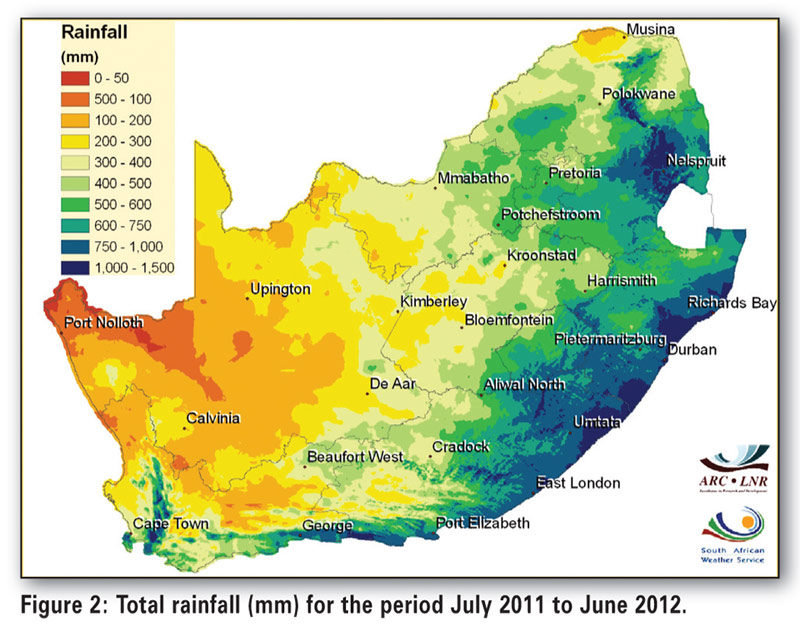
Cape Town is at the bottom of Africa, but at 33.9° S it is roughly as far south as Tunisia and the Mediterranean, or Los Angeles, California are north. To pick other coastal places.
The climate is "Mediterranean" with rain in winter sweeping in over the sea from the west, and hot dry summers. (1)
But the area to the north of Cape Town, towards the equator is dryer, even along the coast. In fact it becomes harsh desert by the time you reach Namibia (2).
So it only takes a small shift of the weather systems away from the equator to impact the winter rainfall that reaches Cape Town.
Water supplies implicitly mean freshwater supplies. Sea level rising can't help that (seawater is not usable directly, and for desalination plants the bottleneck is their capacity and power usage, not amount of seawater available) but it can make it worse e.g. if certain aquifers become saltwater.
And, since most power-generation in South Africa is from coal, desalination - it seems to me - is only aggravating the problem (climate change) over the long run.
Yes, we should probably power those plants from some renewable/sustainable source, but that's a different discussion for another day.
Have you ever tried drinking sea water? It tastes salty. The short of it being: It makes you thirstier; drinking it is worse than drinking nothing.
Desalination is expensive in many ways. If it was a viable way of acquiring water (which it is in some places, like literal deserts) then these places would have already done it. Hence rising sea levels provide no additional access drinkable water.
And just yesterday, I was thinking no one here would need to explain who Mike Judge is to the general audience.
"It's got what plants crave" is a line from his movie Idiocracy. It is directly relevant the discussion at hand, but it's also a zero-effort joke that contributes nothing new.
I for one got the reference. but HN comment style strongly discourages low-effort jokes. It doesn't add information. I'm not surprised that it was downvoted, whether people "got it" or not. This is fine, HN is not reddit.
I don't get it. This is just a link to another attempt to explain the facetiousness of another comment which was itself also downvoted. Why don't we downvote facetious comments instead of the comments that try to redeem them?
I'm saying that it looks like an earnest explanation of a comment that was not facetious.
That's why the explanation as if it was facetious gets the downvote.
Especially since it's not at all baseless. Outside of the subtropics rainfall is expected to increase. But drought length can also increase. It's complicated.
One part of me is disgusted at someone profiting from bad planning and misery of others, the other thinks that this is something that really needs investing.
I meant this in a positive, not negative way. A for-profit company, if done properly, will be able to introduce the required infrastructure where necessary. It should (theoretically at least) also be run in a better way -- if the infrastructure isn't functioning properly, no profits are being made.
"if done properly", state infrastructure can do this just as well. I'd have a look at the Carillion bankruptcy before claiming that the private sector is a solution.
The problem is that state's aren't really motivated to get things done in a cost efficient manner. If the government in SA is like the US, employees are not rewarded for doing anything beyond the bare minimum to prove that they are still alive. In a private business, the employees have to help the business towards its goal of making money, so all of the incentives are aligned to be successful (employees want promotions and not to get fired, the investors don't want to lose money).
Someone will surely try your suggestion at some point, and I hope we don't get to find out what the Enron of water supply looks like.
"Newly discovered tapes have revealed how the energy corporation Enron shut down at least one power plant on false pretences, deliberately aggravating California's crippling 2001 blackouts with the aim of raising prices."
Maybe in the "real world" - its not about money, its about prioritization - and this is South Africa - the tender for water infrastructure would be awarded to a human resources company and money would be squandered on inferior infrastructure. There has simply not been enough priority put on upgrading water supply for the two decades we have known about the ever decreasing dam levels. Its not new - there were other priorities at national level and provincial level - and water problem was shunted, every time as a problem for later. Its not that government/municiplaities were not able to do the work -it was a question of who was paying for it. If a private company wanted to do this the expenditure would have been exorbitant - with very little hope of being remunerated because the income would have remained static - the municipalites would have less budget to maintain the systems and no private company would be able to invest that amount of money and make a profit in any short term.
This is the great strength of capitalism. We might hear about the plot of South African and mourn their descent into dehydration as a dark future that awaits many. Or, the capitalists among us might realize that there is money to be made in providing water, and thereby resources are allocated to providing water, and that dark future is (hopefully) prevented.
There is at least one self-sufficient desalination ship for hire that could apparently just about cover the entire city's needs on its own. It is also apparently very exensive so we are hoping to avoid that. I'd expect that's the kind of company that would be useful in these sorts of disasters.


1. "Day 0" has been moved forward - we're now expected to run out of water 21 April.
2. The daily limit of water per person is 87l but only ~50% of consumers meet this target
3. This is considered a 1/1000 year event (in contrast to 1/100 experienced elsewhere in the country recently). However due to increased population this is being called "the new normal".
4. Water allocation between residential/agriculture was done at some national level, meaning the province wasn't able to manage the supplies correctly.
5. 6/7 water relief projects are behind schedule - these include desalination plants and aquifer pumps.
6. We lose 15% of our water through leaks - much lower than the world average but not as good as the best (around 10% in Australia and New Zealand)
Some other personal notes: 1. There has been talk of tapping the aquifers for decades - the studies haven't been prioritised and we still don't know how much we can safely take. The outlying areas of Cape Town are essentially marshes and during normal rainfall seasons are prone to flooding, so there is definitely some space but noone knows how much.
2. The city has lost R1.6b ($130m) in water fees due to reduced usage, so now we're facing a "drought tax". To me this is bullshit but thats a whole other post.
3. The restrictions should not be eased once the dams are full - with climate change and increasing population its only a matter of time until we run out of water and no amount of rainfall is going to help
4. When we run out of water there will be water trucks and collections points, but there has been no talk of sanitation - I suspect a lot of people are going to get really sick.