The problem is, you are now not only behind but also much slower than your opponent. And as parent poster mentioned, energy is everything.
I would also point out both aircraft are in straight and level flight, basically in formation, with the pilot composed and prepared. This is not how a dogfight looks like.
Based on what I've read from people vastly more informed than me, this absolutely 100% seems to be the case.
Even beyond that, the general impression I get w.r.t stuff like supermaneuverability is that it's a much better use of money to ensure that most fights never even make it to the point where the stuff like the cobra seems like a good idea. Given the choice between 1) "marginally improving survivability in comparatively low-energy corner-case states" and 2) "increasing the odds that the fight never makes it to the merge," #2 seems like a much better choice in terms of money spent and pilots kept alive. (Though a counterpoint, I guess, based my my casual understanding, would be that making the judgment too heavily in favor of #2 was part of what hampered the USAF and Navy's air-to-air combat capabilities in Vietnam)
Energy. If you fire a missile to your rear then it needs to first accelerate to your original speed just to be staying still, only then can it accelerate towards the target.
An AIM-9X can do this, but the kill probability drops rapidly as you move off boresight.
This was addressed by the Pye Wacket missile (http://astronautix.com/p/pyewacket.html) which was to be developed for the B-70 bomber. It was to be a 500lb circular (lenticular) missile which could be launched with its thrust vector pointing in any direction relative to the direction of flight.
but in a dogfight (where this move is presumably useful) the target is not stationary, it's moving towards the missile. if all the missile does is accelerate to stay still, it will still hit the target at 700mph
Surely the aerodynamics are better for firing a missile backwards.
If you fire it forwards, the missile has to accelerate through whatever air resistance you're both already experiencing through even more air resistance to get to the target. That's hard.
If you fire backwards, the missile uses air resistance to accelerate towards (i.e. slow down) towards the target. Even when it goes through 0mph relative to the air and continues to accelerate, the resistance will be much less as it approaches an even higher closing velocity in a shorter period of time.
Modern fighters are all about sensing and targeting the enemy first since missiles are so deadly. The missiles are much faster than the planes so which way the missile is pointed at matters less and most of the time it is better to be pointed forward.
So the optimizations and tradeoffs are in sensing and targeting further away or being able to rotate a sensor to target an enemy off bore.
If you fire it backwards, when it first launches it will be traveling backwards relative to the airflow. So you would have to make a missile that can fly forwards or backwards. Probably not impossible but it must add some difficulty.
You need a backward facing radar for modern fire control targeting calculating a solution. These are heavy and large and will interfere with engine placement.
Bullets don't move at the speed of light.[1] Shoot a bullet backwards off a bullet train, that bullet's ground speed is less than if shot from the ground while stationary. Similarly, shoot a bullet forward off a bullet train, that bullet's ground speed is more than if shot from the ground from a stationary position. Shoot bullets backwards off a jet moving Mach 3 (just sayin') those 1700mph bullets will still be moving in the forward direction of the jet at 600mph relative to the ground.
But the bullet will still hit the plane following you at roughly 1700mph (you could say, the plane will crash into the bullet at that speed, but it‘s the same result), because it‘s also moving at Mach 3.
But the guy that is pursuing you will still be going after you in around Mach 3 so he will go through your bullets like they would be traveling his direction at 600mph.
In theory it's possible to build such system. But dogfights are gonna be extremely rare in the future. The US Air Force believes more in stealth and beyond visual range (BVR) engagements. And so far, given the lead they have in those areas, they are unmatched in the skies.
I would imagine you need to install a second cannon. I think these days dogfights are fairly unlikely, jet fighters are more likely to shoot each others beyond the horizon with the advantage to the side with the missiles with the longest range. A second cannon is a lot of weight for a very remote use case.
But when you're in a disadvantage with conventional guns... if you had guns that could shoot from any direction - wouldn't you not be in a disadvantage anymore?
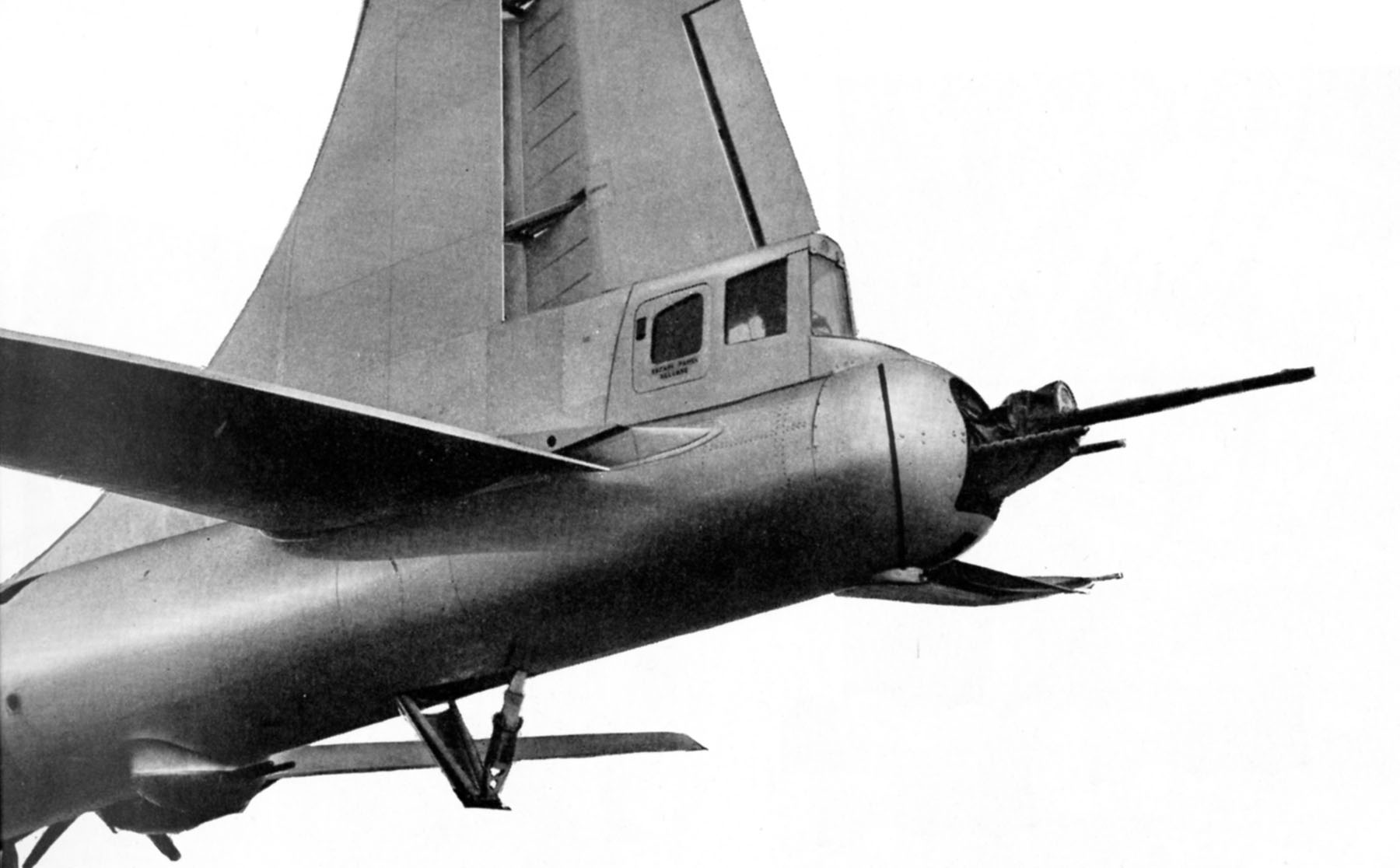
I think the operative question is, why must the guns be fixed? Wouldn’t it be useful for guns to be on turrets that can aim in other directions?
We do it with helicopters (complete with automated aiming), and we used do it with bombers in WW2, after all.
I’m sure the answer has to do with aerodynamics, and the general rarity of close-range dogfighting in the first place, that make such a design impractical.
It's both aerodynamics and mass. The main guns on most western fighters is the M61 Vulcan which is a 20mm rotary gun. The F-35 mounts a 25mm GAU-12 rotary gun. These are both pretty big guns and are typically mounted internally on the jet. Trying to fit one in a turret would not be practical, it would have tons of drag. In order to be able to rotate and elevate the gun it would need a lot of heavy duty motors to be able to actuate at fighter jet speeds.
Even if such a thing nominally worked, that space and mass could go to missiles. Missiles are far more likely to be used than some gun turret. A bore sight mounted canon is far more useful since the pilot is already going to be pointing the whole plane.
Yeah. The guns in a typical WW2 bomber were M2 brownings...which are less than 100lbs.
It's the square-cube law in action (twice over). Going from a 12.7mm to a 20-25mm bullet... twice the diameter, four times the crosssection, eight times the mass.
B-52 was the last USAF bomber to have a rear-ward facing guns. During the Gulf War, one of two theories that a rear-ward facing gunner turned on his defensive fire control system and was hit by friendly fire after an F4 released anti-radiation (HARM) missile in the blind. The AGM-88 locked on to the DFCS and blew off the rear section of the BUFF -- which was then nicknamed "In HARM's Way".
The correct tense is had. In the age of air to air missiles, a chasing plane would never bother getting into range. (but that does make me wonder if anti missile point defense might ever come to flying carriers. A part of me wants to joke that those would likely make the B-52 reach its bicentennial)


The idea is, to be able to make the kill, after you are now behind. Then it does not matter, if you are too slow.
But wikipedia indeed says, this manoever has never been confirmed in real air combat, so yes, its usefullness is quite limited.