IKEA has always fallen apart when you try to move it, none of these changes alter that. The main example in the article is replacing a wooden veneer with paper foil. That is totally non-structural.
And IKEA stuff costs a lot less than 1/3 of finished solid wood furniture.
There are a lot of people who consistently move apartments every 1-3 years and don't even want to take their old stuff to the next one, because it makes no sense in a new layout. I have 3 Billy bookcases in my current apartment to fit precisely the width between two pillars in the wall, and when I move they'll go straight to the curb. I had a totally different set of bookcases in my last apartment because the layout was totally different.
Maybe you want prices to stay higher, but I and most other people sure don't.
I have a few very nice expensive non-IKEA pieces (couch, bed, kitchen table) that last and which I take from apartment to apartment. But everything else is "modular storage/surfaces" (bookcases, cubbies, side/end tables, dresser, bedside table, desk) which is for the current apartment only because it fits it specifically. I want it to be cheap and disposable. IKEA fills the need perfectly, and I want prices to stay as low as possible. I don't want to spend more so any of it would last a move.
(And many times moving isn't even an option. Because you move in with somebody else so you toss all your old furniture, or you move across the country and you'd rather cheaply send a few boxes via post, rather than hiring an expensive moving service.)
> IKEA has always fallen apart when you try to move it, none of these changes alter that.
This keeps getting repeated.. but when I was studying, I bought used IKEA furniture, moved it around several times to different apartments, and then sold it again when I moved from that city.
I've also renovated my house recently which involved disassembling and reassembling some IKEA furniture. They're still fine.
It depends on the type of furniture of course. Yes, there are some specific ones that are harder to disassemble and move without breaking them. But not all.
> I want it to be cheap and disposable.
Isn't it possible to sell them on something like craigslist? I've bought and sold used IKEA furniture before, but I guess it depends on country/culture how willing people are to buy them.
> which is for the current apartment only because it fits it specifically.
I think this is an excellent point. We live in a home I intend to stay in for a long time. It's a bit on the small side, but we try to make the most of it by optimizing the furniture for that specific home. I've even customized IKEA furniture, cutting them to the right width etc. This lets us avoid moving to a new, larger home. That would certainly cost a lot and would be very resource intensive.
I can imagine the next owner would want to keep at least some of the furniture for at least the first few years too, depending on their life situation.
> but when I was studying, I bought used IKEA furniture, moved it around several times to different apartments, and then sold it again when I moved from that city.
I think this is kind of like how some people complain that Apple USB cables are pieces of crap that are always fraying and breaking after 6 months, while other people use them for years with zero issue.
It really depends on how you use it, how you assemble it, how you disassemble it, is it constantly swaying/weakening a little or is it securely mounted to a wall, do you constantly slam the cubby door or drawer shut or are you gentle? I think the assumption should be that it won't last a move, but that you can get lucky through a combination of chance and care.
I'm not that careful with my stuff, but I have some 15-year old Ikea desks that my wife and I have moved from the West Coast USA to the East Coast USA, then to an island in the Pacific, then back to the West Coast, then back to the island again. They are as solid as ever, and I don't foresee ever replacing them, honestly. I have no idea how people are so careless with their things, I have too many old cables so I have a problem where I never have the newest spec cable due to never having to buy new ones!
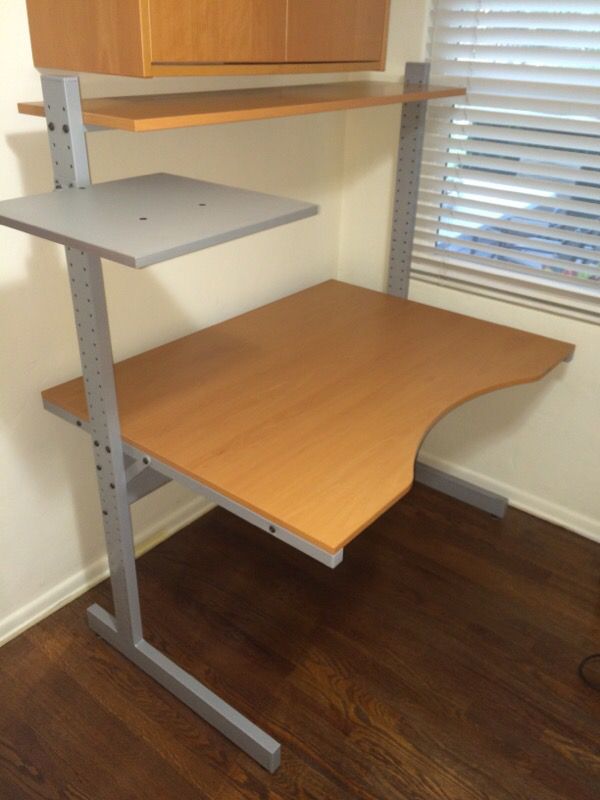
There is a vaaaast difference in quality across the Ikea range. I too had a bulletproof Ikea desk that lasted me over a decade and was still in excellent structural condition when I got rid of it. It was a single large slab of wood (not particle board) with steel legs that screwed into a steel frame with large steel screws. It cost $200 at the time but what with inflation and everything else would probably cost over $300 now.
I just looked it up and it was the Galant desk with T-frame legs, sadly discontinued in 2014.
This is correct. Some of the apparently crappiest particle board Ikea shit I've bought still runs strong decades later (glue can help!), and some of the "solid wood" stuff is so flimsily connected that it died instantly. HEJNE? Great. Love it. Wooden rack mount, strong and wonderful. IVAN? Absolute shit, falls apart, cannot be made to work.
I suppose you mean IVAR, but then I'm surprised as I have practically the whole IVAR assortment, coming mostly from when we had a move at work and renewed furniture there. The wooden racks, wooden cupboards, metal cupboards, I have them all and I love them. They have followed me through multiple house moves as well. They replaced basic pine racks that I got from some hardware store, that were not much cheaper and much less sturdy even though... well I still use them anyway, so I guess they're not so bad.
At one time I turned one IVAR metal cupboard into a growbox for tropical plants (the hollow space at the bottom and the mobile rack inside were pretty handy for running wires, pipes and placing the equipment) and it held very well the humidity, that was about ten years ago, I turned it back into a normal cupboard now and it's still as new. I now use a MILSBO cabinet as my indoor greenhouse.
IVAR is the one where the shelves clip on to little pegs? that used to be metal but now everything is plastic? For me they never clipped strong enough, so a slight bump caused shelves to fly off the pegs, even with the backing straps to keep the whole thing from accordianing down.
Your mention of cubboards might be the thing - you need to build it out around the cupboard instead of trying to just use it for shelves.
Maybe it depends on the country? The shelves in metal IVAR cupboards still use metal clips here in France and Belgium. The shelves for the wooden racks are held by metal brackets and metal bars (I don't use the cupboards mounted to the wooden racks, they are just standing on the ground. I haven't used corner pieces either).
I would expect wire metal shelving to be much cheaper than what you can find at Ikea of course, but also quite flimsy.
Now I'm no Ikea salesman but I always fail to understand what I read on HN (or other US-centric social media sites, as far as I can tell?) when the topic of Ikea comes around.
The wire shelving linked is "kitchen/factory" grade and rated for 650 lbs a shelf, I'd have no issues climbing to the top and jumping up and down on it. I'd be scared to death to do that on a 83" piece of Ikea furniture.
I still have my JERKER desk that is now around 25 years old. There is a clear degradation in quality (structural and cosmetic) over time for IKEA furniture and for me personally I am no longer buying many different furniture types from there. The better beds used to be good value for money, but it looks like that’s also about to end.
Yeah, one of the better things they've ever had, but ultimately it's just edge joined 2x2s, so depending on where you live you're likely to get some cupping/warping over time.
They probably still have similar wood countertops you can buy and use for the same purpose, though.
Nope. At least in the US, all the countertops are particleboard, laminate or quartz. There's a butcher block themed particleboard but that's the closest you'll get now.
I'm still finishing up an IKEA kitchen, but the last I checked there were no solid wood options any longer. Used to be for SEKTION (and the Euro equivalent) they even carried solid ash doors and drawer fronts, those were discontinued a couple years ago. There are solid bamboo fronts (but no doors).
The closest you'll get now are particleboard tops with "thick" veneer. VRENA and MÖLLEKULLA use "thick" oak veneer; KARLBY, BARKABODA, and PINNARP use a "thick" walnut veneer. Veneer being IKEA's choice of words, not mine. These have traditional laminate on the underside.
SKOGSÅ uses "thick" veneer on all sides but is still a particleboard core.
In general I've had good experiences with the office furniture from IKEA. My current desk is a custom oiled wood butcher block slab with (adjustable) IKEA legs, and the legs are perfect - easy to install, don't slip, stable etc.
Still have my Galant T-frame since 2011, survived a cross country move and several in-house relocations, and I use it every day. Still perfectly solid.
Yep, in my experience I’ve had the biggest problems when I overtighten their bolts. You really need to be careful not to tighten past the point where it starts chewing up the wood. But under tightening can have issues too if it makes the structure wobbly, which will also chew up the wood.
I purchased an Ikea Pax cupboard and joined it to its twin (same model) which Id been given by a neighbor. The old one was solid wood whereas the new one was not.
> I think this is kind of like how some people complain that Apple USB cables are pieces of crap that are always fraying and breaking after 6 months, while other people use them for years with zero issue.
Then they're very inconsistent, because I've had multiple Apple USB and power cables that were secured to a desk in cable runs and connectors, and sat on a desk with a cable organizer, and still managed to fray while being moved no more than a few inches to plug/unplug in their life.
I think there's a lot of variation within Ikea products, and it tends to be reflected pretty clearly on the price. In a lot of Ikea's furniture lines they now offer a pretty significant range of price points and there is a corresponding range of quality and durability, with the lower end being trash and the upper end pretty impressive for flatpack.
> This keeps getting repeated.. but when I was studying, I bought used IKEA furniture, moved it around several times to different apartments, and then sold it again when I moved from that city.
> I've also renovated my house recently which involved disassembling and reassembling some IKEA furniture. They're still fine.
Indeed, I still have all of my original IKEA furniture after 7+ moves - none have "fallen apart". They just require partial disassembly to move. My IKEA desk and Billy bookcases are >20 years old and in great condition.
I'm not quite sure how people manage to be so destructive when moving.
No, it's pretty common. Because movers are responsible for replacing your items if they damage them.
They won't dissassemble/reassemble IKEA furniture because it's too likely to fail and then they'd be on the hook for replacement cost, through no fault of their own.
Literally the first Google result for "will movers reassemble ikea furniture" states:
> "Though individual policies vary, most movers will not disassemble and reassemble IKEA furniture, and some even require their customers to sign waivers against damage."
Even if you sign a waiver, they still won't do it because of customer dissatisfaction -- bad reviews with "they ruined my furniture and wouldn't replace it" etc.
Why would one pay someone to assemble an IKEA furniture anyway? These things are so simple to assemble and rarely require more than a screwdriver and allen wrench. A six year old could put together pretty much anything in their catalog.
While it's not the cheap stuff and movers never actually had to disassemble anything more than the bed frame, I have never seen "we don't move IKEA furniture" or any kinds of furniture related wavers.
They're willing to assemble other furniture? In my experience, IKEA furniture is some of the best-designed self-assembled furniture. Other companies don't seem to give any thought to making it easy to assemble at all. Some of the assembly "manuals" are hilariously bad.
IKEA stuff is generally great at assembly -- once.
If the back of the cabinet is nailed on, it's never going to survive removal and re-assembly. It might not survive normal wear-and-tear if you use it a lot.
If the process involves wood screws that bear weight, those joints won't survive disassembly.
> I bought used IKEA furniture, moved it around several times to different apartments, and then sold it again when I moved from that city
IKEA furniture can mean lots of different things.
The Billy bookcase specifically (which this article is primarily about) is not super great at surviving moves. Infact I had to reinforce mine just to hold lots of hard-cover books.
I'm ok with that because the price was so low it still was cheaper that getting stronger bookcases, and because they look good.
Selling furniture on Craigslist is a nightmare in most places and hardly worth doing unless you're really desperate for cash. Buyers will nickel-and-dime you, ask for free delivery, flake on scheduled meetings, show up without enough cash, maybe even try to rob you.
On my last visit to the States I bought some Ikea furniture (Galant desk, a chair, a bed etc) and after 1.5 months tried to sell all that. Used furniture store turned me down. Craiglist banned my account for reasons unknown. Goodwill refused to send a truck to collect items for free. As a last resort, I arranged the items nicely in the garbage room in hope someone picks them up, but the garbage room manager sternly requested I break them up and put into garbage bins. Americans are too rich and wasteful.
My wife sells a lot of stuff used and has good luck dealing with the flakey-nickel-dimers (the same people are typically both) by giving them a price concession of $N if they show up in M hours, where N is typically 5-10 and M is 1-3
It is still my time and attention that is far more valuable for me than whatever I would get back for reselling Billy bookshelves and the likes.
It works for you, you have headspace and you are mentally well composed to deal with that crap.
I’m not, so much rather dump furniture on the curb/trash of course after checking with family and friends in case they would need or want to take it for free. If they take it and sell it off good for them.
I've learned that giving things away is much harder than selling them for a small price. If I want to give something away, I get a lot of interest, but nobody really shows up, nobody is committed. It's a lot of wasteful communication. If I sell it for 5€, it's a much nicer experience and it still goes to the target audience (people who couldn't afford to pay the full price).
Yes, I have moved with IKEA furniture. I would like to point out though that their older stuff was sturdier, and the newer stuff is essentially cardboard.
I have a couch that's moved twice and it is as good as it was when I bought it.
IKEA makes many products that are metal(I have a couple carts like that) and even some of their particle board furniture(two large dressers I have) do fine if you move them carefully.
My moves were from SoCal to the Bay Area and back, so not cross country, but not local either.
My Friheten sleeping couch has been through three complete disassembly processes, has been my daily couch for about three years (then relegated to a guest bedroom) and has been used as bed a few dozen times, but it’s still pristine. Plenty of other IKEA furniture has been through three movings too and it’s still good.
How you treat your stuff and how carefully you (dis)assemble it matters a lot.
> IKEA has always fallen apart when you try to move it
IKEA has different levels of quality, including amazing cardboard LACK.
IKEA also has a lot of solid wood furniture.
What pertains to the article, is that IKEA is keeping prices of the expensive stuff lower than competition... by pushing materials to their limits.
I had moderately expensive IKEA furniture and I had "designer furniture". IKEA isn't much different. I have Besta unit, that has moved multiple times thousands of miles over the last 8 years... still looks pretty good.
I have an IKEA dining table and chair set that's at least 15 years old, and we use it every single day. It's in its third dwelling. It's solid wood and would probably last another 15 years. At this point I don't even like the thing but with two kids now, it's great to have an old table. If it gets crayoned on or written on or glued on or gets food and gunk in the cracks, no big deal, it's old.
I have some other solid wood IKEA pieces that are nearly as old.
Other IKEA stuff has been chocked in the trash over the years but generally it's a good value for the money. I can now afford better than IKEA but alternatives often cost much, much more and I'd rather not spend that much for my kid's furniture that needs to last only a few years anyway. I do shop elsewhere for stuff I'd rather keep longer.
That's actually a bit frustrating, it feels like a lot of options will take more money from you and then not really give you a better, sturdier product. Your options for quality pieces get even fewer if you (or perhaps someone you live with) don't want furniture that looks old-fashioned.
Not necessarily. Remember that cheaper to make often also means less resource intensive. Some IKEA products are little more than very well engineered and carefully packaged cardboard without looking like it (the LACK table, for example, but also the newer wardrobe doors).
Sending it to the local waste-to-energy plant and buying new stuff, three times, doesn't necessarily have to be meaningfully worse for the environment than buying "solid" stuff once, then moving it twice over a long distance (in a relatively inefficient, one-off move rather than large-scale logistics).
I just move my Ikea furniture with me, I don't know why the only alternative is to buy heavy duty stuff. And I just ignore nicks and dents because it seems wasteful to replace a desk just because of a chip.
It's so easy to see a large piece of furniture in the trash and think "OMG so much waste" and to toss a 10-year-old Android tablet in the trash and think "no big deal," but of course I have no idea how much more metals, plastics, waste, etc. went into that old tablet. It just seems like less waste because the volume and weight is smaller - but the disposing user doesn't see how much the manufacturing process consumed. It would be interesting to see some sort of resource that compares waste in this manner.
Consider also the additional cost of moving the (bulky) furniture.
Consider if you're moving cities (lets say 250 miles) and going from a 10' van to a 17' van (with the assorted Ikea furniture) moves you from 12mpg to 10mpg - that's 20 gallons of gas to 25 gallons of gas. That's an extra 45 kg of CO2 emissions.
Buying new furniture at the new destination then is a smaller incremental cost of going to Ikea anyways.
And while I'll admit that this is a very simplistic analysis, the corresponding assertion that doing this is a larger carbon footprint may fail to take into account some nuances.
> IKEA has always fallen apart when you try to move it...
I've had the same Ikea Jerker desk since 1998. It still looks like new, and I've moved across the country with it several times. I even bought a few more when I could... they stopped making them 10-15 years ago. Best desk ever made. Totally modular, so you can canabalize other parts and mix and match to get exactly the desk configuration you want.
> I've had the same Ikea Jerker desk since 1998. It still looks like new, and I've moved across the country with it several times.
The important thing to remember here is that the structural members are entirely metal on that desk. As I recall, it's a full metal frame that doesn't use the tabletop as a structural member.
That right there is the trick to stable cheap furniture. If you get a metal frame it should be pretty durable!
Ikea in the 80s was pretty solid stuff actually. It was cheap but still made of solid wood that could be taken apart many times. My parents still have a lot of furniture from that era.
More recently, my GALANT desks have survived international moves just fine. Sadly they are now discontinued.
When I tried to move my KALLAX [1], the top row of cubicles lost its structural integrity. It was the best thing to happen because it made a great pot rack. I removed the top half of cubes and in the vacant space I put a black pipe across the walls. I can hang at least 15 pots and pans on the pipe using hooks, and in top shelf can go even more pots. KALLAX one of IKEA’s greatest hits.
Just to throw in my prospective, sure some Ikea stuff doesn't move well.
But for me the Billy bookcases have moved great. I have some that have now survived 3 moves and minus some scratches on the side (which isn't really anything unique to Ikea) they look and function like brand new. One of these even has glass doors on it.
Now I have never bought or tried to move a bed from Ikea, but I think their organization stuff like Billy, Kallax, move just fine.
I get that you don't want to take it with you, but why chuck it on the curb where it's likely to become waste when you could sell it cheap or give it away for free? This happens every month at my apartment building - perfectly good stuff that could be used by someone else, thrown away on the curb and often damaged by weather or vandals.
> And IKEA stuff costs a lot less than 1/3 of finished solid wood furniture.
Looking at beds (frames, not boxspring), it’s 1/2 to about the same (that one is partially solid wood) compared to what we paid for fully solid wood 2 months ago, far from "a lot less".
Anecdotally, I have moved across the country 3 times with IKEA furniture I bought nearly 10 years ago and nothing has broken. I'm not sure where this myth comes from.
>And IKEA stuff costs a lot less than 1/3 of finished solid wood furniture.
To put things into perspective, I ordered a desk from a local company. I had a lot of customization options, but basically I wanted a 60 x 30" top. The legs I ordered actually have height adjustment ... with a CRANK. Because it'll never break. So you have 60-inch long boards, maybe about 4-inches wide each, pressed together into a single board. There's attempt to match up the pattern, so at a quick glance most people would think it's a solid piece. Also not much heavier, because there's less adhesives needed to produce the single board.
With the top you had choices not only in the type of wood, but how that wood was engineered (or if it was a single piece).
* If I went with a butcher block construction, which is heavier, that was $1200.
* I went with a face-grain engineered walnut top. That was $2000 for just the top. Looks great, too.
* If I went with a SINGLE solid board, there was not only a real lead time, but the top was $6500.
And that was just for American walnut. I could've picked far pricier woods. Could've picked some garbage pine or something too, but note the spread there. I think for a 60x30, the total spread of options was $500 to $11,000 depending on the construction and the wood chosen.
This is because nature is really bad at producing large perfect boards, especially for a total area past a few square feet. Turns out. A lot of stuff we use even in modern construction is not just engineered, but often uses petroleum products. Plywood uses a urea formaldehyde, but lo-and-behold we figured out how to produce that out of oil! OSB is no different. It's why when 5-over-1s under construction (before fire suppression equipment is installed) catch fire, they go up very fast, and usually burn hot enough where the radiant heat damages nearby buildings.
When you get into large single pieces, not only are they rare, but you want to let the moisture release, preferably naturally. So you have all these boards, being stored in large climate controlled warehouses for months if not years, before they are used in a piece of furniture. That massive opportunity cost of literally keeping boards around is part of why you pay.
I have some short "entertainment benches" I bought many years ago that were made by Ethnicraft in Vietnam, I believe for Crate & Barrel. Engineered face grain, walnut, on a nickel-plated steel parsons style base. Got them over a decade ago, still look perfect, and at a glance, people think they're one piece. They're not, but again at a quick glance they do. All in they were $4500 for the pair. I could've got some solid ones from a German company named E15. The pair would've been over $20,000 then, and over $30,000 today.
-- -----
Meanwhile, you can get a similarly sized desk from IKEA, with legs, for $370. It's particle board with a glued on outer surface to protect it.
In Australia I got this 1800mm x 405mm (so 70" x 15") butchers block panel[1] for about US$50 and then used height adjustable legs from IKEA which were like $15 each. It looks great and is as solid as anything.
IKEA also has an electric height-adjustable desk frame for maybe $300 I think
Honestly I'd prefer a top made out of various pieces of wood glued together - you can make some pretty neat patterns! That said, that process isn't cheap either lol.
When I did mine I went with a jarvis frame and a custom glass top from a local glass company. The frosted (and tempered) 72x30x0.5 top cost me about $600, weighs about 100lbs, can easily handle a like 900lb load with no issue. Super durable. As long as I don't throw broken spark plugs at it or strike the edge with a hammer. And I put 2" radiuses on the corners so you can't break it by bumping something into it quite as easily.
I LOVE IT!
That said, every other person I've shown it to on the internet thinks it's tacky and I should've gone with a "more mature looking ikea butcher block" or something lol.
My son has had good luck with buying a set of adjustable legs from Monoprice[1] and an IKEA countertop[2] for the desktop. It's one of their laminiated wood models and can be trimmed, though he left his at the full 6 feet. He got the legs on sale for $200 and the countertop was $79.
Note that it's wood effect and not actual wood. Over time the veneer fails and starts to bubble or peel, and they can also warp easier with heavy loads


And IKEA stuff costs a lot less than 1/3 of finished solid wood furniture.
There are a lot of people who consistently move apartments every 1-3 years and don't even want to take their old stuff to the next one, because it makes no sense in a new layout. I have 3 Billy bookcases in my current apartment to fit precisely the width between two pillars in the wall, and when I move they'll go straight to the curb. I had a totally different set of bookcases in my last apartment because the layout was totally different.
Maybe you want prices to stay higher, but I and most other people sure don't.
I have a few very nice expensive non-IKEA pieces (couch, bed, kitchen table) that last and which I take from apartment to apartment. But everything else is "modular storage/surfaces" (bookcases, cubbies, side/end tables, dresser, bedside table, desk) which is for the current apartment only because it fits it specifically. I want it to be cheap and disposable. IKEA fills the need perfectly, and I want prices to stay as low as possible. I don't want to spend more so any of it would last a move.
(And many times moving isn't even an option. Because you move in with somebody else so you toss all your old furniture, or you move across the country and you'd rather cheaply send a few boxes via post, rather than hiring an expensive moving service.)