> Are such drastic action appropriate given the current state of the US?
With the debt ceiling ever increasing, approaching a trillion dollars in interest per year, nearing $6k/year per working individual, I would say the correct time to put any effort, whatsoever, into reducing spending, was 20 years ago.
I think the fundamental problem is we lack adversarial systems within the government: it doesn't like to hurt itself. Trying to cut jobs/waste/find fraud is political/career suicide for anyone in government. Accountability requires a true adversary/"outsider". Should that be DOGE, or its current implementation? Probably not. Should the adversarial concept of DOGE exist? I would enjoy seeing arguments against the concept. It seems like it's severely needed.
US debt as a percentage of GDP (i.e. our ability to pay off our debt) has basically remained static since COVID. I agree that the US requires a serious debate about our fiscal priorities and the appropriate levels of spending and taxation, particularly with automatic social security cuts looming. But it is nowhere near an emergency and fiscal decisions are the responsibility of Congress, not the executive.
My point is that our debt only grows unsustainably in response to severe crises (the great financial crisis, COVID). Our deficit is otherwise sustainable during "normal" times as our economy grows alongside it. We of course should want our debt to GDP ratio to be declining during periods of peace and prosperity (and it is evidence of political malfeasance that we haven't seen that happen since the late 90s). But our current spending is not a crisis in it's own right.
Why should you care if the national debt goes up or down? Why is it bad if it goes up? Do you actually understand the underlying mechanics, or have you just built a lot of eloquent abstractions around the idea of “number go up is bad”?
Go high enough, interest payments consume the entire federal budget. There is no way out except revenue growth (infeasible without breakthrough productivity improvements), taxation, and printing money (equivalent to taxation). Before that point, other bad things happen such as creditors losing faith in the government, making debt more expensive and destabilizing the dollar's position as global reserve currency.
Over the last few decades, debt has continued to rise as a percentage of the federal budget, and appears that trend will continue without drastic action.
Barring massive political instability, nobody is ever going to lose confidence in the dollar, regardless of debt ratios. Japan has a debt ratio of over 300%, economists have been predicting a crash and capital flight for decades, but none of it has come to pass.
At the end of the day, the Japanese market is huge and people want access to it. Same thing goes for the US.
If the private market doesn’t want bonds, the central bank can purchase them. That’s not inflationary. What is inflationary is how the government then spends that money, but that’s true for any government spending, regardless of how it was financed. Either way, the debt ratios is literally meaningless.
> If the private market doesn't want bonds, the central bank can purchase them. That's not inflationary.
Central bank buying bonds and increasing money supply absolutely is inflationary. That is precisely how FOMOs work, with the end goal being increasing or decreasing money supply depending on inflation and labour market. So if you already have stubborn inflation and you have a fiscal crisis then unmooring inflation expectations by lowering rates is exactly what you don't want to do (risk becoming a banana republic that inflates away it's debt). I don't think this will happen in the near future but it is absolutely a risk and you'd be foolish as a central banker not to consider it.
What do you mean "there's no failing for a country with a sovereign currency"? There are many, many examples of countries failing. Some of them had sovereign currencies. Sure they can't "run out of money" if they can print more. Along with many more examples of being able to adjust internal values and metrics. This is a very different thing from not being able to fail.
I’ll be clearer. The failure mode that you’re talking about, where debt ratios are so high that a country isn’t able to service its debt, is economically speaking impossible. This isn’t “too big to fail”, it’s the system working as intended.
I'm not sure why you think that's what I'm talking about, because I never brought that up. In fact I agree with that point. The apparatus will never report a failure because it has an incentive not to. The whole system is built and described in a way to make failure seem impossible because confidence is necessary for it to work. But when numbers and reality don't match, reality wins.
The interest still needs to be paid. That requires revenue growth, taxes, or printing money. Taxes and printing money makes everyone poorer - the IOUs of yesterday coming due. Japan has had many challenges over the past few decades.
I'm not an expert but I think I have a reasonable understanding of the situation. If the US debt to GDP ratio gets too high, purchasers of US Treasuries (bills, notes, and bonds) will lose confidence in the US government's ability to service that debt and demand a higher yield on US Treasuries at auction, which increases the cost of servicing the debt. At that point, the government has two choices; pay the higher yield which eventually results in fewer services/higher taxes and a contraction in the real economy, or to default on the debt which would result in very bad things happening (this is where I cop to ignorance on the scale and exact details of the badness). We should get ahead of that by reducing our services/raising taxes now so that we don't risk a loss of confidence that would restrict our ability to borrow in a time of crisis.
1. Nobody is losing confidence in the US over debt ratios. Japan’s debt ratio is over 300%, and they’ve had no issues with financing their spending or capital flight. This is a myth that has been proven false.
2. If the private market doesn’t want to purchase bonds, the central bank can do it. Either way, there is never a need to default on debt owed in your sovereign currency. This will never happen. The risk here is inflation, but that risk is always present, regardless of how spending is financed.
1. Japan is a net creditor nation, meaning it owns more foreign assets than it owes in debt. The U.S., on the other hand, is a net debtor nation, meaning it relies heavily on foreign investors to finance its deficits.
Japan also has a high domestic savings rate, and a large portion of its debt is held by its own citizens and institutions. This reduces capital flight risks compared to the U.S., which depends more on foreign investors (e.g., China, Japan, and others buying U.S. Treasuries).
The U.S. dollar is the world’s reserve currency, which gives the U.S. unique advantages, but also means its debt is held globally. A loss of confidence in U.S. debt could have larger consequences compared to Japan.
2. U.S. benefits from strong global demand for the dollar, but this is not guaranteed forever. If the Federal Reserve were to absorb all bond issuance ( basically monetizing the debt), inflation expectations would rise sharply, leading to a currency crisis or higher interest rates. Zimbabwe and Weimar Germany are extreme examples of this.
U.S. essentially "exports" its debt due to its persistent trade deficits.
U.S. runs large trade deficits, meaning it imports more goods than it exports. Other countries (like China and Japan) accept U.S. dollars in exchange for their goods, and then reinvest those dollars into U.S. assets, primarily Treasury bonds. This has helped finance U.S. debt at low interest rates for decades.
If global confidence in U.S. debt declines, foreign demand for Treasuries could drop, leading to a weaker dollar, higher interest rates, and inflationary pressures.
All of your comments in this thread are misleading.
This creditor/debtor dichotomy is meaningless. It doesn’t change the fact that the debt is owed in dollars and can always be serviced. If foreign investors lose confidence in the US and sell off their treasuries, the central bank can just purchase them and nothing would change. In fact, that’s what Japan does, and that’s why they’re a net creditor. And no, this would not lead to inflation. Again, look at Japan for an empiric example.
I already wrote about how Japan is different from the US and why that changes everything.
> debt is owed in dollars and can always be serviced. If foreign investors lose confidence in the US and sell off their treasuries, the central bank can just purchase them and nothing would change
It changes everything for US citizens. Zimbabwe's debt is also serviced, but I'm not sure US citizens would like to pay one trillion dollars for bread and get cut off from the majority of products and resources that the US imports, because the dollar would be worth as much as the paper it was printed on. It would also mean that the whole stock market would collapse because no one would recycle the dollar anymore. It would be a devastating blow to the US economy. It's so obvious to anyone that knows anything about economy that at this point you are just spreading lies.
No, you didn’t explain how Japan is different. Because in fact it’s not. The key point is that a government that issues debt in its own currency can always service that debt, and this is NOT inflationary.
Zimbabwe’s inflation happened because the country had debt denominated in USD and CNY, along with massive political instability, a shrinking economy, and a war happening all at the same time. Couple that with a useless central bank and you have hyperinflation.
How is that in any way comparable to the US? It’s not. This is obvious to anyone arguing in good faith.
> The key point is that a government that issues debt in its own currency can always service that debt, and this is NOT inflationary.
Hmm. Let's follow your argument to its conclusion. Why stop at 300% of GDP? Why stop at 300 times GDP? It seems that even a small nation with a sovereign currency can eliminate all taxation, borrow an infinite amount of money, buy an infinite amount of stuff, make all of its citizens infinitely wealthy, service its debt with printed money forever, and prices and interest rates will both be unaffected. It's amazing, then, that no nation has yet taken advantage of this exploit!
I feel confident that is not right. I think it may be right that (marginally?) there is not a big difference whether a fixed amount of government spending is financed by taxation or debt, because printed dollars and t bills are so easily interchangeable. But it seems that you are trying to use this argument to prove that if these things are equivalent that they are (in any quantity!) harmless, and that's a non sequitur.
Of course that’s not what I’m arguing, please don’t straw man me.
The constraint on public spending is the amount of real resources that can be utilized. Productive utilization of resources is not inflationary. For example, if you have 10% unemployment, a government can hire those people to build infrastructure regardless of the debt ratio. On the other hand, if you issue public debt to purchase commodities that’s obviously inflationary.
But in either case, the constraint is real resources and inflation, not the debt ratio.
You asked why countries haven’t done this already? They have, it’s called quantitative easing and they do it in financial crises to absorb the productive capacity that the private market isn’t utilizing anymore.
>> Zimbabwe’s inflation happened because the country had debt denominated in USD and CNY, along with massive political instability, a shrinking economy, and a war happening all at the same time. Couple that with a useless central bank and you have hyperinflation.
No mention of velocity or the role of human behavior in an inflationary environment.
> Japan’s debt ratio is over 300%, and they’ve had no issues with...
I don't know what the fallacy of "something is the same along one dimension, therefore the situation along some other dimension(s) must be the same too" is called, but this is a clear example.
This doesn't make any sense. Crises planning should be a fundamental function of the government. Just exceptin that every crises puts us close to being ruined and eventually one will, but it's fine because with no crises were doing ok, is unacceptable
"Since COVID" is a bad baseline, I would draw a parallel with someone who's condition "stayed stable since they entered the hospital a few days ago". It is too recent and the situation pre-COVID was quite bad. The US is the most indebted entity [0] in history. But it is not obviously the most productive; since that title may sit with China now. It is a precarious position.
Complaining about the “national debt” is the clearest sign that someone does not understand economics.
What do you think happens if the debt goes up? Do you think the government is gonna go bankrupt? That’s literally not how it works.
Do you think inflation is gonna happen? Again, literally not how it works. In fact, too low public spending means you get deflation which is even worse than inflation.
Infinite free money hacks is literally how fiat currencies work.
The government wants the economy to operate at close to full capacity, so it creates money and spends it into the private sector.
Eventually that money makes it to individuals, who want to save some of that money. There’s also foreign agents that might want to hold on to your currency, and trade happening that means some of your money leaves your country.
If the government maintains steady spending, this money supply slowly dwindles, which leads to a shrinking economy.
So governments issue debt to offset that dwindling money supply. The catch is that spending that doesn’t create real resources is inflationary, so you have to spend money on things that eventually earn you more money.
At the end of the day, that’s the idea of macro economics. Spend enough to get your economy growing, while making sure inflation doesn’t go up too much. Which is why people that complain about debt have no idea what they’re talking about.
The reason Trump won was because “the economy is doing great since Joe Biden”, meant the billionaires tripled their wealth as mega corporations went from less than a trillion market cap to more than 3 trillion, while me and millions others fixed salaries went up 5% if you were fortunate.
Biden governed far too much as a center-right President, I agree. Meanwhile Trump had those same billionaires with front row seats at his coronation. So the situation will continue to get much worse.
Those billionaires didn’t choose to inflate the money supply. I have no issue with them having assets that go up in value. That just doesn’t mean the economy is doing great. The point is there is way too much spending, and this includes Trump, yet it seems like they really are trying to make a dent in our federal spending, and Musk going in and looking at USAID, is quite awesome.
Trumps net worth actually went down from being in office, and so far so has Elon’s, so I ain’t worried.
I don’t see how that’s relevant to the macro economics discussion, and I don’t see how Trumps tax cuts for billionaires are going to help you in any way.
If you don't see how that's relevant to the macro economics discussion, i don't see how the macro economics discussion is relevant.
We're sending in the young guns to save on government spending because trump won partly on "Biden ruined the economy". The government spending leads to the increase of government debt. Or is the debt coming from a separate source?
I think you're arguing against a position that not many people here hold - people aren't worried about bankruptcy so much as inflation.
My understanding is that the reason the USD is unusually resistant to inflation is that there's artificially high demand due to international demand for the currency as the global reserve currency.
But yeah, if that effect weakens (and the BRICS are trying to challenge the USD as reserve currency), then I think you'll see the USD weaken/inflation spike in response to large deficits.
> What do you think happens if the debt goes up? Do you think the government is gonna go bankrupt? That’s literally not how it works.
You're the one that has no idea what hes talking about.
Debt uncontrollably going up without something to balance it means exactly that. If the debt exceeds the GDP, which is where the US is clearly going, we are looking at a collapse of the US dollar and its global influence. Theres no telling what will happen after that because its unfathomable
This is also why the techbros are staging a coup on the US, so the US doesnt come for the billions when it goes bankrupts
Well, yes. Japan as a nation is a net creditor. Net creditor don't generally struggle when paying back their debts. The question of where the money will come from has an obvious answer. If the US was a net creditor then the story would be completely different.
The value of a currency has nothing to do with how that country’s economy is doing. It’s mostly a factor of international trade. That has nothing to do with debt ratios.
1. I don't think you have a theory for how it works.
> means you get deflation which is even worse than inflation
2. People regularly come up with this theory that prices dropping is a terrible thing. An extraordinary claim for which I've never seen an argument I accepted and the evidence is as thin as a rake. Typically the countries that experience the horrors of deflation go on to be unusually wealthy and prosperous - I'd like to see more of it. But it is easy to see why the governments would believe deflation is bad that since they are typically enormous debtors and inflation favours debtors.
Frankly I suspect that if prices go down all else equal most people will be better off and able to afford more stuff. Wild take, I know.
People who bring up this theory, bring the great depression as evidence, forgetting that the problem there was caused by the law forbidding to reduce salaries, which made prices going down equivalent to minimal wage going up, which of course leads to unemployment.
Given the confusion around, eg, the 2008 financial crisis I just flat out reject that there was 1 lesson in the 1930s that was so unambiguous that the debate is settled. It is a ridiculous claim. There was so much going on and so many people always pop up in a crisis trying to muddy the waters to get their preferred policy through. Look at the minimum wage debate - still unsettled despite what I would consider overwhelming evidence in theory and practice. And whatever anyone's personal beliefs, if that can't be settled there is no way at all that the inflation/deflation question has a firm answer from one event in the 1930s.
Especially given that "prices always up"="good" is counter-intuitive and I can't find anyone with a clear argument in favour of inflation. There is lots of gobbledegook and occasionally people who make arguments equivalent to holidays being bad because they reduce economic output. Which is an argument but not very persuasive, I'd prefer to optimise towards an end state where I get to live out a permanent comfortable holiday; even if the economic metrics go down. I like comfort.
Well if I want to talk about inflation we have things like the Nazis, Zimbabwe, a long list of collapses that countries never really recover from. But if we look up deflation... https://en.wikipedia.org/wiki/Deflation#Historical_examples
EU - Still to see the long term consequences, but it isn't obvious the deflation was the bad thing in the story.
Hong Kong - Jewel of Asia.
Ireland - Very high HDI and GDP ppp per capita.
Japan - Economic success story.
UK - Can't argue that they're a success! But their problems after WWI wasn't the deflation.
US - Some good some bad, lots to debate, but the latest episode (Great depression in the 1930s) set them up to conquer the world and establish the Not-An-Empire they have now. If that is a bad outcome I fear the good ones.
I'm not seeing the Zimbabwe equivalent. In fact it looks a lot like deflation is associated with - if not a precursor to - long term economic success and prosperity.
Is there an example where you can explain how the deflation actually led to economic success? The above feel like very distant correlations more than a result.
'prices dropping' often includes labor as well, since currency is primarily a medium of exchange.
I'm not arguing that deflation leads to economic success. I'm arguing the evidence that it is bad is nonexistent. Although it has some interesting interactions with the tax system and government policies.
If you go through the arguments, inflation/deflation are both mostly neutral because people just adjust their expectations by whatever they think the rate will be. In practice though inflation policy is typically masking money printing projects or policies that destroy wealth. And by reversing that, deflation is usually positive but only because it suggests that the political leadership at the time was interested in honest market signals rather than seizing an opportunity to conduct handouts.
> 'prices dropping' often includes labor as well, since currency is primarily a medium of exchange.
Inflation or deflation, by definition, doesn't impact how much someone can buy in real terms. Because wages and goods are theoretically changing at the same rate.
Deflation is bad because it’s literally your economy shrinking. It’s not prices dropping, it’s less spending across the board. Depending on your demographics you end up with huge unemployment numbers or a standard of living for the older generation that can’t be sustained by the new generation.
If you’re arguing a fringe point of view please make that clear up front. If I knew you think deflation is good I wouldn’t have ever replied.
And by the way, you say Japan is an economic success story because of deflation, but I guess you never bothered looking up their 300% debt ratio that they have been running for decades, exactly because they didn’t want deflation to ruin their economy.
> Deflation is bad because it’s literally your economy shrinking.
Well, this comment is off to a bad start. What about a very small economy of 1 widget that can be produced and sold for $2 per unit time, then a technological change that causes the equilibrium to move to 2x widgets for $1 apiece in over the same time? The real production of the economy has doubled, and experienced 50% price deflation. The same basic scenario can be developed at any economic size and complexity. No unemployment. No standard of living drop. Just people affording more stuff.
Deflation, in fact, is literally not the economy shrinking. It is a systemic reduction in prices.
> And by the way, you say Japan is an economic success story because of deflation, but I guess you never bothered looking up their 300% debt ratio that they have been running for decades, exactly because they didn’t want deflation to ruin their economy.
This is pretty typical of anti-deflation comments in my experience - what are you trying to say here? Countries manage to overwhelm themselves with high debts with inflationary monetary policy too; the problem - if there is one - is the borrowing of money. It is hard to end up in debt without borrowing money and investing it unproductively. That decision is independent of monetary policy.
And I didn't say Japan was an economic success because of deflation. There wasn't a "because".
> Inflation or deflation, by definition, doesn't impact how much someone can buy in real terms. Because wages and goods are theoretically changing at the same rate.
From your earlier post:
> Frankly I suspect that if prices go down all else equal most people will be better off and able to afford more stuff. Wild take, I know.
As you mention above, this isn't likely to actually be that different.
But:
>In practice though inflation policy is typically masking money printing projects or policies that destroy wealth
Inflation rewards moving money into goods, and deflation rewards moving money out of goods. Generally, an economy where money moves around is better than one where it sits idle. Yes, it does penalize saving cash (), which offends many puritan mindsets (including mine), but it rewards risk-taking and committing your currency towards capital, both of which tend to make the economy more productive.
() - So, if your 'wealth' is in currency, then inflation does devalue your wealth. But if your wealth is in capital, that capital should fluctuate with the currency, and inflation doesn't devalue that.
Heh, you noticed. I was being a bit sneaky in my word choice [0] there - the commonly used measure is the CPI [0] which doesn't include wages - so in practice it would often measure "deflation" which is really just prices going down due to technology improvements and people becoming better off. Think what has been happening in the tech world for however long. If not for pro-inflationary policy the overall economy would tend to stable prices except for massive drops in the cost of tech goods, leading to measured "deflation" (not really deflation but error in the measure) and people getting wealthier.
That was why I said "prices go down" instead of "deflation" - because the measure in practices is a price basket which doesn't directly include wages.
> But if your wealth is in capital, that capital should fluctuate with the currency, and inflation doesn't devalue that.
In the abstract, yes. In practice, after you factor in the interactions with capital gains tax it actually means there is a wealth tax (transaction tax? Extra tax on the principle, anyway) which is relatively punishing to anyone trying to save for their old age.
EDIT [0] With benefit of 24 hours hindsight, it would have been more proper to say "consumer prices" to distinguish the CPI from inflation.
>US debt as a percentage of GDP (i.e. our ability to pay off our debt)
US debt as a percentage of GDP doesn't demonstrate the continued ability to pay off the debt, since the ability to pay off the debt is dependent on that debt's interest. The issue with the debt in the current environment is that it is going to start rolling over into higher interest rates. If the debt is structured to pay higher interest then that lessens the ability to pay off the debt even if the debt as a percentage of GDP stays the same.
Some people have a lot of unexpressed sadness and anger and fear from the pandemic (and housing crisis before that) and are projecting it on to indirectly or totally unrelated things.
there are distributional impacts from crowding out and potential long term effects on AS, never to mention that the inflation risks are very real… debt is likely already politically constraining the fed right now
You're upgrading from a crisis that impoverishes a bunch of people to ... a crisis that impoverishes everyone. Unclear what the improvement was. And potentially literally how you get Hitlers running the government, inflation is one of those effects that breeds political instability.
You said we - possibly there is a flaw in my grammer. How should I be referring to this "we"? Isn't the "I" to "We" transform applied to "you" still "you"? I thought "you" could be plural for groups.
I don't think going from "we" to "they" would be appropriate although in hindsight it might have been a better choice.
You’re describing the independent Inspectors General. That were summarily fired. Could they have had more power and independence? Sure. But there were real independent offices doing what you describe.
The problem is EM and DOGE are equating “fraud and waste” to “I think it’s wasteful”, which is a judgement the adversarial auditor should not be allowed to make.
because they can take loans against their paper wealth and spend that as income. and as a bonus they get to write any interest payments off of their taxes.
Never mind that “wealth” can evaporate as quickly as it’s created, the numbers don’t make sense at for “borrow until you die”.
If you think it does I challenge you to do it. Instead of selling taxable equities during retirement, just borrow against them then let your heirs get them tax free when you die.
You can insanely cheap margin loans against your holdings if you keep the ratios high. Like 1-2%. Sure it won’t add up to much but you can do it.
Then kept rolling it over for 20+ years and tell me how 1-2% interest is less than a 25% capital gains tax.
Maybe if you’re going to die within a few years (and can time your death).
Then explain why if it works so well why Musk paid $10B in taxes when he sold Tesla stock if it works so well.
> Then explain why if it works so well why Musk paid $10B in taxes when he sold Tesla stock if it works so well.
Loans to Musk were a risky asset before the election. He was at risk of investigation in the event Trump lost. No one would have given him a loan big enough to supply the cash needs which this sale supplied.
That said, ordinary billionaires can of course make use of this strategy.
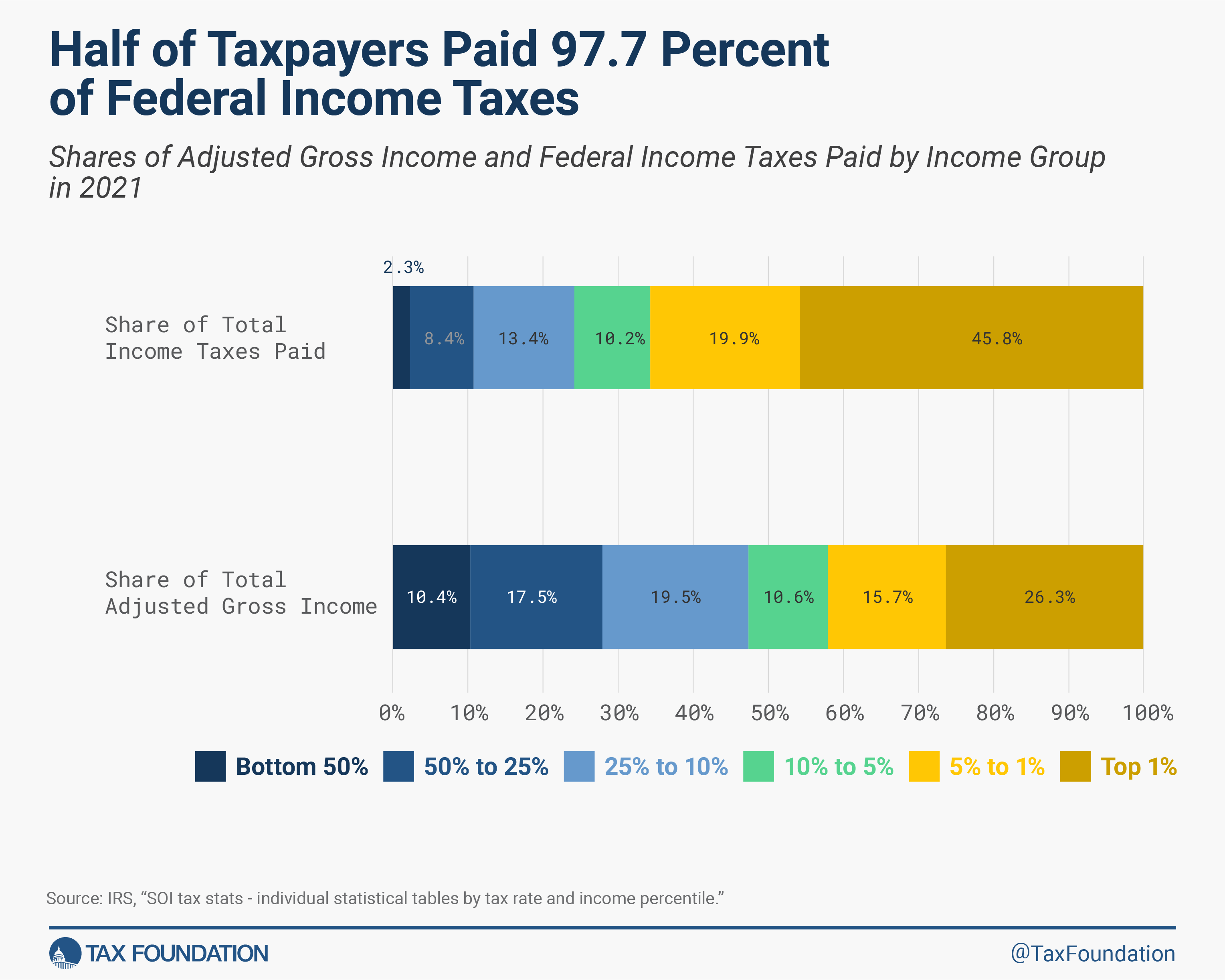
I know you're making a good faith argument, but you're twisting the definition of regressive. For example, if a country has one citizen with an income of 1 trillion, and one hundred thousand citizens with an income of $10,000 each, the trillionaire would still pay over 99% of taxes even if taxes were proportional.
The point is that with severe income inequality, it is fair that the super rich pay a very, very high proportion of taxes. The 40.4% seems high for the "top 1%" of the population, but if you replace "top 1%" with their actual average income, the comparison is less misleading.
The Tax Foundation has a well-known conservative leaning mindset when they publicize data. They project the benefits for business and lower tax policy.
It is not a legit source for progressive tax policy.
The Congressional Budget Office has been the most reputable source for tax policy data. The current director was appointed by Trump 2019 and was retained through Biden's presidency.
The CBO is very wonky and so far as withstood partisan meddling by presidents.
This only takes into account income tax and not other taxes which are often more regressive such as sales tax, payroll tax etc. When analyzing taxes paid we should take into account all taxes
No healthcare, no public research to today's extent, no military etc. etc. Yes when your government is doing nothing normally it doesn't cost that much.
In 1960 the top tax rate was 91%. In 1980 it was 70%. Reagan dropped it to 35% and it's stayed below 40% since. Then add in that corporations and the wealthy have moved away from having normal income that isn't taxed (loans backed by assets) and you've lost half the tax revenue that paid for cheap housing, nearly free healthcare and public college and you have a healthy society and middle class.
But then to screw the pooch even more, Bush printed 5 trillion for his wars and two tax cuts. Trump printed money for his tax cuts too. (these expenses were never in the annual budget - they just printed the money)
Tesla, one of the richest corporations in our country just reported 0% tax in three years.
Our national debt has nothing to do with the annual budget and expenses, including USAID and helping Ukraine.
While tax cuts do contribute to the national debt, it is not accurate to say the national debt is "100% of tax policy". Tax revenue as a % of GDP has been pretty stable for a long time.
https://fred.stlouisfed.org/series/FYFRGDA188S
So what actually is driving the national debt higher? The never popular answer is entitlement spending (Social Security, Medicare, Medicaid) + interest, which is exasperated by an aging population. In fact, almost all future debt growth is driven by these programs. The rest of the budget is expected to balance out. Tax revenue is expected to increase, and discretionary spending is expected to fall as a % of GDP.
How is social security adding to debt when its funded by payroll tax? And the government has borrowed 3 trillion from it.
Replace Medicare and Medicaid with a socialised 1 payer system as it would be much cheaper. The numbers I saw was that the current system costs 48t and 1 payer system would be 32t. And negotiate down costs and all materials and drugs on top of that.
>How is social security adding to debt when its funded by payroll tax?
Simple - the payroll tax doesn't raise enough funds to cover the full cost of the program. Even if it did raise 100% of the needed funds, that's still money Congress cannot tax a second time. At the end of the day, the government has two buckets: income and expenses. It doesn't matter whether some of that income is called "payroll tax", and some of it is called "income tax". Every cent raised through a payroll tax, is a cent that cannot be raised through an income tax, and visa-versa.
>Replace Medicare and Medicaid with a socialised 1 payer system as it would be much cheaper.
Yet...none of the advocates of a socialized healthcare system have ever put forward a real bill that can be rated by the Congressional Budget Office. Instead, they put forward shell bills which importantly lack any funding mechanisms.
> The numbers I saw was that the current system costs 48t and 1 payer system would be 32t.
The current system is divided between public and private spending. Even if you could reduce the overall cost to 32T, that's still a net cost increase on the public side. How will the government raise that money? The advocates for social healthcare never say.
I mean it ran at a surplus for 30 years until 2009 when boomers started retiring, still has over 3T in assets. How can you claim it's adding to the deficit?
If it's removed and replaced with nothing do you just let old people die in the streets? Or did you want to keep the tax but stop paying out? I don't see how the outcome is different then.
Increase income tax on the wealthy? It's not hard, you used to do it.
>I mean it ran at a surplus for 30 years until 2009 when boomers started retiring, still has over 3T in assets. How can you claim it's adding to the deficit?
It takes money from the general fund in the form of interest payments. And the CBO assumes that when the 3T in assets run out in about ten years, there will be some kind of continuous bailout whereby money from the general fund is used to plug the shortfall.
>If it's removed and replaced with nothing do you just let old people die in the streets?
You don't have to remove it entirely. You could implement means testing so that only those who truly need it receive money.
>Increase income tax on the wealthy? It's not hard, you used to do it.
It wouldn't generate enough revenue. Social Security and Medicare, and their associated interest payments are expected to run a ~100T deficit over the next 30 years. If you want to go the "just raise taxes" route to bridge that, you'll have to raise taxes on everybody. If you doubled middle class taxes and implemented a 20% VAT, it might raise enough to stabilize social security and medicare. But that would be the largest tax increase in American history, and Americans would receive no new benefits in return.
The government "borrowed" from the SS fund. That's why it's endangered. The money was there and it should still be there.
The government also screwed the postal service by taking their profits (one of the few things in government that actually makes one) and then yells at them for not making enough income.
We need a flat corporate and billionaire tax that has no loopholes.
The government borrows money from Social Security, and the government pays that money back with interest. So what you are complaining about is actually a transfer of money from the general fund into Social Security. And when we talk about the impending insolvency of Social Security, we're talking about the point at which this subsidy stops (because they won't have any surplus funds to lend), and the program is forced to cut benefits to match what payroll taxes bring in.
Also very predictable exenditures over time, which increase with an aging population with decreased firtility rates. Which have little to do with actual firtility but are just a measure of kids vs parent ratio, it might play a role though. Everyone always forgets that it is entirely predictable but nobody does something about it because it hurts.
Also doesn't help if you borrow against the money put in. The US is not alone in taking money from the baby's/old peoples fund unfortunately, same happened here but worse the money was just taken. Although it was mostly spend on education and construction so there is that at least.
Strange how the national debt increases much faster when the president is a Republican. Republicans love to run the debt up when they are in power and then use it as a weapon when they are not.
We have it: three branches of government. But the political branch loyalty has been superseded by political party loyalty and it breaks the system.
What I think should happen is that the vast majority of legislators (Senators/Representatives) should be furious that the Executive branch is disregarding laws that they wrote themselves. And the justices should be furious that the Executive branch is disbeying their interpretation of the law.
Haven't republicans been campaigning on reducing govt spending for like 50 years?
Aren't other countries adversarial enough?
I think these are made up concerns. By and large the US is dominant in the real world, and always will be given its size, location and cultural foundations. And that translates to being able to print and spent a large amount of money, which could be used to solve real world problems, such as:
- climate change and the need to transition energy, transportation over time with some urgency
- chronic housing shortage
- education costs
Instead they're focusing on fake problems and solutions that will make the real problems worse.
> Haven't republicans been campaigning on reducing govt spending for like 50 years?
Not really. There is a political strategy Republicans have engaged during this time known as "Two Santas" which can explain it:
  First, the Two Santas strategy dictates, when Republicans
  control the White House they must spend money like a
  drunken Santa and cut taxes to run up the U.S. debt as far
  and as fast as possible.

  This produces three results: it stimulates the economy thus
  making people think that the GOP can produce a good
  economy; it raises the debt dramatically; and it makes
  people think that Republicans are the “tax-cut Santa
  Clauses.”

  Second, when a Democrat is in the White House, Republicans
  must scream about the national debt as loudly and
  frantically as possible, freaking out about how “our
  children will have to pay for it!” and “we have to cut
  spending to solve the crisis!” Shut down the government,
  crash the stock market, and damage US credibility around
  the world if necessary to stop Democrats from spending
  money.

  This will force the Democrats in power to cut their own
  social safety net programs and even Social Security, thus
  shooting their welfare-of-the-American-people Santa Claus
  right in the face.[0]
Except that is inaccurate. With the exception of the Biden admin, Republicans have been increasing the national debt at a _much_ higher rate.
Both private and public dept have been rising rapidly since the 70/80's and the introduction of neoliberal policies. Real wages have stagnated, so Americans go into debt. Tax cuts for the rich, so the US has to borrow.
Yes, but it would be dishonest to claim that only Republican admins drastically increased the deficit. Biden is an exception. I’m not comparing him to Trump either.
Any remotely serious attempt to balance the budget will have to involve serious cuts to some or all of Defense, Medicare, and Social Security; along with tax increases, either new taxes or closing loopholes. Trump and Elon are completely uninterested in doing any of those things, and are in fact going to make them worse.
Indiscriminately firing federal workers whose salaries will collectively make up maybe one tenth of one percent of the budget is not at all about reducing debt, that's just the thin justification they are using the destroy any independence and competence within the government that might get in the way of their looting and corruption.
Anyone who thinks that Trump and Musk are serious about reducing the federal debt at this point aren't likely to be swayed by anything I say. But for anyone who genuinely believes that I hope you will look at what the national debt and deficit are right now, and then to check on them in a few years when both are dramatically worse. You will find that two of the most prominent bullshitters in the world are in fact bullshitting on this topic as well.
To add to this: specifically regarding random firings and loopholes. Every marginal dollar spend on the IRS brings in $5 to $9 in return to the government [*]. Yet they are firing IRS agents. More generally, we know, and the government knows, how to reduce the deficit because the CBO offers options regularly [%]. All of the big ticket items require some kind of healthcare cuts, which are all not fun. Note that they do not have any suggestions for cutting any part of USAID. The biggest saver would be "Eliminate or Limit Itemized Deductions".
> Any remotely serious attempt to balance the budget will have to involve serious cuts to some or all of Defense, Medicare, and Social Security; along with tax increases, either new taxes or closing loopholes. Trump and Elon are completely uninterested in doing any of those things
Easiest thing to do IMO is fund anyone that is over 18 that has paid into Social Security. Anyone younger - simple, reduce taxes to not include it. Phase that fucker out. Get rid of all but 10% of federal income tax.
Also, make all black budget projects that involve underground alien bases public and move it all private, so Elon and other people can just directly invest in those instead of coming out of our taxes through the DOD.
I am happy to cut government spending and increase government efficiency (obviously). I have so far not seen any evidence that DOGE is working is this direction. As I like to point out the marginal dollar spent on the IRS brings in ~$10 of revenue. If DOGE or Trump really cared about the deficit they would expand the IRS. They would take ease the burden of NEPA, but in the meantime increase the number of bureaucrats to make the process faster. They would reform the Paperwork Reduction Act. They would make it easier for government officials to handpick hires.
On the policy side they would push for port automation. They would get rid of the Jones act. They could standardize and simplify the tax code (& get rid of loopholes like stepped up basis)
Instead they are breaking random government websites, blocking & politicizing USAID (< 1% of budget), mass firing with seemingly no plan for running various orgs, trying to increase mass incarceration (?) and reinforcing captured markets (like TurboTax).
He campaigned (first time) to reduce the national debt and instead exploded it by giving massive tax cuts to corporations and the wealthiest of the wealthy.
> Trying to cut jobs/waste/find fraud is political/career suicide for anyone in government
US Government Accountability Office already existed to do this, without it being career suicide for those involved (at least until Trump began attempting to end it despite being nonpartisan)
You are way underreacting to what’s going on here. This is not about saving money, or trying to cut waste or fraud. Elon Musk has been posting wild conspiracies on X to justify what he’s doing. But the actual changes are reactionary and political. Accountability is long gone if someone like Elon is in direct charge of what bills get paid. Fraud and waste will skyrocket in these conditions.
Tesla and SpaceX ran on government money. X is doing poorly enough that he’s suing former advertisers demanding that the courts force them buy ads.
He now has significant influence over all of those things. Official government communications are only being released on X, incentivizing people to use it. The next NASA contract is going to be awarded by people who know their boss’ boss’ boss’ boss’ boss owes his political career to the owner of one of the bidders. Last quarter, a quarter of Tesla’s net income was unrealized Bitcoin profits – and he’s pushing the government to subsidize Bitcoin so it can get the kind of adoption it hasn’t been able to achieve on merit!
This is why government ethics rules exist, and why high-level officials have public confirmation hearings. Even if he was incredibly scrupulous about not making decisions based on his own interests, it reeks of corruption and provides many avenues for potential abuse (e.g. what if China threatened to seize his factories unless he helped them get a better deal?). The federal employees he’s attacked have annual training reminding them that they can’t accept gifts over $20/year – and really shouldn’t even then – with consequences up to going to jail for a long time.
Hold on there, Tesla has repeatedly shown an amazing ability to cut costs of their products while improving functionality/quality.
Yes Tesla benefits from credits caused by other companies not meeting co2 targets set by the government but that wouldn't have been enough to save them from three near bankruptcies. And yes, they are still quite a ways away from being a leader in overall quality and consistency but yhey are executing extremly well in their R&D compared to other US car companies only to be outdone by the Chinese, certainly not any US company.
As someone solidly on the left, this has really frustrated me to no end with the typical lefist sources I watch. In 2025 Facts really matter but all I see are facts being omitted to push a narrative (ie. Elon wasn't the founder of Tesla, Tesla/SpaceX is just alive because of the government subsidizes, Elon does not know anything about how to make a car/rocket).
They cite his bad behavior or screwups in reforming Twitter but unless you have followed everything that Elon has accomplished/failed at you are lying by omission. This is especially dangerous now because by dismissing him as dumber than he really is, you are setting him up for surprise successes because people let their guard down.
This is what I see on /r/fednews at how shocked they are over how fast he is moving at his slash and burn.
You would have known this had you followed the whole Twitter saga very closely, the early days of Tesla where they ousted the original CEO for deliberately lying to the board, and the three near bankruptcies of the company where Elon pulled out hail mary after hail mary to save the company.
See this is my point. You can easily google that answer and I suspect you know it already. The entire context is missing because you are pushing your narrative. Tesla was founded by Eberhardt and Tarpenning and thats where the left always stops. Without any doubt we know that Eberhart would have tanked the company. Tesla would have been nothing without Elons involvement especially now that we know of the lies that occurred early on during Roadster. There would be no Tesla left had he continued. Leaving this out causes people to miss lessons that help them understand how Elon thinks.
Lessons such as how he brought in his fixers to go 'line by line' in the books to figure out where all the money is going: sound familiar?
>Tesla is getting cooked by Chinese carmakers and only tariffs or outright bans can help. In EU their sales are falling quickly due to his salute.
Did you not read my message completely or were you so fixated on your conclusion that you missed how I admitted that Chinese are outdoing Tesla?
Don't listen to me, heres Elon Musk talking about how good his Chinese competitors are:
"If there are no trade barriers established, they will pretty much demolish most other car companies in the world," he said. "They're extremely good."
In regards to EU, yes they are sinking there, so are all the other EU companies. The Chinese will own that market. That entire continent is a sinking ship and in hindsight maybe it was a mistake to even open a factory there as im sure Musk is realizing now.
I am so disappointed that the left has apparently learned nothing from the Twitter saga and are instead relearning all the mistakes made there because they didn't pay attention the last several times this happened. Instead of downvoting figure out how you can exploit Musks's weaknesses to stop him.
So the company was founded, Elon Musk joined later and funded it. Are investors founders now or what? This isn't a leftist things, it's just reality. I'm not disputing that he was instrumental in Tesla's success, saving the company several times with new financing.
He overpaid about 20B for twitter and tanked it's value so it's almost worthless now. For example by telling advertisers to fuck off, and when they did he started suing them for doing what he told then to do. All this to turn twitter into a far right extreme and racist echo chamber to push propaganda. All regular users and companies are fleeing it to other platforms. Now he's using his position in government go force agencies to use it for communication, padding his own pockets.
I don't think there is anything I can say to knock some sense into you but i'll bite anyway.
>So the company was founded, Elon Musk joined later and funded it. Are investors founders now or what? This isn't a leftist things, it's just reality.
The left position implies or outright says that he just used his money to take over the company pushing the poor founder out. This nonsense is as far from the truth as you can imagine. Two guys that came along with no financing and just a general business plan. As the founders they were given the chance to run the company and ran it into the ground losing almost all of the investor's money. The original plan was for Elon to start his own company: A company called Faraday Motors(ironic). He was convinced by his business partner to instead join forces with these other two guys. A mistake he probably still regrets.
Is the left correct in that Elon was not the founder? Yes...are they being disingenuous? Absolutely. We can't be playing this stupid game anymore after their abysmal loss this past election.
>I'm not disputing that he was instrumental in Tesla's success, saving the company several times with new financing.
You make it sound like he just wrote a check, walked away, and it magically fixed itself. Now you are being dishonest. A lot had to happen correctly between then and now for Tesla to be where it is today and not just some distant memory.
OP made the claim "Tesla and SpaceX ran on government money." This is another disingenuous statement. Tesla utilizes a program open to any car company to encourage them to transition to ZEV. Its not Tesla's fault that other car companies still cannot take advantage of the program due to the cars that they sell. They had 10+ years to turn the ship around and many still haven't done so. It is certainly not some sweetheart deal only allocated to Tesla or even created for Tesla.
The same can be said for SpaceX: they provide a service, the government pre-paid for that service...SpaceX still has to provide the service. The left makes it sound like they are just being thrown free money.
Frankly why do you even nitpick this so much? What are you even trying to prove? My overall point was that people need to know this history so they can see his tricks coming a mile away instead of being caught off guard like many are doing right now. How is that a bad thing?
>He overpaid about 20B for twitter and tanked it's value so it's almost worthless now. For example by telling advertisers to fuck off, and when they did he started suing them for doing what he told then to do. All this to turn twitter into a far right extreme and racist echo chamber to push propaganda. All regular users and companies are fleeing it to other platforms. Now he's using his position in government go force agencies to use it for communication, padding his own pockets.
Thats just like your opinion man. Here is an alternative take: That Twitter deal in hightsight is looking to be one of the best acquisitions in the history of tech. For 44 billion (of which a lot is other people's money) he literally bought the USA. In the grand scheme of things it is chump change.
>And you still think he's a good guy.
Well I really don't know what kind of a person he is. What I do know is that he will continue to surprise you if you keep your mind closed like that.
You don't see the conflict of interest in one person both controlling how public funds are spent, and running private companies that may have those funds directed to benefit them?
When Elon runs his companies, he is beholden to shareholders to use the company's resources effectively to generate and maintain value.
Who is Elon beholden to when managing public funding and programs as an unelected non-official? Who will vote him out when he wasn't voted in? Who will revoke his confirmation when he was never confirmed?
> What is happening in DC (currently) has broad public support.
Things have been moving quite quickly, so this seems like a premature judgement. Can you cite a survey that shows that levels of support for disbanding USAID, for example; or taking over the treasury system; or "deleting" DirectFile?
I am responding to a specific comment about public support. Besides surveys, what method would you suggest for accurately determining public support for particular policies? And leave your self-satisfied partisan snark out of it.
I couldn’t care less about measuring the popularity of the President a couple weeks into the term. You could ask a fortune-telling chicken for all I care.
I’m ecstatic about everything that’s being done to make the country better right now. We’re again moving in the right direction. That’s what matters to me.
> I couldn’t care less about measuring the popularity of the President a couple weeks into the term. You could ask a fortune-telling chicken for all I care.
Then why are you responding to my objection to a post asserting the alleged popularity of current actions? Are you just interesting in spreading snark and bitterness without any thought or substance?
> I’m ecstatic about everything that’s being done to make the country better right now. We’re again moving in the right direction. That’s what matters to me.
Oh, sorry, I didn't realize that you're dumb. What's happening right now is vandalism of the government.
> So why would "fraud and waste" skyrocket under him?
TSLA doubled in value in the month after the election, despite the financials of the company going down. The only reason for the increase in share price is because the market expects Musk to benefit from Trump's corruption, in the form of less oversight and more government subsidies.
They mean that he will divert or protect payments and credits going to his own businesses or partners. His interest in capital efficiency exists to generate profit for himself, not as a blessing for other orgs he provides as a gift. He did it with Twitter/X after he became owner of its profits.
If treasury money is diverted to his private interests, that is waste and perhaps fraud. But to him it achieves the same end (personal profit) as capital efficiency of orgs under his own ownership, not just his control
Elon has gone off the reservation. Just based on his insane social media postings, he's either completely mad or is cynically pretending to be. Either way he is completely untrustworthy.
At this point, it's probably the safer bet to assume Musk isn't the primary reason those companies are capital efficient.
Maybe he runs companies like he plays video games. Someone else drives while he pretends to.
That's a very valid argument. Both SpaceX and Tesla are quite capital efficient. Maybe another angle to consider is what's being optimized for? What outcomes would be considered successful for these federal agencies? That's probably going to tell us more about whether the austerity measures that seem likely result in more efficient use of resources to create successful outcomes.
One thing that seems worth think through more is whether the stated outcomes of those agencies is what's actually be optimized for, or whether those are suborned for personal gain by a few parties.
This is not correct. SpaceX is covered by ITAR and therefore cannot hire foreigners.
Of the approximately 70,000 Tesla employees in the US, fewer than 2,000 are H-1B workers. The rest are US citizens or permanent residents. Tesla's manufacturing is much more vertically integrated than other auto manufacturers, so they rely almost entirely on their US factories to produce the cars they sell in the US. Other auto makers tend to do more manufacturing overseas to save on labor/safety/environmental costs, then do final assembly in the US to avoid tariffs.
JFC, he named a quasi-governmental agency "DOGE"! He may as well have called it "The Department of Pump"
And his buddy the president is happily sending the currency and stock markets up and down with his every idiotic tariff announcement. I wonder if the top man at DOGE is on the list of people who Trump tips off?
Musk, Trump and half this administration are off-the-charts corrupt.
You would have to cut entitlements if you're relying on cuts alone, and those require Congressional action to change. It's absolutely wild people actually believed Musk without spending a few minutes understanding the issue.
Certainly, building systems to search for and prevent fraud is a worthy goal. Solving for that is orthogonal to what is taking place (which is Musk and his loyal, inexperienced band of lackeys doing whatever they want without governance and oversight). Is all of USAID fraud? Does the executive branch have the authority to unilaterally shut the program? No, these are the actions of authoritarians.
Everything Musk and Trump have done have been virtue signaling, removing oversight and political independence, gutting consumer protections, and pissing off our allies.
A Russian puppet candidate could not do more damage to this country than what the Trump administration is doing right now.
Nothing being done fights the large causes of fraud/waste/abuse. Nothing being done helps the cost of housing or the cost of healthcare or college or fuel.
The so called successes of the tariff wars so far have been done at the expense of our long term credibility as a nation.
Indeed. There's undoubtably fat to cut all across the board but anybody who decries government spending and waste and doesn't include the DOD as part of that is a hypocrite at best.
I didn't downvote you, but tell how you would like to downsize the military's mission 95%. No overseas bases? No Coast Guard? No R&D? Just looking at a big number and saying "cut it" is easy, saying what to cut is hard.
95% is overly aggressive, but that doesn't mean there's opportunities to trim fat.
Addressing the DOD's accounting failures is a first step -- famously admitted to by Don Rumsfeld:
Rumsfeld says, “Our financial systems are decades old. According to some estimates, we cannot track 2.3 trillion dollars in transactions. We cannot share information from floor to floor in this building. Because it's stored on dozens of different technological systems that are inaccessible or incompatible.”
There's zero incentive to cut waste -- in fact the opposite. At the end of the fiscal year it's SOP to spend every last penny in the budget on anything they can, just to ensure their budget isn't cut.
Afghanistan and Iraq cost the US ~$6T and we got nothing to show for it.
There's got to be a reasonable center between "God bless the US Military" and "Shut it all down".


With the debt ceiling ever increasing, approaching a trillion dollars in interest per year, nearing $6k/year per working individual, I would say the correct time to put any effort, whatsoever, into reducing spending, was 20 years ago.
I think the fundamental problem is we lack adversarial systems within the government: it doesn't like to hurt itself. Trying to cut jobs/waste/find fraud is political/career suicide for anyone in government. Accountability requires a true adversary/"outsider". Should that be DOGE, or its current implementation? Probably not. Should the adversarial concept of DOGE exist? I would enjoy seeing arguments against the concept. It seems like it's severely needed.