I just got back from a week-long vacation where I flew Southwest. It was my first Southwest flight in a while and I will now not fly any other airlines.
The rise of "basic economy" seems a lot like the general phenomena of "enshitification" and has a similar motive - degrade your product to squeeze the last drop out of the consumer. And it seems logical that charging by the "degree of shit" in a product means every level is going to be shit actually.
SW seems to be steadily removing everything that differentiated them as a carrier. There's no reason to choose them other than pure price for a route now.
They were able to resist enshittification for a long time because they were actually one of the most profitable airlines and were able to keep their unique culture.
Then they had a flight meltdown, lost a bunch of money, and got targeted by activist investors.
You are thinking long term profitable, but most of the current "activist investors" barely think about short term profitability, and mostly from the perspective of their own profitability selling shares or running a short somewhere and "indirectly" helping their short by giving bad advice to a different company. They mostly read the quarterly reports and that mostly to look for "easy profits" Company A is making that they could pressure Company B to do for a quarter or two to bump stock prices before they sell again. Swoop in when a company has a bad quarter, pressure them to have "one good quarter", sell, rinse, repeat. (Makes them good money, makes most companies a race to the bottom to appease their whims as short-term investors.)
It's a good idea in theory if you can somehow force dividends to some long term vesting strategy to reward long term investors over short term investors.
It's a bad idea in historic practice, given the very origin of the turned out to be awful, something of the root of much short-term-ism and "activist investors" in the first place, "fiduciary duty to the shareholders" phrase was the awful Ford v. Dodge Brothers case where the Dodge Brothers were some of the earliest investors in Ford (as partners and parts dealers for Ford) and went to court to argue that record profits in a particular quarter should not be invested in long-term capital investment (a large new plant) and R&D as Ford was planning to do, but presented as a windfall of a large dividend to shareholders instead. The court agreed with the Dodge Brothers for, er, dodgy reasons, and the clear conflict-of-interest motive from hindsight of the Dodge Brothers "activist investing" in that moment was to notoriously use said dividend windfall to expand their efforts as a Ford competitor (produce more Dodge cars, if you haven't guessed) from Ford's own profits.
It's not a single court case that gets us to where we are today with short-term thinking in Wall Street, but that's such a weird foundational one.
They've also made some longer term strategic flops, like investment into Hawaii, which by its isolated long-haul nature is significantly different from the rest of their flights (usually short hauls that can maximize aircraft utilization per day)
I could have phrased that better; Southwest was the airline that didn't during a period where all the others did. Prior to 2008 or so none of the major airlines in the USA did.
>The rise of "basic economy" seems a lot like the general phenomena of "enshitification" and has a similar motive - degrade your product to squeeze the last drop out of the consumer. And it seems logical that charging by the "degree of shit" in a product means every level is going to be shit actually.
How do you draw the line between "cutting frills that nobody really cares about" and "enshitification"? Prior to airline deregulation air travel was luxurious[1]:
>BERAS: But it's not just that the planes were more spacious. Back then, the airlines would go out of their way to compete with each other on amenities.
>MALONE: Right. Like, the plane we're on, it had a lounge in the back. You might get a six-course meal or a fancy cocktail included.
>BERAS: Plus, all kinds of other perks, like custom playing cards delivered in a fancy case, shaving kits delivered in a fancy case, cigarettes delivered in a fancy case.
>MALONE: Yeah. And, you know, as we get into the '70s, the amenities got ridiculous. Airlines even had meat carving stations, so flight attendants would roll the meat right up to you and carve it up right there in front of you at your seat.
>BERAS: But perhaps the pinnacle of all amenities was...
>VAN DER LINDEN: They had a piano bar, an honest-to-God piano.
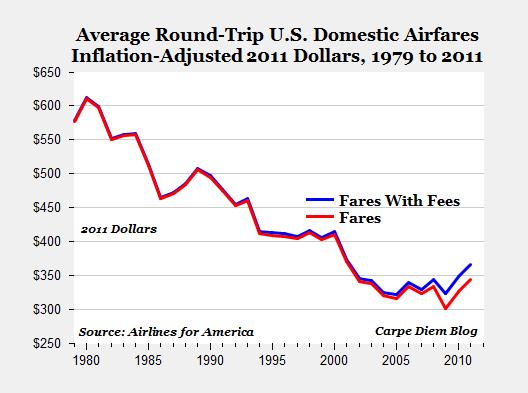
But air fares dropped after deregulation, after much of these perks were reduced[2]. Of course, people who wanted those amenities would rather than they be bundled, because they'd be paying for it anyways and airlines could benefit from economies of scale for offering those amenities. They might even call it "enshitification", if the word was around back then. But most people would rather that their experience be a little crappier but save a few hundred bucks on airfare instead.
I frequently wonder if these folks attempting to squeeze the very life out of the “consumer” (I prefer the phrase “citizen & voter”) ever stop and wonder what will happen when there’s nothing left to squeeze? Because that day is coming sooner rather than later. Its my suspicion that it will end with blood. Rather a lot of it.
The employees and executives might not care, but surely the shareholders do? If they really think "shit hits the fan" is going to happen any time soon, then they should sell their overvalued shares and buy some fixed income instrument like treasuries. Except they don't, because that'll be a dumb move. Despite the saying of "companies only care about the next quarter" being around for decades, the stock market has been on a tear, with little sign that "shit hits the fan" is going to materialize any time soon.


The rise of "basic economy" seems a lot like the general phenomena of "enshitification" and has a similar motive - degrade your product to squeeze the last drop out of the consumer. And it seems logical that charging by the "degree of shit" in a product means every level is going to be shit actually.