I don't know what you're talking about -- that isn't true.
There is absolutely no perceptual hue shift in the HSL/HSV models depending on saturation and lightness/value, or when they get translated into sRGB. That's the entire point of HSL/HSV, to isolate hue and hold it constant.
HSL/HSV are not perceptually uniform in terms of brightness when hue is changed, or even brightness linearly. But hue is hue. Perceived hue does not change based on brightness or saturation.
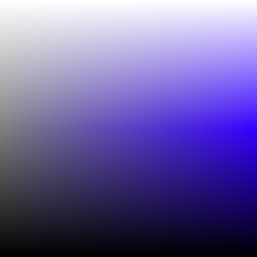
There most definitely is perceptual hue shift in HSL (and HSV); it's illustrated quite well at [0](The blog of the creator of OKLab), particularly in [1], an image showing S and L axes while leaving H fixed.
Well I'll be damned, you're right -- I'm playing with it in Photoshop now, and it seems to be exclusive to hue values of 233-270, in the transition from blue to purple, and nowhere else. Matches what [0] says -- "This is particularly obvious for deep blue and purple colors."
So first, thank you for the correction. It's fantastic to learn something new. And second, do you have any idea why the OKLCH example on the page is so atrociously bad? The way blue changes to cyan is even worse than the HSL/HSV difference of blue-purple. It's like the cure is worse than the disease. If they were so concerned with hue fidelity in the first place, I'm surprised they wound up producing an end result just as bad.


There is absolutely no perceptual hue shift in the HSL/HSV models depending on saturation and lightness/value, or when they get translated into sRGB. That's the entire point of HSL/HSV, to isolate hue and hold it constant.
HSL/HSV are not perceptually uniform in terms of brightness when hue is changed, or even brightness linearly. But hue is hue. Perceived hue does not change based on brightness or saturation.