A key limiting factor for dietary use of single cell protein is the high mass fraction of nucleic acid, which limits daily consumption due to uric acid production during metabolism. High rates of RNA synthesis are unfortunately necessary for high protein productivity.
The paper notes:
>It is important to note that MP products often contain elevated levels of nucleic acids, constituting ~8% of the dry weight [17], which necessitates consideration when assessing their suitability for human consumption. To address this, a heat treatment process is employed at the end of fermentation that reduces the nucleic acid content in the fermented biomass to below 0.75/100 g, while simultaneously deactivating protease activity and F. venenatum biomass. However, this procedure has been observed to induce cell membrane leakage and a substantial loss of biomass, as evidenced in the Quorn production process [17], which also utilizes F. venenatum as the MP producer. Our experimental trials have encountered similar challenges, achieving a biomass yield of merely ~35%, and observed that heating process increased the relative protein and chitin content (Figure 2D,E), which may be related to the effect of membrane leakage, while the intracellular protein of the FCPD engineered strain was less likely to be lost to the extracellular. Thus, concentrating the fermentation broth to enhance protein and amino acids content in successive steps to produce a highly nutritious water-soluble fertilizer appears to be an effective strategy for adding value to the process (Figure 1).
The challenges of developing economic single cell protein products, that are suitable for human consumption, are described in chapter 3 here:
While the paper is behind a pay wall, the abstract highlights that they used knock out gene editing, meaning this is not a GMO of the old days, with trans genes, but a mkdifcation one could have achieved with classical breeding if given enough time and resources.
If I understand this right, this would even in the EU now be allowed to be sold without the GMO label.
Technically, any gene sequence can be achieved with enough time and resources. Thats what evolution is afterall. Using CRISPR but not labelling it as genetically modified seems pretty wild, but then again EU does have some funky regulations.
>Technically, any gene sequence can be achieved with enough time and resources.
not in a meaningful way, no. the probability that a new mutation you want will occur is much much lower than the probability you can breed offspring without a gene that's already in the bloodline.
They've altered Fusarium venenatum which is currently what Quorn utilizes in its products.
"The production process of gene-edited MP is more environmentally friendly than chicken meat and cell-cultured meat."
That's good news, if they get to the point where it is more economically friendly than chicken meat it will be great news.
I was coming to write about Quorn. I wondered if it was in the family because Quorn is an industrialised bioreactor process. This should translate over, unless weakened cell walls make for a process unfriendly change.
I would love to eat meat free alternatives. Quorn gives me IBS. Same with the highly processed meat free "meat".
Beans are my basic goto for protein plus eggs.
There’s little chance that the statement is true. Chickens kept in a backyard can live on bugs and kitchen scraps and there’s no delivery cost for eggs or eventual meat.
A negligible fraction of chicken production is backyard operations. Any quote talking about chicken production is referencing how they are actually produced, which is generally huge industrialized farms (often hundreds of thousands to millions of birds a year).
Back of the envelope, for a family of 4 eating US quantities of chicken... you need to be slaughtering ~100 chickens per year. In a homesteading setting it usually takes a chicken about 12 weeks to reach slaughter weight, so you need to be raising a minimum of 25 at any time.
By replacing (some) farmed meat with farmed fungi protein.
Although it's theoretically possible for a disease to infect both fungus and animals, because the biology is so different, the risk is greatly, greatly reduced.
In addition, it may be possible to reduce the use of treatments such as antibiotics which, in their currently mass application to farmed animals, could directly lead to the development of antibiotic resistant in diseases which affect humans and animals.
It's so odd to me as a veggie that people want something that "tastes like meat". If you've been immersed in decent veggie food for a while this isn't something you crave. Why would I want to eat a bit of dead animal? It's something I might do in a survival situation in a barren place, like Han Solo or something, but not if there are fresh veggies to hand.
If you want to do this for ethical reasons, which you should, then just eat vegetables. They taste way better. You just have to recalibrate your senses to deal with the higher levels of flavour.
But if people really want "chicken nuggets" for some reason then there's no reason it should have to involve animals at all, so this is a good thing, I guess.
meet tastes great and all, but I wonder where science is at (if at all) on making original food that tastes good. How about food that doesn't taste like any natural food we've had, but still tastes really good?
Jell-o (gello?) is a good example, nothing tastes like it naturally. Why aren't there tasty food that are original in terms of taste and texture but good for health and the environment? I suppose part of the struggle is that food is entrenched into culture so much. burgers and bbq are inextricable from july 4th and memorial day for example.
The trouble is that “tastes good” isn’t a blank canvas. It’s built on hardwired signals plus learned associations. Our basic tastes evolved as nutritional indicators: sweet signals energy, umami signals protein, bitter warns of potential toxins. And our brains are rather insistent about finding flavors more pleasant when they match patterns we’ve already learned are safe.
Jell-O actually proves this rather than refuting it. It succeeds because it hits that hardwired sweet preference, not because it invented some novel taste dimension. A truly new taste that doesn’t map onto the existing five basics would likely register as “off” rather than delicious. Your brain wouldn’t know what to do with it, nutritionally speaking.
So you’d have to either work within those existing taste channels while creating novel combinations and textures, or somehow condition people to associate genuinely new sensations with safety and reward. The latter is slow going. We’re quite literally built to be suspicious of unfamiliar foods.
> A truly new taste that doesn’t map onto the existing five basics would likely register as “off” rather than delicious. Your brain wouldn’t know what to do with it, nutritionally speaking.
We have five taste receptors, so it's it's actually impossible to get something that doesn't map unto those five. Instead, what we call the taste of food, and what GP was referring to, is actually the smell of food, or more commonly, its aroma, which we can detect both from the outside by sniffing it with our noses, and while it is in our mouths via molecules wafting up to our respiratory tract.
Unlike the simplicity of taste, we have a huge array of smell receptors, with most of them having much more indirect associations, if any, with any specific survival need. It's very much possible, and in fact quite common, to synthesize novel smells/aromas which don't resemble any natural food.
There are plenty of "synthetic" flavours - Takis, Twinkies, and bubblegum drinks spring to mind.
There are also a wide variety of textures that are heavily industrialised. If you go to some fine dining restaurants, you'll find smells and colours which you simply cannot replicate at home - let alone make from scratch.
Most synthetic meat and fish is really just a flavour carrier for whatever sauce people like. I've had imitation chicken, shrimp, beef, crab, etc. They all taste great - but that's mostly because the sauces are the same as their meaty counterparts.
The chicken that KFC uses, sure. There’s a huge difference between that and a chicken that’s been raised well and allowed to get to a sensible age before slaughter.
The taste/texture of jello is just collagen (roughly, "meat stew flavor"), fruit juice, and (tons of) sugar. It’s just an extremely heightened version of natural flavors. There is nothing new under the sun.
I find this highly annoying. Here we've had very tasty wheat based slices that can serve the same purpose as sliced salami/meats on bread, and didn't try to muck anything in particular. But they disappeared from the shelves while the stuff branded as Vegan Salami seemingly does well.
I guess for casual buyers having a familiar reference point is just crucial.
Your question is rather ambiguous. Do you mean using chemistry to develop new techniques or combine unusual ingredients to create food that has novel flavors or textures? That would fall under Molecular Gastronomy, which has been highly influential within fine dining in the last few decades.
Do you mean processing ingredients with the goal to take cheap ingredients and make a product as hyper-palatable as possible? That would generally be called "ultra-processed food"; you're not going to find a Doritos chip in nature.
Do you mean developing completely completely new flavors via chemical synthesis? I don't think there's much possibility there. Our senses have evolved to detect compounds found in nature, so it's unlikely a synthetic compound can produce a flavor completely unlike anything found in nature.
Also, I think you're overestimating jelly. Gelatine is just a breakdown product of collagen. Boil animal connective tissue, purify the gelatine, add sugar and flavoring and set it into a gel. It's really only a few of techniques removed from nature. If you want to say it's not found in nature, then fair enough, but neither is a medium-rare steak.
I'd argue that Jell-o tastes good because sugar tastes good and that it's just the novel texture coupled with sweetness that is the attraction. I doubt many people know what unsweetened gelatin tastes like or if that even tastes good.
Livestock emits between 10% to 20% of global greenhouse gases (in carbon equivalent/100y-GWP) [1]
In contrast, all data centers (not just AI) currently use less than 1.5% of all electricity, making up less than 0.3% of global emissions [2]. Although recent increases in data center electricity usage is lamentable, even in the short term future, much of this can and more importantly _will_ be low-carbon energy, and the ratio should continue to improve with time.
A 1% reduction in livestock emissions is therefore about the same as a 50% reduction in data center emissions.
The cow farts, the important forests being torn down far cattle, the important forests being torn down for soy beans that feed the cattle, the inhumane conditions in which the cattle are raised. The problem you dismissed is indeed far larger than the one you're worried about.
It's a bit extreme to refer to that "climate" summit "guests" as cattle, but I won't deny it gave me a chuckle.
>the inhumane conditions in which the cattle are raised
Gosh, that's sad.
One way to go about it is to vote with your hard-earned and only buy meat from the Ethically Raised in the Swiss Alps Cows that look quite happy on the photos then.
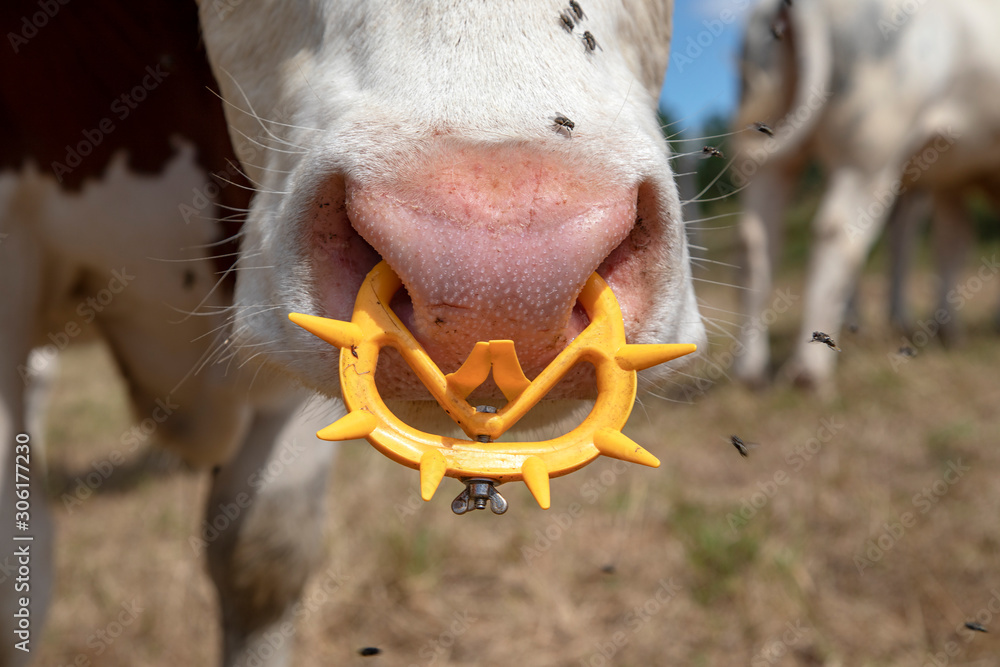
what is the context for this photo please? (that is not a calf btw?)
It certainly does not look very nice, are you relating this to the "Ethically Raised in the Swiss Alps Cows" in the comment you replied to?
In truth, they just take the calves away from the mothers after a short while, ship them out to the abbatoir. There is no benefit to them being in the same enclosure with a spiky nose ring, it seems that this must have a different purpose than the one you mentioned.
I suggest reading/listening a little bit outside of the PETA propaganda bubble. For example, here's a good short discussion on the topic with a cattle farmer: https://www.youtube.com/watch?v=n4cHn6NX4wQ
We already have licensing fees for GMO seeds. Can't be all that long before they CRISPR an actual chicken breed, and start charging licensing fees for those as well.


The paper notes:
>It is important to note that MP products often contain elevated levels of nucleic acids, constituting ~8% of the dry weight [17], which necessitates consideration when assessing their suitability for human consumption. To address this, a heat treatment process is employed at the end of fermentation that reduces the nucleic acid content in the fermented biomass to below 0.75/100 g, while simultaneously deactivating protease activity and F. venenatum biomass. However, this procedure has been observed to induce cell membrane leakage and a substantial loss of biomass, as evidenced in the Quorn production process [17], which also utilizes F. venenatum as the MP producer. Our experimental trials have encountered similar challenges, achieving a biomass yield of merely ~35%, and observed that heating process increased the relative protein and chitin content (Figure 2D,E), which may be related to the effect of membrane leakage, while the intracellular protein of the FCPD engineered strain was less likely to be lost to the extracellular. Thus, concentrating the fermentation broth to enhance protein and amino acids content in successive steps to produce a highly nutritious water-soluble fertilizer appears to be an effective strategy for adding value to the process (Figure 1).
The challenges of developing economic single cell protein products, that are suitable for human consumption, are described in chapter 3 here:
https://www.researchgate.net/profile/Martin-Hofrichter-2/pub...
reply