It's easy to laugh at these groups' apparent selective interpretations of their rules. But at the same time I realize that they are intelligent people, who no doubt reasoned this through to a degree that I can't even fathom. I don't know if this means that I'm right or they're right, whether a gut reaction of "haha that's obvious bullshit" should be listened to or whether that feeling should be ignored when it contradicts the experts' opinions.
This is a common misconception about the Amish and other plain people, eg stricter Mennonites. They don’t have a universally agreed about set of rules. Each community sets its rules differently. Most Amish don’t reject technology wholesale they slowly evaluate individual technologies for what effects they would have on the tight knittedness of their community and closeness to god. For example most Amish places of business have electricity, battery powered lights are common as well as gas powered fridges. They generally don’t reject modern medicine. However, they generally don’t have electricity at home because they don’t want to be reliant on the grid at large. If and how much solar and wind power are adopted in Amish communities will be an interesting thing to observe over the next decade or two.
Now there are some communities who reject all power that doesn’t come from “gods creatures” and will reject e bikes and stick to push scooters and buggies. But e bikes totally fit in a lot of Amish and plain communities.
They want to avoid critical outside dependencies. For example relying on the electrical grid is avoided because that would be overly dependent on a single outside supplier.
But using electrical devices powered by batteries or generators or solar panels is fine in many of those communities because there are multiple suppliers of all of those (and in the case of generators for the fuel to power them).
From what I (think I) learned writing https://news.ycombinator.com/item?id=39373558 they seek to minimise transactions with the rest of the world, so buying durable manufactured goods is acceptable (and higher-tech goods are even preferred as long as they have longer lifetimes) but subscribing to services is avoided.
So basically the higher number of transactions required for the manufacturing of higher-tech goods is ignored as long as it's not a transaction they are directly involved in?
That's my understanding, yes. For instance, for fabric, they avoid retail, going to manufacturers (or at least wholesalers) and buying a community-year's worth in a single transaction.
I guess it's channeling https://www.biblegateway.com/passage/?search=John+17%3A15-16... ; transactions between english and amish are necessary (from being in the world) but to be minimised (not being of the world), whereas transactions between english or between amish don't count for flow across that boundary.
As opposed to mainstream christians, who are often revealed to be woman abusing*, child molesting hypocrites even without having a stance on technology?
* those who are worst on this account are far worse than the amish, for the latter deliberately let people leave their community, while the former seek to bind even non co-religionists to their beliefs.
Oh, I won't be disagreeing with you on that at all. I just especially detest the way in which the Amish are presented as some quaint, simple group of morally adherent individuals, when they are just another religious cult with the same old religious cult problems.
They're not just a tight knit community - they are a purposely exclusionary, isolating religious group. They demand submission to elder men, and do everything they can to keep the literal status quo, including sketchy cover ups of inappropriate behavior.
I've never understood why they get a pass on this. Is it the beards and bowl cuts maybe?
I grew up with Orthodox Judaism and wrote my Bar Mitzva speech on Jewish law governing the usage of electricity on Shabbat. It was a surprising endeavor through "well this was only valid back when vacuum tubes were used" and turned into "the rabbis who wrote the original responsa wrote absolute responsa, and now we respect their decisions". Now, the Orthodox community makes it a point of pride that they "disconnect" on Shabbat, in spite of the fact that it is not part of the list of the 39 Labors that are forbidden on Shabbat, and in spite of other parts of Jewish law about not introducing new restrictions over time.
When discussing religious matters - even when there's supposed to be some kind of logic involved, really, underneath, these are emotional decisions. Today it is simply a part of how a community defines itself. A local community makes these decisions together, or not at all, or individual members leave. I imagine Amish communities are similar.
Question is how will it go when someone does decide to say goodbye to the community rules. Will family be under peer pressure to try keeping them aligned and break off all contact if they fail? Those "community made decisions" can be seriously one way street affairs...
I wonder if the following pattern can be observed: assuming that decisions are effectively not made by the community, but by some high status heads (whose decisionmaking privilege can be formal or not formal at all), then in a community with very fluid status, you'd see a self-radicalizing effect of status candidates trying to outdo each other one zealotry. Whereas in a community where status is not fluid at all (aristocracy in everything but name, or some formal education) decisionmakers would be much more at liberty to go soft. Is there a name for this?
Yeah even in Holland that's a problem. We have some calvinist villages where it's really not done to wash your car on Sunday "because god rested on Sunday" even if you don't subscribe to their harsh religion :(
Also I've heard some terrible things from jehova witnesses who got shunned by their entire family after speaking up against the group of elders called the "lighthouse" or something. One of my friends got really screwed up by that.
These communities are not at all healthy IMO and they force things that are supposed to be left to the democratic government.
As a tangent, I learned a few years ago that my oven has a Sabbath mode, intended to help observant folks keep the sabbath. It’s an interesting feature and I wonder how it started being implemented in appliances.
(my understanding is that the intersection of the companies that (a) are hardcore orthodox, and (b) want to run servers, simply hire muslim or other sysops, so they can deal with a machine going down on the sabbath)
It prevents the light from going on or off when you open the door; allows you to keep it set without auto-shutoff; and doesn't immediately respond to temperature change button presses, and only checks them on a set schedule (this last feature is generally accepted amongst Orthodox Jews as allowed for holidays — "Chag" — but not for Shabbat).
Broadly, yes. You program it beforehand to come on and stay on all thru the day (think of it like a slow cooker), and, ancillary functions, like the light coming on if you open the door, are disabled.
My understanding is that amish „Gelassenheit“ and the orthodox melakhah of בורר are similar (as are both to taoistic 非常道) in that one should take things as they come.
I'm not Amish, but e-bikes actually make a lot more sense if you understand why the Amish rejected electricity in the first place. It's because, up until very recently, the only practical way to actually obtain and use electricity is to have your house wired up to an electrical grid that delivers on-demand power supplied elsewhere. This is a no-go for a religious community that views decentralization as the only path to holiness.
Remember: the Amish don't hate new technology because it's technology and they want to live in a fantasy world. They hate technology because it's a centralizing force.
What changed? Simple: solar. Solar is (mostly) decentralized electricity: once you buy solar panels you are dependent only on the continued existence of the sun for power. This actually fits into the Amish lifestyle extremely well for the same reason why it fits into the lifestyle of Nigerian Youtuber Africa Everyday, for entirely coincidental reasons[0].
[0] Most Nigerians would jump at the chance to have reliable centralized electrical infrastructure. The Amish are energy poor by choice.
"once you buy solar panels you are dependent only on the continued existence of the sun for power"
Or until the panels degrade too much or break down, and you have to buy new ones as you cannot make them. So it is still a dependency, but less strong.
The Amish buying a bunch of old PV manufacturing equipment and accidentally kickstarting America's solarpunk revolution isn't exactly something I had on my 2020s political upheaval Bingo board, but...
That still doesn't contradict their point about decentralization. When the panels need replacing you replace them from whichever suppliers are available at the time and then you're good for another 20-30 years. If you're hooked up to the grid then you owe a specific entity money every month.
Amish approaches to technology are way more nuanced and sophisticated than most people think. You might find this article [1], called "Amish Hackers", interesting.
I recommend watching Peter Santenello's series about the Amish, where he interviews many Amish people, including people who are in the extreme traditional churches. It's on YouTube.
Yeah, smart people are just as at risk of self deception as anyone else, and feeling yourself reason things through doesn't guarantee that you're not simply rationalizing.
Self deception and cognitive dissonance are actually distinct from each other.
As you say self deception is easy to fall into. I have on at least one occasion I can remember thought doing something was stupid, and then realized I had done the same thing.
My face still burns from blushing when I think about it.
I don't know which that scenario would fall under, but I know it wasn't pleasant, and it always makes me pause and try to see things from outside my own perspective.
Thanks for pointing this out. "Right" is the wrong word. I think I would have been better to say something like, "whether I'm simply ignorant or whether they're deceiving themselves."
"Some people are commuting eight to 10 miles, some only one or two miles, but they jump on their bike and go. With a traditional bike, that would never have been considered"
As a European this struck me as odd. 8 - 10 miles on an ordinary bike is considered a pretty normal bike commute. Especially as Ohio is pretty flat right?
As an european I feel like 8-10 miles (13-16 km) is a rather long bike commute which would take at least 45 minutes on an ordinary bike. I ride my bike a lot and would occasionally do such a commute but most people aren’t willing to do that at all, sadly.
It takes about 45 minutes to travel that distance in a city (Berlin in my case) and you arrive all sweaty. I used to do this a couple of times a week when our office was on the other side of town. I would bring a clean shirt obviously. It's doable but not for everyone.
Ebikes make such a distance very easy. A friend of mine lives on the edge of Berlin (Friedrichshagen) and his commute is a full hour with an e-bike. A bit over 20 kilometers.
I walk to work these days. Much more relaxing and I listen to podcasts. I don't mind if it takes a bit of time. Anything up to 5, 6 kilometers is fine with me. I gave up my bike last year (I was renting one) as I don't need it anymore.
The issue with biking in Berlin is similar to what the Amish in this article are experiencing: it's dangerous. Traffic is not well adjusted to bikes and city planners keep producing these crazy traffic situations with their ineptness. Construction sites. Buses that have to cross the bike lane to the bus stop, etc.
And that's before you consider that the rule that Germans love rules has one giant exception: traffic rules. Jumping a red light. Not a problem. It was orange a second ago and who can tell the difference? Taxis driving 90 in a 50km zone (i.e. the city limits): happens constantly. 30km speed limits? More of a guideline and those signs are used very sparingly. Speed cameras are science fiction. I've never seen one in Berlin.
I've seen several, but they are carted around and look like some trailer parked innocently on sidewalk, I was curious about one "futuristic" looking trailer thinking it was maybe a bike garage or something but after careful observing it was indeed a speed camera.
> 30km speed limits? More of a guideline and those signs are used very sparingly.
Yeah, unless they are near school zone. Then they are almost invisible and you have a radar with flash to make sure that you know you are speeding.
There are more outside Berlin. I drove one road where it had a side road every 1km or so. And of course constant 60-80-60-80-60 signs. And a radar exactly there where you finally said "fsck it" and didn't slow at that next 60km/h.
It is time that matters 15km can easily be 30 min on a regular Bike a commute is considered too long when it is above an hour. It is not length but how secure you feel and how fast you can peddle. We should strive to make bicycle infrastructure straight and easy, and make cars take detours.
> We should strive to make bicycle infrastructure straight and easy, and make cars take detours.
This is the key to encouraging Active Travel. So much infrastructure is designed primarily for motor traffic and provision for cyclists tends to be just tacked on and not really thought about in any depth.
One big problem with cycling is when you get a road with lots of light-controlled junctions that makes you keep stopping and starting - the loss of momentum can turn an easy ride into an exhausting one. It's particularly galling when you can see that there is room for cyclists to safely go through a red light (c.f. Idaho Stop style laws) and so you have to decide between being a law-abiding citizen of the road, or instead treat red lights as advisory. Sometimes, it's even worse than just slowing you down as junctions can be quite dangerous if you're setting off at the same time as motorists - I aim to anticipate the lights changing and get a brief head-start so that I can be highly visible in front of the drivers and across the junction before anyone has a chance to turn across me.
But your friends are not going to be happy with the BO after said 9.3 miles if he's a hot, humid day. There needs to be a shower on the other side of the trip.
It is not length but how secure you feel and how fast you can peddle.
It's also how dirty/sweaty you get on the ride. In the USA, bike showers are a rare amenity from employers.
My last employer said they had showers for bikers, which seemed like a great amenity, until I actually looked at them -- the shower room was down a little used utility corridor that was only unlocked during 8-6pm business hours, so if you got to work before or after that time you couldn't get in. There were no lockers, so you couldn't even leave a wet towel there for the day, you had to take it up to your desk.
I had a 14 mile ride to work, 90% on a separated bike trail so it was a great commute, but I rarely rode to work due to the poor bike shower situation since after an hour's ride I definitely needed a shower before work. But I was lucky enough to be able to share a drive in to the city with my wife on most days, then I'd bike home since I usually left work later than her.
Also, most workplaces in the US don’t have showers available. My commute is 7 miles (11 km). On average it takes me about 40 minutes for the ride and another 15-20 minutes to shower and change my clothes.
40 minutes might be a slow pace for many, but there’s a couple of decent hills, a bunch of stop signs and lights, and my steel frame bike with my panniers filled with the stuff I need for the day is pretty heavy.
An e-bike could change the equation significantly.
My commute to the office is 37km, though nowadays I mainly work from home. I tend to go in once a week, so I do one journey by train (the office is right next to a train station which is handy) and take my bike on board and the other journey I cycle if it's not raining too much. In the pre-COVID times, I used to go to the office everyday and built up my stamina/fitness enough so that I could do both journeys by bike (weather permitting). It's not particularly difficult doing that kind of distance (I'm over 50) but it helps if you treat it as fitness training - 80 minutes cycling instead of 80 minutes in a gym.
If you don't regularly do 16km rides it would be really heavy to do one out of the blue. Every time I've biked that much it was a true voyage :') and I was young that time.
And I'm from Holland and used to bike every day when I lived there. I wasn't exactly fit (we don't have that American reverence for sports or fitness in Holland) but not terrible either.
The EU Commission says [0] 3km is the average bike trip length in most European countries. They reference this other EU funded study [1] on replacing short car trips with walking and cycling, which says:
> The willingness to cycle over longer distances differs between countries, but in general we should not expect people to use a bike for transport on distances longer than 3-5 km.
Both are from before the e-bike boom. A 2019 Dutch study [2] says the average e-bike commute trip is ~8.5km, which indicates a rough doubling of the conventional bike range from 3-5km to 6-8km. Notably, commutes are significantly longer than all other ride types in the Dutch study, even with e-bikes.
I grew up near an Ohio Amish Country (Sugarcreek) which was south of where the glacier came in the last ice age, and can attest that it’s fairly hilly.
> 8 - 10 miles on an ordinary bike is considered a pretty normal bike commute.
People on e-bikes were more likely to get more exercise (i.e., more calories burned) than regular cyclists because of less (perceived?) effort, and therefore a willingness to travel further distances:
> Physical activity levels, measured in Metabolic Equivalent Task minutes per week (MET min/wk), were similar among e-bikers and cyclists (4463 vs. 4085). E-bikers reported significantly longer trip distances for both e-bike (9.4 km) and bicycle trips (8.4 km) compared to cyclists for bicycle trips (4.8 km), as well as longer daily travel distances for e-bike than cyclists for bicycle (8.0 vs. 5.3 km per person, per day, respectively). Travel-related activities of e-bikers who switched from cycling decreased by around 200 MET min/wk., while those switching from private motorized vehicle and public transport gained around 550 and 800 MET min/wk. respectively.
> Therefore, this data suggests that e-bike use leads to substantial increases in physical activity in e-bikers switching from private motorized vehicle and public transport, while net losses in physical activity in e-bikers switching from cycling were much less due to increases in overall travel distance.
Yah, I believe it: sure, you might do more total work, but less peak intensity. And the payoff of cycling (being outside, getting to see things, etc) would be greater per unit of effort.
I currently have a commute of 15km and I definitely think it's too much to do every day, both directions, and am considering getting an s-pedelex for that reason. I would say 5km is the distance where it is really obviously a bike use case, and 10km is the threshold, for me personally.
8-10 miles in a place like Austin or Phoenix in the summer in 105-115 degree heat really sucks, and you need a shower when you get to where you're going, unlike most European cities, although I imagine some parts of Italy and Spain would similarly suck with the humidity.
> 8-10 miles in a place like Austin or Phoenix in the summer in 105-115 degree heat really sucks, and you need a shower when you get to where you're going
Some work colleague of me does a 25 km bicycle ride for each direction (so altogether about 50 km) for commuting each day he is in the office. Yes, he likes going by bicycle.
After getting to the office building, he takes a shower (there exist showers in the basement of the office builing). He actually loves to promote the possibility of this way of living as a benefit to potential new hires.
In other words: where is the problem? Take a shower if you like to or it is necessary after the commute.
I'm 8km from the school I teach at. That's just enough to make me sweaty. Showering at school is perhaps possible (there is a tiny faculty locker room on the other end of campus) but not really realistic.
I'm considering an e-bike to make the idea more realistic. A couple more miles per hour with a little less effort changes everything.
A bigger problem, unfortunately, is that I'd need to travel along a really busy highway at each end of the journey, and it kills cyclists with some regularity.
Holmes county doesn't have a lot of big hills, but it does have a lot of small rolling hills under 100'/30m in height. You could definitely get sweaty doing 10 miles in August.
Haha here in Spain I get sweaty walking 10 minutes to the subway in just a T-shirt.
Needless to say the office smell situation is difficult in summer, especially now that the government decided offices may not be cooled below 27 degrees C (80 F) i get sweaty just sitting at my desk. I mean seriously how can you concentrate in such heat? It's usually 28 or 29C there.
Most other companies just ignore that law and have the temp at 22-23C or so. But ours just has to be the one that doesn't.
That law was supposed to be a temporary thing during the energy crisis but they never repealed it and the situation is literally unworkable in summer.
Not sure what the regulations in Spain say about it, but I have a small USB-powered desk fan. It doesn't cool the air itself, but a little airflow can help cool you, regardless.
The problem is that since the pandemic they moved the whole office to a "hot desk" system which means you have to drag all your stuff from another floor so that makes it much harder to bring accessories.
I just avoid the office like a plague now, I hate working there :')
I had a twelve mile bike commute in Los Angeles and it was about 50 minutes on a recumbent when I was in great shape. Lots of stop lights though. That'd get old after a while for most people, though I was young, childless, and loved the ride. Free gym too!
How do stoplights work on a recumbent? I've ridden one but a couple times and found that starting and stopping were a bit awkward. Does it get more graceful with practice, or do you do your best to time the lights and reduce the stops?
I honestly am surprised I survived. The commute was 90% bliss (down the beach path from Santa Monica to El Segundo) and 10% terror (getting around Marina Del Rey and when I had to go inland). One time I rode down Lincoln blvd (a terrible idea) and nearly got pancaked. I heard brakes squealing behind me for _several_ seconds and a pickup truck came to a stop 6 inches behind my rear wheel. I think they'd been looking at their phone and not the red light with traffic waiting for it. Absolutely joyous ride though - I wish I had a gopro back then, one time dolphins were jumping out of the water alongside me as I went down the Ballona creek Jetty https://maps.app.goo.gl/cSHddj3sRF7YUsFt5
The more I learn about how fragile our modern IT infrastructure and economy is, it seems the Amish are building a more robust society. Maybe they'll inherit the earth after our horrendously complex web of dependencies is destroyed by war or by accident.
I hope most Amish communities can avoid the following:
1. Off-grid solar systems that eventually shutdown if they lose network connectivity.
2. Tractors and other agricultural equipment connected to the internet, likely susceptible to remote security vulnerabilities that could threaten the harvest.
3. Complex supply chains that require cloud services and network connectivity to function.
Yes, but they're in a better position than most of us, and they would be wise to reconsider their ongoing dependencies on networked infrastructure and modern supply chains for anything life-critical. It's ok to rely on an off grid solar system or an electric truck as long as you disconnect them from the Internet and maintain a cache of replacement parts.
I was struck by the number of people pictured wearing high vis but not helmets; I suppose it might partially be because they're riding in places where pedestrians are otherwise very rare so cars are an even greater danger than usual. The article mentions:
> At the same time, helmets pose special problems for Amish women. They grow their hair long and keep it wrapped in a bun covered with a cap. For this reason, most bike helmets do not fit Amish women. Mullett said he has talked with some helmet manufacturers and encouraged them to build helmets suitable for Amish women, so far without success. For now, far more men wear helmets than women.
Seems to me that if you could make an exception/determination that ebikes were okay, it would make sense to adjust the rules around hairstyle and cap wearing as well. Not really my place to speak though.
The Amish aren't really about rejecting technology just to be luddites, but rather to about trying to preserve their traditions and culture. One of the ways they do that is to avoid adopting new things (technologies, processes, etc) until the community leadership agrees to it. There are Amish that have cars, electricity and computers because their communities have determined that those technologies are acceptable in certain situations and allowed them.
Seen that way, electric bikes may not be a big change from the regular bikes some communities already allow for transportation. Appearance is a very significant part of Amish culture though, and changing those norms just to fit a technology is exactly what they don't want to do.
Their actual goal was to own the looms (to the exclusion of the factory owners). The original Parliamentary compromise regarding the introduction of looms was that skilled weavers would get first dibs on using them. A bunch of factory owners said "Fuck that" and just started using them anyway. Parliament not only didn't punish them for breaking the law, they passed even more laws to criminalize machine breaking on pain of death so that the Luddites couldn't protest anymore. Then they made up a story about them irrationally hating machines so they could paint organized labor as regressive.
The Amish reject technology that ties them into a centralized society because they think decentralized, off-the-grid living makes you closer to God. The Luddites did not reject technology, they destroyed it as a tactic to bring capital back to the negotiating table. They're closer to the artists naming-and-shaming AI art users: few if any of them are Dunepilled[0] enough to actually want, say, a ban on computer programs that create art. What they want is protection against being economically replaced.
> The Amish aren't really about rejecting technology just to be luddites, but rather to about trying to preserve their traditions and culture. One of the ways they do that is to avoid adopting new things (technologies, processes, etc) until the community leadership agrees to it.
Neither feels right to me. The Luddites and Amish share a common thread, which is that of ownership and control and ability to set one's own course. I don't think the Luddites agreed that preserving traditions and culture was what drove them. They wanted mechanization to serve us all, to not be used to control them. They resisted the mechanization of the human spirit. The Amish have their own culture & tradition, but I think again what's afoot here is also in part about control & ownership, at least as much as it is tradition & culture.
To call this just tradition & culture ignores & skips over what's really at stake, which is control & ownership. Whether we have the ability to use technology on our own footing, or whether it is an injected force that shapes and molds us. Is tech soft and malleable, or is it hard & unyielding, forcing humanity to change itself?
I wonder if this change is economically driven: if electric vehicles and tools allow Amish to produce more, then their churches benefit from higher tithes.
To some degree yes the Amish are most likely to use modern technology in business contexts. On the other hand if economics were the sole factor they’d all have robot tractors and the other multitude of productivity enhancing tools that have been developed for agriculture that have been developed over the last 200 years.
It's interesting to me that you pose this question. I would suggest that this says more about the culture you live in than the culture the Amish live in. (No offence intended.)
My hypothesis is that you live in a primarily material culture (safe bet, since we mostly all do.) Thus most of your life decisions surround money. What can you afford, how to get more of it, how to spend less of it and so on. Again, z safe bet, since that's true for most of us in general, and is emphasised especially in the US.
Most of this is just baked in, so when we look at alternative lifestyles we can assume that they make decisions as we do. That can be a mistake simply because its hard to conceive the way others live.
For example it's common for Europeans to get over 30 days paid leave a year. In the US most shift workers get none. In Europe salaried workers work fixed hours, then go home. In the US they stay late, do emails all night, and so on.
Neither approach is right or wrong, they're just different. And it's easy to put my motivations on another group, send then see their decisions as crazy.
Gentrification and inflation are real and they are coming for you if you fall behind.
The Amish try to be self-sustaining, but it is extremely hard to not participate in modern society, especially considering healthcare. If Grandma is sick, do you let her die or do you pay $100k for cancer treatments?
If you have 7 or 8 kids, then where does the land come from to house them?
Europe is a great example of a region that hasn't had a significant technology breakthrough in decades. (I'm less familiar with healthcare tech, but most engineering products have come out of the USA and Asia). The impact is real: the pounds and euro have fallen in value to the dollar.
I've lived my whole life in a country with inflation. Its really not a big deal (to us anyway.) Wages rise with inflation to keep pace, investements take it into account ,we're not aiming for fixed-income pensions, and so on.
I know there's a generation in the US that haven't seen it before, so it's scary, but once employers get into step with it, it's really not.
Gentrification is a more complex issue, and tends to be quite local. But again it's normal for neighborhoods to revitalise every second generation or so.
Again though, your opening statement was viewed through the idea of money. And I get that you live in a world where this is the first (and often only) consideration. How might you see it differently though if you took a different primary goal?
Obviously the world you live in is the world you live in. So I'm not expecting your society to change. Rather I'm challenging you to imagine a different premise.
My understanding is inflation is scariest when you approach retirement. At this point, you should divest from high-risk investments, and relying on low-risk cash flow vehicles (bonds, HYSA, dividend stocks, etc.).
But low-risk blows up in your face if inflation jumps.
The primary goal isn't money. It is being able to live a comfortable lifestyle in the area that I want to live in and receive the healthcare that I want to receive. Money helps you achieve that goal.
In the case of the Amish, I'd imagine they have similar ideas about their future. They want to continue living as they have been living and carefully introducing modern technologies into their culture.
I am sure you can name a small number of examples that came out of Europe (Mistral, Spotify, Siemens, etc.), but the fact is the US and Asia generate way more value than Europe has in the last few decades.
We were talking about technological breakthroughs/inventions, not market cap. Plenty of technological progress and research comes from Europe. Of course China and the US have larger, higher value _market_, that's well known but Americans in particular seem to love swinging it around.
And idt it's fair to compare a couple hundred million people to four and a half billion people in the case of EU vs Asia.
I couldn't imagine a community 'leadership: telling me what to do and wear :(
Of course we in the modern world are also a bit limited in terms of what we can buy but I often make my own pretty extravagant stuff to wear. Not always appreciated by conservatives but I couldn't care less.
Ps nobody in the Netherlands wears helmets on bikes and we don't really need to. But I guess collisions with cars are more common in areas where bikes are less common. I've fallen many times but I always had my arm protecting my head in reflex even though it happened so fast I didn't even realise.
The thing is that we don't view bikes as an exercise or sports thing you gear up for but just a convenience thing you grab for the 500m run to the shop. Besides having to put it on you'd be stuck having to carry it as well.
And bikes are kinda the king of the road in Holland anyway. If you get hit by a car it's automatically their fault so they're really careful.
Hi-Viz is only useful if the driver(s) are actually looking and paying attention. There's plenty of examples of drivers hitting static objects that are festooned with hi-viz colouring and reflectives.
Bicycle helmet safety standards are generally for speeds up to 12mph and/or a static drop from 2m onto a hard surface. They are specifically not designed to withstand the forces/accelerations involved in a multi-vehicle collision.
(One of my bug-bears is when people point to a destroyed bicycle helmet and claim that it saved their life. Helmets are designed to compress and are particularly weak when subjected to tensile/shear forces. If a helmet splits in two, then it most likely wasn't being effective)
Helmets are for when they fall awkwardly; in practice, this rarely happens (disclaimer: I live in a bike friendly country). High-vis is for other traffic to see them. Motorcyclists often have both.
I half-considered getting one of those (I'm in the UK), but the initial cost was expensive and they were single-use as in they needed to go back to the manufacturer to be reset after being triggered which was an additional cost.
I'd be dead scared of false positives riding in one. That might be harmless at a speed slightly above pedestrian, but my speed range does not end there.
Slightly off topic, but I’m surprised that helmet manufacturers haven’t made more helmets for other people whose practices make wearing traditional helmets challenging (like Sikh men with turbans).
By that logic everyone in a car should wear a helmet in case of an accident.
Head trauma is a real danger in car accidents. Wearing a helmet in your car will help with any head trauma. Why don't car drivers wear a helmet?
The modern car itself, and several of its safety features, act as a fairly effective "helment".
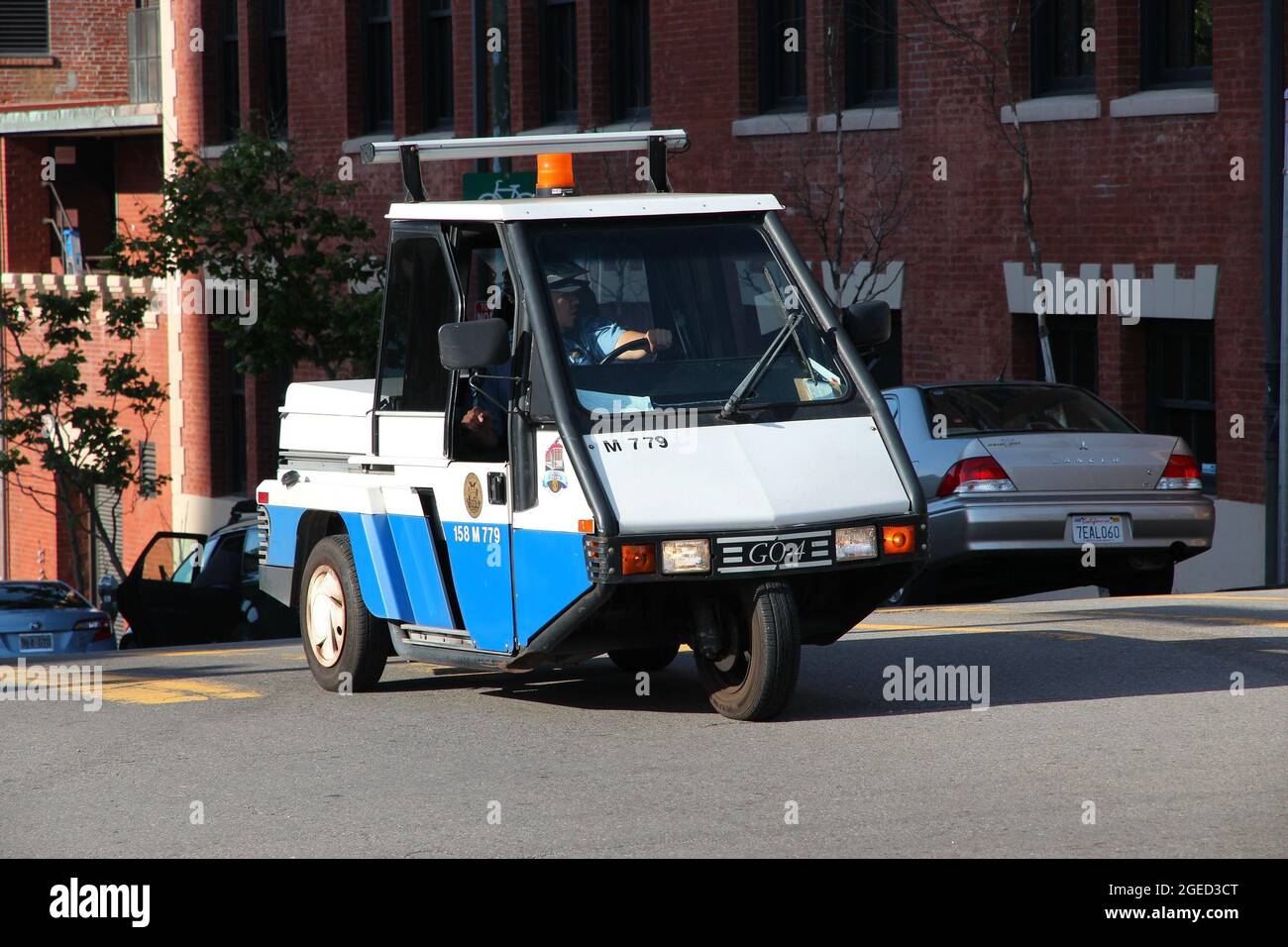
In San Francisco (and I assume many other places) the parking enforcement cops ride these little things called "interceptors"[0]. They're little more than 3-wheel motorcycles with a body around them. They don't really have much in the way of safety features, so the drivers wear bike helmets.
It's about gauging risk and determining what's likely to help. I would bet that if everyone wore helmets in cars, it wouldn't change injury/fatality stats a meaningful amount, beyond what seatbelts, airbags, etc. already do. But for bicycles (and perhaps these "interceptors", they perhaps do make a difference.
You're probably aware of other cases where people wear helmets, for example on construction sites and while riding motorbikes or indeed bicycles. A lot of people riding cars wear seatbelts. I don't understand what's supposed to be so baffling about wearing helmets in this case, as well.
Bicycle helmets are virtually useless when involved in a multi-vehicle collision (e.g. a cyclist and a car driver). They are typically tested IIRC for speeds of up to 12mph onto a static surface from a height of 2m or so. The forces involved when colliding with a motorised vehicle are orders of magnitude greater.
and what percentage of bike accidents are collisions with cars? I've had a few bike accidents, none were head on collisions, mostly unexpected obstructions, gravels like ball bearings and one time a love tap by a car where I got a bruise and the driver got yelled at for not paying attention.
Because car drivers, unlike ebike riders and buggy drivers, are surrounded by a metal cage built to some level of crash protection standard. Car drivers also largely wear seat belts that prevent them being thrown through the air and impacting trees, kerbs, etc.
A closely related argument is that we should encourage shower helmets due to the chances of head injury whilst showering. Also, ladder helmets and light-bulb changing helmets.
Bikes, especially e-bikes, go routinely around 40mph and share the road with huge chunks of metal (cars) that go even quicker. You head will cave in if you hit the ground or get hit by a car at these speeds. You really don’t see the need for a helmet?
Drivers in modern cars also wear “helmets” btw. The car (roll cage and airbags) is specifically designed to fulfill the exact same purpose.
Cycle helmets are not designed to cope with those kinds of impacts and are mostly useless for typical traffic collisions with other vehicles. The safety standards are designed around a cyclist falling off at up to 12mph.
Which is is a perfectly fine design goal for hitting the ground, because riding faster does not increase the speed component orthogonal to the road surface. That's always roughly like dropping while standing still, slightly more when the crash starts with some upwards tumble.
The same it true for motorcycle helmets, effective protection for going into a brick wall at speed would require helmets with a crumple zone thickness approaching the length of a car crumple zone. Get ready for hearing the term ludicrous speed a lot when wearing that.
Yes, I agree that cycle helmets are appropriate for non traffic collisions. The problem is that mainstream media and popular culture like to portray them as essential for riding in traffic despite them not being suitable for that. It's largely victim blaming.
If 2 tons of steel hit you at 40mph+, you will die. You can be dead wearing a helmet if you wish.
Trying to find a way out of that situation is futile, you're trying to fight the laws of physics. The solution is to not be there in the first place, not trying to add 5cm of padding on top of your head.
The way to do so, at policy level, is building a network of dedicated cycling paths physically separated from motor traffic and protected intersections where bike traffic is priviledged over motor vehicles.
But regardless of the state of infrastructure, recommending helmets to cyclists has overwhelmingly negative consequences. The minor safety benefits pale in comparison to the damage done by the reduced amount of bicycle trips caused by the friction introduced by needing a helmet. Cycling has such immense benefits that virtually any reduction in trips due to helmet advocacy will have devastating health outcomes. This isn't a matter of comparable numbers that can be discussed either, we're talking orders of magnitude here.
If the above is unconvincing, some research follows (quotes presented to be read in order):
[1]: "Cycling UK wants to keep helmets an optional choice. Forcing - or strongly encouraging - people to wear helmets deters people from cycling and undermines the public health benefits of cycling. This campaign seeks to educate policy makers and block misguided attempts at legislation."
[2]: "Even if helmets are 85% effective (and assuming q = 0.5 as above), the number of cyclists’ lives saved will still be outnumbered by deaths to non-cyclists if there is a reduction in cycle use of more than 2%"
[3]: "Enforced helmet laws and helmet promotion have consistently caused substantial reductions in cycle use (30-40% in Perth, Western Australia). Although they have also increased the proportion of the remaining cyclists who wear helmets, the safety of these cyclists has not improved relative to other road user groups (for example, in New Zealand).
The resulting loss of cycling’s health benefits alone (that is, before taking account of its environmental, economic and societal benefits) is very much greater than any possible injury prevention benefit."
[...]
"Evidence also suggests that even the voluntary promotion of helmet wearing may reduce cycle use."
[...]
"Even with very optimistic assumptions as to the efficacy of helmets, relatively minor reductions in cycling on account of a helmet law are sufficient to cancel out, in population average terms, all head injury health benefits."
[4]: "With 290 cyclist fatalities in 2022, cyclists were the largest group of road casualties. Of these, most were killed by collision with a vehicle (206 bicycle deaths)."
[5]: "Cycling levels in the Netherlands have substantial population-level health benefits: about 6500 deaths are prevented annually, and Dutch people have half-a-year-longer life expectancy. These large population-level health benefits translate into economic benefits of €19 billion per year, which represents more than 3% of the Dutch gross domestic product between 2010 and 2013.3.
The 6500 deaths that are prevented annually as a result of cycling becomes even more impressive when compared with the population health effects of other preventive measures. In an overview, Mackenbach et al.11 showed that the 22 new preventive interventions that have been introduced in the Netherlands between 1970 and 2010 (e.g., tobacco control, population-based screening for cancer, and road safety measures) altogether prevent about 16 000 deaths per year.
Still, our results are likely to be an underestimation of the true total health and economic benefits."
[6]: "Riding a bicycle to work every day reduces the risk of premature death by 41% (risk of dying from heart disease: -52%; risk of dying from cancer: -40%)."
[...]
"Regular cycling boosts physical fitness and compares to 1 to 2 weekly gym sessions."
[...]
"Bicycle use not only improves physical health, but also has a positive impact on mental health and subjective well-being."
I used to live in NY state. I remember reading about this group of motorcyclists protesting the states motorcycle helmet law by riding around at rallies helmet-less. Their argument against helmets was the usual “I’ll be dead anyway with or without a helmet” or “I’d rather be dead than a cripple.” Then at one of these rallies, while riding at fairly low speed, this guy hit a rock or oil patch or something, dropped his bike, hit his head and died. Medical experts agreed if he was wearing a helmet he’d almost certainly be fine.
And chances are he was dead without his head being caved in. That's simply the wrong model when talking about head protection from traffic dangers.
Where the helmet protects from small but fast-moving masses (weapons, falling rock or tools), protection of the skull structure can absolutely be the helmet's job. But where the danger is hitting a large mass like a car or a planet, the acceleration involved is the dominant problem and it will get you long before "caved in". Helmets provide a bit of a crumple zone that can certainly be very valuable, but at impact speeds that would be "cave in" without the helmet, even a crumple zone precisely tuned to exactly this impact (chances are that would be a wildly suboptimal configuration for many many other impacts) would fail to flatten the acceleration curve to survivable levels. "handsome corpse" wasn't aimed at helmets in general, it was aimed at the mental model of protecting from cave-in.
Because the added weight at high velocity would result in more severe whiplash. This, wearing helmets in a car could actually increase rather than decrease injuries following a crash, especially in children who wear harnesses. This is the reason why HANS devices are used in racing.
Because you're in a steel cage surrounded by air bags. It's about statistics, not "perfect safety". Head injuries per bike rider are far worse in bike accidents (and motorcycle) than in cars. It's about being reasonable but not being a bubble boy.
Your car will most likely have an explosive charge inside the steering wheel that quickly inflates a cloth bag with air to cushion your head and prevent it from smacking hard against the steering wheel. They're called "airbags".
For example, if you had protective headgear guarding you the innumerable number of times you were dropped as an infant then this conversation wouldn't be necessary, but society is forced to pay the price for enabling bad faith actors asking "questions" about an extremely well researched topic that you've either chose not to do any knowledge seeking on your own for, or are willingly ignoring to postulate another topic that absolutely no one who values their time would want to discuss with you about.
Maybe someone like you SHOULD wear a helmet in a car though, so good suggestion! :)
That is a broad generalization that can't be right. I wear a helmet because I don't want to bust my head open like a dropped cantaloupe. Am I missing something here? Same when I'm on a motorcycle. I've never lived anywhere that adults -had- to wear a helmet, but kids often are required to, legally speaking.
I've had a serious head injury, though not from cycling. Hurting your limbs is painful and may cause you to lose mobility. Brain damage affects your very ego and ability to experience the world - permanently. I have a headache and fatigue as I write this comment, my eyes aren't quite focused on the text like they used to be, and I am considerably less intelligent than I was. This will probably last for the rest of my life - for most of my existence.
It's difficult to put into words just how soul-crushing it is to have your inner monologue disrupted, slowed, and impaired. To sit in a class and listen, just as you used to, yet not comprehend or learn. To sit in front of your IDE expecting to accomplish a once-trivial task, yet feel nothing but overwhelming nausea and your working memory being overloaded.
It hammers home that consciousness is not special and that we're nothing more than biological machines.
Protect that consciousness. It is precious and it is vulnerable. Wear a helmet.
What I found interesting was the jump (in Lancaster County, at least) directly from push scooters to e-bikes. Like, presumably there was a reason why regular manual bicycles weren't allowed. But e-bikes came along, and then they decided they were ok.
I get that these sorts of determinations aren't a science, and they do their best to evaluate technology based on the impact to their community, culture, and values, but it surprised me to learn that some communities that are adopting e-bikes largely limited themselves to push scooters before that.
Unless I misunderstood that part of the article (or the article just got it wrong).
I think (just from reading the article) that bikes had been allowed there the whole time, but that the geography and the distribution of settlements pushed rides just above the threshold of attractivity.
One implication of this interpretation is that even before ebikes, it would have been entirely possible (even if extremely unlikely) for someone to go ahead and explore the limits in lifestyle compatibility of lycra, Japanese/Italian groupsets and narrow tires, discover that those would have a huge impact on the practicability threshold on cycling and caused a conversion from buggies to bikes without electricity.
(the difference between a proper go-fast-bike and a lowly "comfortable" commuter are huge, it's not only the fitness. Most roadbike enthusiasts have the distance threshold they consider acceptable on a "slow bike" just as low as Joe Average, if they do a longer cycling commute it's on a bike that's closer to the ones they use to go three digit miles in a day than to the common commuter bike)
This really isn’t that surprising, each Amish community has its own rules and almost all adopt/reject rules based on how it impacts their church and relationship with god. For instance many Amish drive around trucks for work. But they’ll have rules limiting it to picking up supplies, many even have cell phones.
That said, other communities reject all forms of modern “comforts”. Medicine, cars, electricity, manufactured foods, etc.
The Amish community is pretty large, hundreds of thousands.
It’s not surprising some would adopt e-scooters.
My favorite amish interaction was asking why one had a wagon full of maybe 20 containers cheese balls. Apparently, it was allowed and their entire community loved them, but it was a 20 mile ride to town so they buy in bulk (this community usually rejected almost everything, so kind of surprising)
The scary part of this to me is biking on country roads, especially with 55mph speed limits that big pick-ups regularly blow past. I live in a rural town, and I would be terrified to bring a bike outside slower town roads.
I feel sad about this. Amish communities seemed like a stronghold of never-changing, perfectly off-grid and durably viable (also fairly humane) way of life with clear values which wouldn't fluctuate chaotically as they do in modern cities, making a remarkably sustainable society.
The first bell rang when they started using modern kitchen appliances although powered with compressed air instead of electricity.
Now they embrace electricity and electronics.
Even from the points of so few, it still seems reasonable to extrapolate and predict Amish communities will turn very different in a century or so. Perhaps they will start using smartphones the day everyone else will forget about these in favour of AR/VR goggles.
I can also understand adopting the e-bike. It doesn't look at all like a slippery slope that will lead to an automobile lifestyle--at least for the rest of the world, it has the effect of making car sales less likely, not more.
The e-bike is a symbol of degrowth, the way forward for future cities. Why shouldn't the Amish help wave that flag?
By the way (your mention of the "automobile lifestyle" guided me to this question), are they always small villages or dwelling within towns built by "normal" people? I wonder if they occasionally build their own towns and if they design them differently because of lack of automobiles.
Amish communities have always tended to changed. They just wait to adopt new technology until after it has been in widespread use among the rest of us long enough for them to see the benefits and the drawbacks. Then they decide if the benefits outweigh the drawbacks sufficiently to adopt it without harming their community.
As others have stated their use of technology has always been governed on a per community basis.
I also would not exactly feel that bad, I suspect they receive a lot more romanticizing than they deserve. A lot of these communities are pretty sad as the kids that grow up in them so not have enough education to escape them if they want.
It's easy to ridicule the Amish for their lifestyle and their roundabout solutions to the restrictions ordained by their faith, similar to some orthodox Jewish traditions. But I think there is also something honest about it. No one can lead a 100% rational life; indeed it is not obvious that would even be desirable, that it makes sense or is even possible. Effective altruism is a good example on how mislead such a notion can become. Of course one can argue about what constitutes rationality, adopt a more balanced consequentialism and avoid some of the more absurd conclusions. Anyway, I find something sympathetic about just facing some impracticalities head on.
Perhaps it is because it is a USA thing, but I do not understand the limits they talk about in the article. These Amish cannot use electricity... but they can use solar power? Why is regular electricity in their faith worse than the same energy harnessed via solar power? What is the difference from their point of view?
I think the key thing to remember is that they aren't trying to find loopholes or focused on the letter of the law with these decisions.
The rules they have are for practical reasons (whether you agree or disagree with them). It isn't as important to them whether it is perfectly consistent with the letter of the law as whether it fits with the purpose of the rule in the first place.
Which is contrasted with strict Jewish communities that take the opposite stance — the letter is what matters and there's a certain joy in finding loopholes.
Automatic elevators, timers, an odd definition of inside, pre-torn toilet paper it's all fascinating and clever.
A very interesting example of this is the eruv in Golder's Green in North London[1] which is a thin wire which apparently converts outside areas into a private space, allowing observant orthodox Jews to do things on the Sabbath they would not otherwise do. There are proposals for a couple more of these in North London.
As someone who is not religious at all I find it fascinating.
> Which is contrasted with strict Jewish communities that take the opposite stance — the letter is what matters and there's a certain joy in finding loopholes.
I think there is still something in common with the Amish approach, in that whether a theoretically possible loophole is allowed in practice often comes down to rabbinical judgement over what the practical consequences would be.
And, just like different Amish groups have different rules, different subgroups within Orthodox Judaism differ over the set of "loopholes" permitted – e.g. some Hasidic dynasties are much stricter about certain areas of halacha than others
I think you are more or less correct with regards to electricity but the rule applies more broadly to technology. Obviously, the Amish use wheels and other tools. The problem for them (and which I think a great many people would agree) is when technology ceases to serve us and we (society) become indentured to the technology. Consider all these "phone-free" movements, limited screen time, and social media detoxes. In this light, the Amish seem very much enlightened that they take many years to deliberate whether a technology is an overall positive or detriment. Going back to the use of electricity. I think probably a huge part of a grid that works at nighttime is that it definitely changes society in the sense that nightlife is all of a sudden possible. You can debate whether or not it's a positive impact to society but the impact is inarguable. People will fall on different sides of that debate.
> The problem for them (and which I think a great many people would agree) is when technology ceases to serve us and we (society) become indentured to the technology.
The Amish view of technology is a bit more nuanced than "modern technology bad". Generally, technology needs to have a legitimate purpose for the community in order to be adopted. So a grid connection would be bad as it's a connection to the outside world, and electricity on tap would encourage vices like television. But battery power, or solar power, where the purpose is simply to power your tools to make your work more efficient is acceptable. Were people to start hooking up smartphones to the solar panels and posting videos on TikTok, the opinion about the technology might change.
If you squint, solar-charged e-bikes are just removing a few middlemen. The sun grows the grass, the horses eat the grass, the horses convert solar energy into motive power.
From what little I know about the topic, the Amish are careful to only allow the change that doesn't threaten their culture. So they might have no problem with renewable energy (they have been using wind to pump water for a long time), but they might have a problem with connecting to the regular electrical grid and becoming dependent on it.
They don't like to be in debt or use credit. They don't like billing plans where you use a service now and pay for it later. They don't like being bound by contracts. Back when you couldn't get a cellphone without a contract, they didn't use cellphones. When prepaid smartphones came out, they sold like hotcakes in Amish country. They don't like to be billed for using the power grid, but owning your own solar panels is kosher.
I'm speculating here, but utility electricity involves a continuous billing relationship and dependence on an entity that most certainly does not share their values.