I was struck by the number of people pictured wearing high vis but not helmets; I suppose it might partially be because they're riding in places where pedestrians are otherwise very rare so cars are an even greater danger than usual. The article mentions:
> At the same time, helmets pose special problems for Amish women. They grow their hair long and keep it wrapped in a bun covered with a cap. For this reason, most bike helmets do not fit Amish women. Mullett said he has talked with some helmet manufacturers and encouraged them to build helmets suitable for Amish women, so far without success. For now, far more men wear helmets than women.
Seems to me that if you could make an exception/determination that ebikes were okay, it would make sense to adjust the rules around hairstyle and cap wearing as well. Not really my place to speak though.
The Amish aren't really about rejecting technology just to be luddites, but rather to about trying to preserve their traditions and culture. One of the ways they do that is to avoid adopting new things (technologies, processes, etc) until the community leadership agrees to it. There are Amish that have cars, electricity and computers because their communities have determined that those technologies are acceptable in certain situations and allowed them.
Seen that way, electric bikes may not be a big change from the regular bikes some communities already allow for transportation. Appearance is a very significant part of Amish culture though, and changing those norms just to fit a technology is exactly what they don't want to do.
Their actual goal was to own the looms (to the exclusion of the factory owners). The original Parliamentary compromise regarding the introduction of looms was that skilled weavers would get first dibs on using them. A bunch of factory owners said "Fuck that" and just started using them anyway. Parliament not only didn't punish them for breaking the law, they passed even more laws to criminalize machine breaking on pain of death so that the Luddites couldn't protest anymore. Then they made up a story about them irrationally hating machines so they could paint organized labor as regressive.
The Amish reject technology that ties them into a centralized society because they think decentralized, off-the-grid living makes you closer to God. The Luddites did not reject technology, they destroyed it as a tactic to bring capital back to the negotiating table. They're closer to the artists naming-and-shaming AI art users: few if any of them are Dunepilled[0] enough to actually want, say, a ban on computer programs that create art. What they want is protection against being economically replaced.
> The Amish aren't really about rejecting technology just to be luddites, but rather to about trying to preserve their traditions and culture. One of the ways they do that is to avoid adopting new things (technologies, processes, etc) until the community leadership agrees to it.
Neither feels right to me. The Luddites and Amish share a common thread, which is that of ownership and control and ability to set one's own course. I don't think the Luddites agreed that preserving traditions and culture was what drove them. They wanted mechanization to serve us all, to not be used to control them. They resisted the mechanization of the human spirit. The Amish have their own culture & tradition, but I think again what's afoot here is also in part about control & ownership, at least as much as it is tradition & culture.
To call this just tradition & culture ignores & skips over what's really at stake, which is control & ownership. Whether we have the ability to use technology on our own footing, or whether it is an injected force that shapes and molds us. Is tech soft and malleable, or is it hard & unyielding, forcing humanity to change itself?
I wonder if this change is economically driven: if electric vehicles and tools allow Amish to produce more, then their churches benefit from higher tithes.
To some degree yes the Amish are most likely to use modern technology in business contexts. On the other hand if economics were the sole factor they’d all have robot tractors and the other multitude of productivity enhancing tools that have been developed for agriculture that have been developed over the last 200 years.
It's interesting to me that you pose this question. I would suggest that this says more about the culture you live in than the culture the Amish live in. (No offence intended.)
My hypothesis is that you live in a primarily material culture (safe bet, since we mostly all do.) Thus most of your life decisions surround money. What can you afford, how to get more of it, how to spend less of it and so on. Again, z safe bet, since that's true for most of us in general, and is emphasised especially in the US.
Most of this is just baked in, so when we look at alternative lifestyles we can assume that they make decisions as we do. That can be a mistake simply because its hard to conceive the way others live.
For example it's common for Europeans to get over 30 days paid leave a year. In the US most shift workers get none. In Europe salaried workers work fixed hours, then go home. In the US they stay late, do emails all night, and so on.
Neither approach is right or wrong, they're just different. And it's easy to put my motivations on another group, send then see their decisions as crazy.
Gentrification and inflation are real and they are coming for you if you fall behind.
The Amish try to be self-sustaining, but it is extremely hard to not participate in modern society, especially considering healthcare. If Grandma is sick, do you let her die or do you pay $100k for cancer treatments?
If you have 7 or 8 kids, then where does the land come from to house them?
Europe is a great example of a region that hasn't had a significant technology breakthrough in decades. (I'm less familiar with healthcare tech, but most engineering products have come out of the USA and Asia). The impact is real: the pounds and euro have fallen in value to the dollar.
I've lived my whole life in a country with inflation. Its really not a big deal (to us anyway.) Wages rise with inflation to keep pace, investements take it into account ,we're not aiming for fixed-income pensions, and so on.
I know there's a generation in the US that haven't seen it before, so it's scary, but once employers get into step with it, it's really not.
Gentrification is a more complex issue, and tends to be quite local. But again it's normal for neighborhoods to revitalise every second generation or so.
Again though, your opening statement was viewed through the idea of money. And I get that you live in a world where this is the first (and often only) consideration. How might you see it differently though if you took a different primary goal?
Obviously the world you live in is the world you live in. So I'm not expecting your society to change. Rather I'm challenging you to imagine a different premise.
My understanding is inflation is scariest when you approach retirement. At this point, you should divest from high-risk investments, and relying on low-risk cash flow vehicles (bonds, HYSA, dividend stocks, etc.).
But low-risk blows up in your face if inflation jumps.
The primary goal isn't money. It is being able to live a comfortable lifestyle in the area that I want to live in and receive the healthcare that I want to receive. Money helps you achieve that goal.
In the case of the Amish, I'd imagine they have similar ideas about their future. They want to continue living as they have been living and carefully introducing modern technologies into their culture.
I am sure you can name a small number of examples that came out of Europe (Mistral, Spotify, Siemens, etc.), but the fact is the US and Asia generate way more value than Europe has in the last few decades.
We were talking about technological breakthroughs/inventions, not market cap. Plenty of technological progress and research comes from Europe. Of course China and the US have larger, higher value _market_, that's well known but Americans in particular seem to love swinging it around.
And idt it's fair to compare a couple hundred million people to four and a half billion people in the case of EU vs Asia.
I couldn't imagine a community 'leadership: telling me what to do and wear :(
Of course we in the modern world are also a bit limited in terms of what we can buy but I often make my own pretty extravagant stuff to wear. Not always appreciated by conservatives but I couldn't care less.
Ps nobody in the Netherlands wears helmets on bikes and we don't really need to. But I guess collisions with cars are more common in areas where bikes are less common. I've fallen many times but I always had my arm protecting my head in reflex even though it happened so fast I didn't even realise.
The thing is that we don't view bikes as an exercise or sports thing you gear up for but just a convenience thing you grab for the 500m run to the shop. Besides having to put it on you'd be stuck having to carry it as well.
And bikes are kinda the king of the road in Holland anyway. If you get hit by a car it's automatically their fault so they're really careful.
Hi-Viz is only useful if the driver(s) are actually looking and paying attention. There's plenty of examples of drivers hitting static objects that are festooned with hi-viz colouring and reflectives.
Bicycle helmet safety standards are generally for speeds up to 12mph and/or a static drop from 2m onto a hard surface. They are specifically not designed to withstand the forces/accelerations involved in a multi-vehicle collision.
(One of my bug-bears is when people point to a destroyed bicycle helmet and claim that it saved their life. Helmets are designed to compress and are particularly weak when subjected to tensile/shear forces. If a helmet splits in two, then it most likely wasn't being effective)
Helmets are for when they fall awkwardly; in practice, this rarely happens (disclaimer: I live in a bike friendly country). High-vis is for other traffic to see them. Motorcyclists often have both.
I half-considered getting one of those (I'm in the UK), but the initial cost was expensive and they were single-use as in they needed to go back to the manufacturer to be reset after being triggered which was an additional cost.
I'd be dead scared of false positives riding in one. That might be harmless at a speed slightly above pedestrian, but my speed range does not end there.
Slightly off topic, but I’m surprised that helmet manufacturers haven’t made more helmets for other people whose practices make wearing traditional helmets challenging (like Sikh men with turbans).
By that logic everyone in a car should wear a helmet in case of an accident.
Head trauma is a real danger in car accidents. Wearing a helmet in your car will help with any head trauma. Why don't car drivers wear a helmet?
The modern car itself, and several of its safety features, act as a fairly effective "helment".
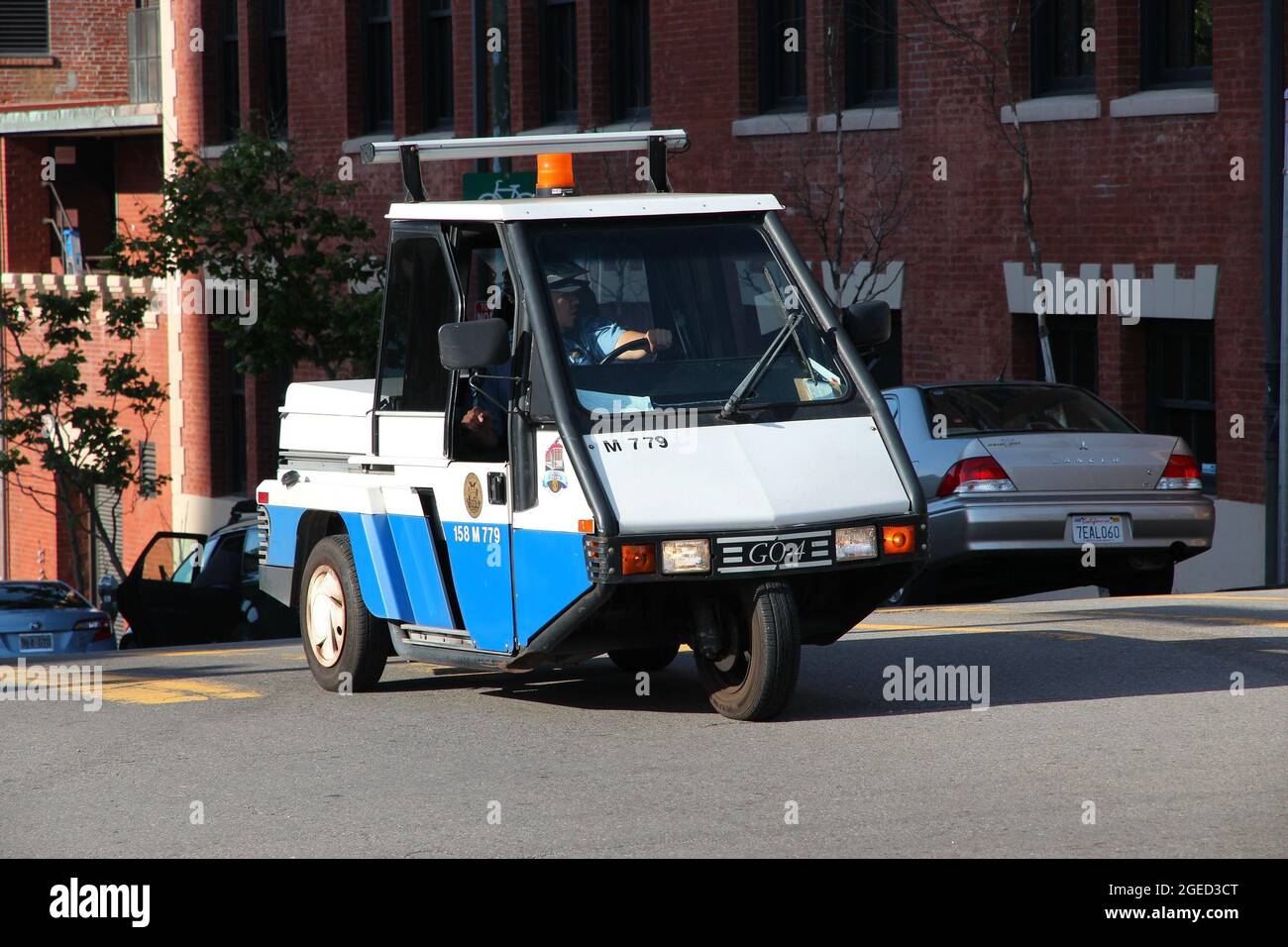
In San Francisco (and I assume many other places) the parking enforcement cops ride these little things called "interceptors"[0]. They're little more than 3-wheel motorcycles with a body around them. They don't really have much in the way of safety features, so the drivers wear bike helmets.
It's about gauging risk and determining what's likely to help. I would bet that if everyone wore helmets in cars, it wouldn't change injury/fatality stats a meaningful amount, beyond what seatbelts, airbags, etc. already do. But for bicycles (and perhaps these "interceptors", they perhaps do make a difference.
You're probably aware of other cases where people wear helmets, for example on construction sites and while riding motorbikes or indeed bicycles. A lot of people riding cars wear seatbelts. I don't understand what's supposed to be so baffling about wearing helmets in this case, as well.
Bicycle helmets are virtually useless when involved in a multi-vehicle collision (e.g. a cyclist and a car driver). They are typically tested IIRC for speeds of up to 12mph onto a static surface from a height of 2m or so. The forces involved when colliding with a motorised vehicle are orders of magnitude greater.
and what percentage of bike accidents are collisions with cars? I've had a few bike accidents, none were head on collisions, mostly unexpected obstructions, gravels like ball bearings and one time a love tap by a car where I got a bruise and the driver got yelled at for not paying attention.
Because car drivers, unlike ebike riders and buggy drivers, are surrounded by a metal cage built to some level of crash protection standard. Car drivers also largely wear seat belts that prevent them being thrown through the air and impacting trees, kerbs, etc.
A closely related argument is that we should encourage shower helmets due to the chances of head injury whilst showering. Also, ladder helmets and light-bulb changing helmets.
Bikes, especially e-bikes, go routinely around 40mph and share the road with huge chunks of metal (cars) that go even quicker. You head will cave in if you hit the ground or get hit by a car at these speeds. You really don’t see the need for a helmet?
Drivers in modern cars also wear “helmets” btw. The car (roll cage and airbags) is specifically designed to fulfill the exact same purpose.
Cycle helmets are not designed to cope with those kinds of impacts and are mostly useless for typical traffic collisions with other vehicles. The safety standards are designed around a cyclist falling off at up to 12mph.
Which is is a perfectly fine design goal for hitting the ground, because riding faster does not increase the speed component orthogonal to the road surface. That's always roughly like dropping while standing still, slightly more when the crash starts with some upwards tumble.
The same it true for motorcycle helmets, effective protection for going into a brick wall at speed would require helmets with a crumple zone thickness approaching the length of a car crumple zone. Get ready for hearing the term ludicrous speed a lot when wearing that.
Yes, I agree that cycle helmets are appropriate for non traffic collisions. The problem is that mainstream media and popular culture like to portray them as essential for riding in traffic despite them not being suitable for that. It's largely victim blaming.
If 2 tons of steel hit you at 40mph+, you will die. You can be dead wearing a helmet if you wish.
Trying to find a way out of that situation is futile, you're trying to fight the laws of physics. The solution is to not be there in the first place, not trying to add 5cm of padding on top of your head.
The way to do so, at policy level, is building a network of dedicated cycling paths physically separated from motor traffic and protected intersections where bike traffic is priviledged over motor vehicles.
But regardless of the state of infrastructure, recommending helmets to cyclists has overwhelmingly negative consequences. The minor safety benefits pale in comparison to the damage done by the reduced amount of bicycle trips caused by the friction introduced by needing a helmet. Cycling has such immense benefits that virtually any reduction in trips due to helmet advocacy will have devastating health outcomes. This isn't a matter of comparable numbers that can be discussed either, we're talking orders of magnitude here.
If the above is unconvincing, some research follows (quotes presented to be read in order):
[1]: "Cycling UK wants to keep helmets an optional choice. Forcing - or strongly encouraging - people to wear helmets deters people from cycling and undermines the public health benefits of cycling. This campaign seeks to educate policy makers and block misguided attempts at legislation."
[2]: "Even if helmets are 85% effective (and assuming q = 0.5 as above), the number of cyclists’ lives saved will still be outnumbered by deaths to non-cyclists if there is a reduction in cycle use of more than 2%"
[3]: "Enforced helmet laws and helmet promotion have consistently caused substantial reductions in cycle use (30-40% in Perth, Western Australia). Although they have also increased the proportion of the remaining cyclists who wear helmets, the safety of these cyclists has not improved relative to other road user groups (for example, in New Zealand).
The resulting loss of cycling’s health benefits alone (that is, before taking account of its environmental, economic and societal benefits) is very much greater than any possible injury prevention benefit."
[...]
"Evidence also suggests that even the voluntary promotion of helmet wearing may reduce cycle use."
[...]
"Even with very optimistic assumptions as to the efficacy of helmets, relatively minor reductions in cycling on account of a helmet law are sufficient to cancel out, in population average terms, all head injury health benefits."
[4]: "With 290 cyclist fatalities in 2022, cyclists were the largest group of road casualties. Of these, most were killed by collision with a vehicle (206 bicycle deaths)."
[5]: "Cycling levels in the Netherlands have substantial population-level health benefits: about 6500 deaths are prevented annually, and Dutch people have half-a-year-longer life expectancy. These large population-level health benefits translate into economic benefits of €19 billion per year, which represents more than 3% of the Dutch gross domestic product between 2010 and 2013.3.
The 6500 deaths that are prevented annually as a result of cycling becomes even more impressive when compared with the population health effects of other preventive measures. In an overview, Mackenbach et al.11 showed that the 22 new preventive interventions that have been introduced in the Netherlands between 1970 and 2010 (e.g., tobacco control, population-based screening for cancer, and road safety measures) altogether prevent about 16 000 deaths per year.
Still, our results are likely to be an underestimation of the true total health and economic benefits."
[6]: "Riding a bicycle to work every day reduces the risk of premature death by 41% (risk of dying from heart disease: -52%; risk of dying from cancer: -40%)."
[...]
"Regular cycling boosts physical fitness and compares to 1 to 2 weekly gym sessions."
[...]
"Bicycle use not only improves physical health, but also has a positive impact on mental health and subjective well-being."
I used to live in NY state. I remember reading about this group of motorcyclists protesting the states motorcycle helmet law by riding around at rallies helmet-less. Their argument against helmets was the usual “I’ll be dead anyway with or without a helmet” or “I’d rather be dead than a cripple.” Then at one of these rallies, while riding at fairly low speed, this guy hit a rock or oil patch or something, dropped his bike, hit his head and died. Medical experts agreed if he was wearing a helmet he’d almost certainly be fine.
And chances are he was dead without his head being caved in. That's simply the wrong model when talking about head protection from traffic dangers.
Where the helmet protects from small but fast-moving masses (weapons, falling rock or tools), protection of the skull structure can absolutely be the helmet's job. But where the danger is hitting a large mass like a car or a planet, the acceleration involved is the dominant problem and it will get you long before "caved in". Helmets provide a bit of a crumple zone that can certainly be very valuable, but at impact speeds that would be "cave in" without the helmet, even a crumple zone precisely tuned to exactly this impact (chances are that would be a wildly suboptimal configuration for many many other impacts) would fail to flatten the acceleration curve to survivable levels. "handsome corpse" wasn't aimed at helmets in general, it was aimed at the mental model of protecting from cave-in.
Because the added weight at high velocity would result in more severe whiplash. This, wearing helmets in a car could actually increase rather than decrease injuries following a crash, especially in children who wear harnesses. This is the reason why HANS devices are used in racing.
Because you're in a steel cage surrounded by air bags. It's about statistics, not "perfect safety". Head injuries per bike rider are far worse in bike accidents (and motorcycle) than in cars. It's about being reasonable but not being a bubble boy.
Your car will most likely have an explosive charge inside the steering wheel that quickly inflates a cloth bag with air to cushion your head and prevent it from smacking hard against the steering wheel. They're called "airbags".
For example, if you had protective headgear guarding you the innumerable number of times you were dropped as an infant then this conversation wouldn't be necessary, but society is forced to pay the price for enabling bad faith actors asking "questions" about an extremely well researched topic that you've either chose not to do any knowledge seeking on your own for, or are willingly ignoring to postulate another topic that absolutely no one who values their time would want to discuss with you about.
Maybe someone like you SHOULD wear a helmet in a car though, so good suggestion! :)
That is a broad generalization that can't be right. I wear a helmet because I don't want to bust my head open like a dropped cantaloupe. Am I missing something here? Same when I'm on a motorcycle. I've never lived anywhere that adults -had- to wear a helmet, but kids often are required to, legally speaking.
I've had a serious head injury, though not from cycling. Hurting your limbs is painful and may cause you to lose mobility. Brain damage affects your very ego and ability to experience the world - permanently. I have a headache and fatigue as I write this comment, my eyes aren't quite focused on the text like they used to be, and I am considerably less intelligent than I was. This will probably last for the rest of my life - for most of my existence.
It's difficult to put into words just how soul-crushing it is to have your inner monologue disrupted, slowed, and impaired. To sit in a class and listen, just as you used to, yet not comprehend or learn. To sit in front of your IDE expecting to accomplish a once-trivial task, yet feel nothing but overwhelming nausea and your working memory being overloaded.
It hammers home that consciousness is not special and that we're nothing more than biological machines.
Protect that consciousness. It is precious and it is vulnerable. Wear a helmet.


> At the same time, helmets pose special problems for Amish women. They grow their hair long and keep it wrapped in a bun covered with a cap. For this reason, most bike helmets do not fit Amish women. Mullett said he has talked with some helmet manufacturers and encouraged them to build helmets suitable for Amish women, so far without success. For now, far more men wear helmets than women.
Seems to me that if you could make an exception/determination that ebikes were okay, it would make sense to adjust the rules around hairstyle and cap wearing as well. Not really my place to speak though.