The Looker is quite possibly the greatest parody ever executed in a video game. It creates the same kind of "ahah" moment that games like The Witness do, but in a way that really pokes fun at the level of pretentiousness those games tend to indulge themselves in.
It's the gaming version of Galaxy Quest: a parody that is not only great when it stands by itself, but is satirical in a way that shows they are genuinely big fans of the source material.
(Though perhaps unsurprisingly, Blow has only once mentioned The Looker, saying he hates how it devalues his art, and now refuses to talk about it ever.)
> Blow has only once mentioned The Looker, saying he hates how it devalues his art, and now refuses to talk about it ever
This is so fascinating to me, because when I really get a piece of creative art, like I thought I did with both Braid and The Witness, I usually feel like I get some insight and empathy with the person who created it. Yet every time I read or hear from Jonathan Blow ... I do not feel that. So, I guess I've been challenged by art again, hooray!
He was focused on creating a very particular feeling of epiphany as an artistic statement, and I think he succeeded at that. Is the game not especially fun? Is it perhaps overlong? Probably? But I can think of very few, if any, games that provided the very particular feeling that The Witness provided in those moments that I felt it -- the feeling of the world opening up with new possibilities and interpretations.
Yes, I agree with this - as an expression of learning by wordless doing it was a really profound experience. The ending video of real life was great, reminded me of when I played a lot of Katamari and started seeing the whole world as things to roll up. I share the sentiment in these comments about Blow himself, but The Witness is a great game - though I get why people don’t like it: it’s a slow burn and requires a tolerance for pretentiousness. I don’t feel it was too long, it was as long as it needed to be, it’s just a big game
I thoroughly enjoyed The Witness, but it nearly collapsed under the weight of its own pretentiousness. Especially to your point, what counted as a "narrative".
They say The Looker is made for two kinds of people: if you loved The Witness, you'll love The Looker, and if you hated The Witness, you'll love The Looker.
It's a pretty short game - a couple of hours, if you don't spend hours and hours stuck on one of the puzzles. (just look up a walkthrough at that point - the game's not so awesome to be worth spending hours stuck)
I did not notice the environmental puzzles, even after the obvious one at the top of the mountain looking down. I didn't get that that wasn't a one off. Someone had to point them out. I've had other friends who also missed that. It's arguably the game's single biggest reveal / surprise. It was pretty amazing!
That said, only found maybe 20 of them and was not compelled to keep looking for all of the rest.
Interested to play this but I think the trailer does it a huge disservice. Just a barrage of voice clips and no real structure to it. I think it would help the game a lot if they replace that trailer ASAP
This looks to be the first of Jon Blows games to put writing front and center, so I wonder if the clunkiness goes beyond the trailer. That's not really his forte.
It's been about 15 years since I played it, but I recall the writing in Braid being memorably shallow, clumsy, and pretentious (with the grand twist at the end being that they guy who spent the whole game acting like a clingy stalker was actually a clingy stalker this whole time).
The actual story wasn’t anything special, but I thought how it told the story through mechanics was really well done. It wasn’t the first to do that but did it a larger scope than anything else at the time.
I very deliberately did not say anything about my opinion about the quality of writing in Braid (and I think replaying it again wouldn’t do it any favors) ;)
But I do think that the writing was fairly central to the intended experience and design of the game.
Not really, the writing is sectioned away from the gameplay and easy to skip over unread without missing anything relevant to the main event, the puzzles. It's not good but its unobtrusiveness made it easy to forgive. Judging from this trailer the characters will be yapping to themselves and each other during gameplay though, so it had better be well executed, especially if they end up talking a lot.
I agree, a trailer should focus on emotional reaction, not a simple display of features or quirkiness (1400 puzzles,10 years of dev). Besides, the voices and writing are generic and maybe even AI generated. The witness had a really good promotion canpaign beautiful and intriguing.
> not a simple display of features or quirkiness (1400 puzzles, 10 years of dev)
I think a 'number of features' metric can work but only for players that already know and like your game, where an expansion with 'Five exciting new areas' is understood as something that they'd enjoy, and I agree it feels odd for a new IP.
Similarly, saying how many years it took isn't remotely a selling point for a new player. If you'd been following the development process then you probably wouldn't care, and if you hadn't you also probably wouldn't care.
It does seem awkward to have to design a trailer for a pure puzzle game, something that essentially relies on things going on inside a player's mind for fun, which by definition won't be visible.
Baba Is You did have something you can show potential players, but I'm not sure there's a trailer that could convey The Witness' 'Oh, I wonder if I can...' moment as it's a very internal experience that comes from playing enough to get to that point.
The Witness was, however, visually beautiful (IMO) and its symbol-based language let the trailer keep an element of mystery and intrigue. Order of the Sinking Star, while potentially also a fantastic puzzle game, seems to not be able to hide anything by nature of it being very clearly a Sokoban-like. Even if there are as-yet-unseen depths to how it treats the Sokoban format, the trailer needs something to work with, and while I think it also looks lovely it perhaps doesn't have the The Witness visual appeal or mystery to draw people in.
Blow falls into a classic engineering mistake of marketing the challenge or effort to make something (audio logs everywhere) and not the end experience.
Note that when masters like Steve Jobs do it, they mention it very quickly, or they mention the ideals of craftsmen ship, rather than the actual process.
Essentially Braid Anniversary edition. Huge effort for someone to just say “oh so just Braid Remastered?”
In general from his streams you learn that so much goes wrong during the slog that is video game development. Hire failures. Contractors billing $$$ and writing 1-2 LOC. Devs rage quitting. Platform optimization. Even a suicide (not just an employee but someone close). They do all this work and dropped the ball on marketing despite betting the future of the company on its reception, but even failing that I think it was clear to a normal person (which can be hard to reach out to and interact with) that there was no appetite for this game.
When I saw the trailer in my YouTube feed I immediately thought it was an ad for those trash mobile games. Watching it didn’t really change my opinion either. I don’t actually want that to come across in a disparaging way - but it was just the vibes it gave off.
Leans center-right. Candid. Publicly supported Trump. Other stuff that just makes him a normal person circa 90s but really turns some people off in 2025.
He mentioned in a recent interview the trailer ended up getting rushed due to complexities working with the companies who edited it and the conference timeline, and that he is also somewhat unhappy with it.
I'm getting "bring your adventure" vibe, similar to The Witness.
Take Thomas Was Alone for example - seemingly simple platform puzzle game with deep and engaging story where you're more interested about characters than new mechanics and puzzles.
In contrast The Witness could be scraped to core puzzles and released as an iPad game for $5.99, but the whimsical island and scattered pseudo intellectual voice clips make it so much more giving you opportunity to pause and think about life.
This seems very similar. A sokoban puzzle game with an entirely optional plot line that leaves a lot for interpretation by the player.
With Blow the devil is simultaneously in the details and at the meta level.
For example in the Witness, which I consider one of the best puzzle games ever made, you get a fairly simple core mechanic, but the game builds upon it in very interesting ways. It feels like a journey of learning and always challenges you in some novel way at each step. There are also several revelations along the way, where you discover new layers on top of the core puzzles.
I would expect that this new game will feature similarly careful design.
I enjoyed the Witness for a while but I bounced off it pretty hard in the Mountain. It wasn’t until I watched a let’s play on YouTube that I learned there was a film room, a hidden cave complex under the mountain, a time trial, and other optional secrets. I can absolutely understand a certain type of gamer liking this but for me Talos Principle (both 1 and 2) is peak puzzle genre.
That said I’ll probably buy this game if it comes out next year.
I found them quite boring since they are all repetitions on the same theme - just drawing lines on a square. It could have been a mobile game. The world doesn't feel connected to the puzzles, and the exploration aspect of it could have been a completely separate game. It feels like two games glued together, which is IMO not a good design.
It's also not a game that's very demanding from a technical performance perspective, and really has very limited numbers of active entities / animations, so why should I care about his opinions on game architecture or anything else?
He hired a level designer who also wrote a Sokoban game. (Can’t remember the name, but it was free and web-based, IIRC.) That game had some really great, unique ideas in it, and I’d be shocked if the new Blow game was bog standard.
It was Jack Lance, who wrote Enigmash. Tragically, he died in 2023 at the age of 25. Jack Lance superlatively creative. I cannot find the words to express how much the world lost. I do not know of a finer puzzle designer.
interactions between the various mechanics in the games likely yield countless surprises, and let you build something considerably more elaborate than thesum of its parts..
The Puzzle Boy / Kwirk series of games is Sokoban-based, but has 3 different mechanics on top of that: turnstiles, pits (that can be filled by blocks), and blocks larger than 1x1. One of the things I love about it is that, each mechanic is interesting on its own, and each combination of mechanics results in levels with very different feels. Lots of puzzles with a bunch of mechanics try to throw tons of them into each level, and each level ends up feeling very samey. But judicious use of combinations can lead to a lot of interesting variety.
I’m a fan of Alan Hazelden and Draknek’s work but stating upfront that he a) wasn’t involved with the work directly but b) agreed for it to be used years ago, while then going on to write what seems to read as a light hit-piece for Blow himself, and then using that to launch into a point about how his politics and Blow’s don’t align (not relevant for puzzle game progeny) feels like more like him using the trailer for Blow’s game as a trampoline for his own personal beliefs and politics.
He also used the same thread to mention his own grant fund while not acknowledging that Thekla (Blow’s company) also has (or had at some point) a similar scheme [1]
Meanwhile the various accusations about Blow’s politics beliefs are mysteriously missing, or at least seem to be large extrapolations from other Twitter comments also not cited. Is there something in the thread I missed?
>Meanwhile the various accusations about Blow’s politics beliefs are mysteriously missing
He sort of went mask off during COVID, so I believe it. I also believe Blow is a smart dude and would try to erase that history right before a PR rally for his game.
I'm not even on Twitter but I hear about such events in the gamedev scene for years.
Also not on Twitter and try hard to avoid the easy source-less Internet drama, though I recall some comments about the vaccines being rushed out and not going through the standard trial processes and periods.
It doesn’t seem untrue, though given the environment at the time justified, but that comment was extrapolated to “He’s a hard-right anti vaxxer”. No citations of my own though, so this is just memory.
Either way, this is why I try to stay off Twitter.
You are picking a small comment among a mountain of them and giving the most charitable possible interpretation of it. Strange for you to join conversation to defend the guy as you admit you have no sources to cite.
A mountain of comments that you or others are able to provide, I’m sure? You’re right, I don’t have any, I’m simply asking others that are making bold claims about so-called extremist views to provide appropriately sized sources.
> The funding for underrepresented creators was a condition of my involvement in this project, so doesn't represent his values so much as mine. He was at least willing to do it though, which I'm not sure he would be today. (https://mastodon.gamedev.place/@draknek/115713018435458495)
Seems like this was all sorted out by early 2019 - and nearly 7 years have passed since! Plenty of time for a person to change from somebody you'd be happy to associate with to somebody you might not.
> Some people have mentioned they couldn't tell from this thread whether these games are used with permission. For clarity, yes, we agreed to this in mid 2016 and signed a contract in late 2018/early 2019. (https://mastodon.gamedev.place/@draknek/115707937686651789)
> The funding for underrepresented creators was a condition of my involvement in this project, so doesn't represent his values so much as mine. He was at least willing to do it though, which I'm not sure he would be today.
Interesting, and thanks for the sources. I was under the impression that it was the same fund as that announced in 2010 [1] but the date in [2] plus the apparent timeline does align.
"I'm not sure he would be today" is a strawman and just Hazelden's own current views of Blow, but I doubt there's going to be a direct quote (or even better, a new grant from Thekla) to back it up. But yes, 7 years is a long time and the political landscape has changed "somewhat".
That specific quote feels to me like a strange one to complain about, given that it's so obviously his own subjective opinion. Even if you're English, perhaps inclined to employ this sort of phrasing to state something that you are certain is incontrovertible fact (and will be so to everybody listening), the subjective nature has hardly been downplayed!
> These games are the starting point, but the bulk of the game is new puzzles combining mechanics from different games together.
> I made two free games which were later licensed to be used and remixed in this project.
Seems indeed to be the case. Blow designed (I guess) the mashup and "composition" if you will, but the puzzles themselves have all been designed and licensed by others, so seems the title of the HN submission and article is wrong. Blow didn't design these puzzles at all.
We don’t know that, AFAICT (after reading the Ars article and the Bluesky post). Some of the puzzles are probably reused, and other new ones using the same mechanics may have been written. I’m not sure why you’d so confidently state “Blow didn’t design these puzzles at all”… do you have something against him personally?
The license was for the puzzle mechanics. Probably a few of the tutorial puzzles are the same, but Blow would not copy paste puzzles themselves. That would be both financially and artistically silly.
I don't know why you just handpicked the covid trutherism without quoting the full thing, here the full quote from the link above:
> Additionally, in recent years it has become increasingly clear that Jon’s beliefs/priorities and mine are not aligned. He’s adversarial to people talking about privilege and representation, is dismissive of diversity efforts, has dabbled in covid trutherism, and is pro-MAGA.
Here the post after just for a full picture
> I believe Trump is a self serving authoritarian who's dismantling democracy, trying to make trans people illegal, and wanting to set up concentration camps for immigrants - whereas Jon in February called him "the best President we have had in my entire life".
I left a link to the exact post I'm referring to with the whole thread available for context.
And I didn't include the whole thing, because it doesn't change my point which is that IMO BSky people are insufferable. A game is released (which in part includes their work if I understand it right) and they can't help themselves and make this about Trump.
I'm sure I'd have the same opinion if I saw what's happening in Truth Social. These echo chambers are not good.
I think when politics are normal, this is a fine position…. Don’t really care if the author is no new taxes vs expanding safety net.
But, politics have become much more extreme. Imagine your wife or friends parents being deported. It’s absolutely sensical to not support people that are loud about hurting your loved ones.
Does that change how good/bad the game someone releases is? Don't get me wrong, being obviously anti-scientist isn't that great if I absolutely have to judge them, but I'm not sure if that has any impact on how fun a game is.
If I'd stop consuming stuff from people/organizations I disagree with politically, I literally would have to move into a cave and start my own hunter-collector society from scratch. Is this really how others make decisions in their daily lives?
Yes, this is how I make decisions, but it also depends on the category of decision. E.g. in entertainment, there's too much content available to care about one specific author / creator / etc (this also applies to "console exclusive" games and platform-exclusive TV shows). In this particular case, I vaguely recall Blow making some comments (pre-COVID era IIRC) that sounded too asshole-y / high-horse-y that I no longer seek his opinions on things and try to stay away from his content. I still have bazillion technical articles available to read and plenty of video games to play.
I enjoyed Braid and this revelation doesn't change that, but there's a lot of entertainment and it's easy to not support someone who has views (or at least doesn't express them publicly) that conflict with my own personal values.
I don't particularly go hunting for information about artists, studios, etc, to find out if I agree with them. I just happen to no longer like their stuff when I find out things I don't like.
It's not "how I make decisions" but more just something that affects my taste for things.
> I'm not sure if that has any impact on how fun a game is.
It might if the game has a more-than-perfunctory story, because authors often incorporate their political or religious beliefs into their stories. (This is usually a good thing: most of the novels that people love would be nothing if stripped of those themes.)
It's unfortunate that The Good Scott Adams occasionally gets mixed up with The Evil Scott Adams. It's so ironic that they share a name.
Many people know who the The Evil Scott Adams is, because he's such an unrepentant attention starved troll who is notorious not only for making a sock puppet to praise and flatter himself as a genius on internet forums, but for his obsessive unvarnished hateful bigotry, racism ("blacks are a hate group"), misogyny, conspiracy theories, anti-health-care-for-poor-people ideology, and Trump boot licking, and he obsessively infuses his MAGA religion into everything he says and does. Enough said.
At the opposite end of the spectrum is the Good Scott Adams, a pioneer of the Adventure game genre, who is devotedly Christian, but in the kind, uplifting, well meaning, Jimmy Carter kind of way. He's a really nice guy, who did lots of quality groundbreaking work!
He didn't infuse his original games in the 70's and 80's with ham fisted Christian themes or any kind of bigotry. And he did a Bible based game in 2013, but it was clearly labeled as such, not trying to sneak religion in through the back door.
Somebody asked him about his faith, and he sincerely talked about his religion, but didn't evangelize or anything like that, he just talked about himself when asked.
To piggyback on MPSimmons’ question, have you played any of the interactive fiction from the 1995 revival on?
I read in your interview that you consider your company Clopas as a ‘company of Christians’, rather than a ‘Christian company’, and that you make games “[which] God can use in His glory to uplift people..”
Can you discuss more about what ‘uplift’ means to you, and how it’s reflected in your games? What’s an example of a non-uplifting game/mechanic?
I’m not a Christian, but I find this idea a fascinating one. My mind first goes to something like RDR2, which while perhaps not uplifting in the traditional sense, reminded me of the awe of natural beauty (or God’s creation, if you prefer). Or do you mean more like - the game somehow inspires the player to be a better person, for various definitions of ‘better’?
Thanks for taking the time today!
ScottAdams on Nov 24, 2021 | parent | next [–]
You raise execellent questions. Thanks for asking!
To me uplift means to leave the player in a better state than when they started.
To bring them closer to God's Glory and plan for their life. To see the Universe and as an incredible place to be and to see Life as an incredible gift from our most awesome and loving Creator.
I am looking forward to an eternity of exploration, discovery and insprired creation due to the agency of my savior and friend Jesus.
ScottAdams on Nov 24, 2021 | parent | prev | next [–]
I did miss your first part of your questions and appologize.
In most cases I have not played most IF that is out there. Though Myst stands out as an incredible exception to that. But it of course was mostly non-verbal and delight to eyes.
Part of the reason of not playing many is a reticence to accidentally steal a puzzle idea (via absortion as it were) and the other is simply I have way more fun writing, coding and designing :)
Good stuff. I followed the link to Good Scott's wiki page and learned he helped out on a text adventure as recently as 2018. That's pretty interesting.
It doesn't, but historically a lot of the reasons people consume art is due to fashion, and art is a way to put you in in and out groups.
So naturally if someone has different political beliefs, or has went too "commercial" people suddenly have to change course. Being a good game/book/song won't have anything to do with it
Separating the art from the artist is a long and old debate.
I personally can’t watch Roman Polanski’s art, the classic and easy example. You can be a great movie producer, pedophilia and rapes are big no-no to me. But not to everyone apparently.
For the non vocal people believing in pseudoscience and fascist propaganda, I can close my eyes more easily. I don’t want to know. I can guess sometimes but I won’t check. As soon as they become vocal, it kills the art for me. I can’t enjoy art from people against my values, me, and my friends and family.
One of the important elements here is the extent to which materially it matters. If I buy a book Lovecraft wrote a hundred years ago the money isn't going to end up diverted to support the "patriots" who want to intimidate my neighbours, whereas when I buy a Harry Potter box set for a relative you can bet that Rowling's share will help fund "Gender Critical" movements trying to make life worse for some of my friends and colleagues...
For books particularly I can totally buy Death of the Author, what I think I read might be entirely different from what the author says they intended, which further nobody can prove is what they actually intended. For that last for example I do not for one moment believe Vernor Vinge that he "Didn't know" what Rabbit is in "Rainbow's End". It's an AI. Maybe Vinge doesn't intend the book as a Singularitarian Catastrophe (you can argue the book thinks it's about avoiding such a catastrophe) but I don't see any way to interpret it where Rabbit isn't a super-human AI.
You're conflating whether one should feel guilty for supporting an author, and whether the author's speech outside a work matters to understand its intended meaning.
The latter is the actual Death of the author, the former is usually called Death of the author by people who want to separate themselves from the authors they know they can be judged for supporting.
I think my point was distinct from naming this idea (Death of the Author). It wasn't about guilt it was about consequences and those are distinct things.
Also, AIUI Death of the Author is not about whether their beliefs mattered to understand the intended meaning, but instead whether "intended meaning" is even a thing anyway. No need to understand it if it doesn't exist. I prefer in other contexts not to try to guess intentions when I can instead look at the effects and it seems to me our law and practice agree.
Notice for example that while proving attempted murder requires that you wanted the victim to die, murder does not. The fact that they are dead satisfies this aspect of the crime, you aren't innocent of murder just because you didn't intend that the victim would die.
> "you aren't innocent of murder just because you didn't intend that the victim would die."
You might be; from the UK's Crown Prosecution Service guidance website[1]: "Involuntary Manslaughter. Where an unlawful killing is done without an intention to kill or to cause grievous bodily harm, the suspect is to be charged with manslaughter not murder.". From Wikipedia[2]: "In English law, manslaughter is a less serious offence than murder."
The GBH (Grievous Bodily Harm) is crucial there. The intent only needs to be GBH which is way easier to prove, for example weapon use. The prosecutors don't need to prove intent to kill, the death is evidence that you killed somebody (except in the rare cases they can't produce a corpse, for which they have to do more work)
What if there is no GBH intent either? What if you are just being negligent or careless, like speeding while driving thinking you are a better-than-average driver and won't crash, or if you are not speeding and someone runs out in front of you, or if you are throwing roof tiles off a roof as you remove them while thinking people will see and hear what you are doing and walk around the pile, and you end up killing someone?
The death is evidence that you killed somebody, but you can still be "innocent of murder" (and guilty of manslaughter instead. In the UK). That's why there are so many varieties of manslaughter, to determine how culpable the person is, whether they were negligent, whether they were comitting another crime, etc.
I haven't played any of these games, but "explains otherwise" seems to be a misrepresentation given that the commenter you linked is saying himself that Blow's game combines ideas and rulesets from several other previous games.
Elsewhere in the arstechnica comments you linked
> But, uh... this isn't a "Linus Torvalds is a jerk" sort of situation. "Controversial" undersells just how outlandish and inappropriate Blow's views are. Blow is a full-bore fascist sympathizer who also doesn't seem to think that women have any role to play in his profession.
What's going on on these platforms? Is there any serious evidence to the strong claims?
It seems that the "covid trutherism" or "spreading covid misinformation" claim is unjustified. Here's Blow's original tweet:
> If a state entity does an oopsie in a lab, then forces its citizens to undergo an experimental treatment because of the oopsie, while suppressing news of side effects, and also denying that the oopsie is anyone's fault ... that's just abusive?
Unfortunately Blow was unwilling to come out and state his position here, relying instead on innuendo, so we have to kind of guess what he was trying to say. I interpret him as making four claims here:
1. The COVID-19 pandemic originated in a lab leak.
2. Some Chinese people were forced to accept experimental vaccinations.
3. The government of the PRC suppressed news of the side effects of the vaccines.
4. The government of the PRC worked to prevent investigations into the cause of the pandemic.
Claim #4 is plainly true; the WHO and several other countries have protested this at great length.
Claim #2 probably depends on your threshold for "experimental" and "forces". https://en.wikipedia.org/w/index.php?title=Sinopharm_BIBP_CO... explains that emergency vaccination was available in China in July 02020, and there are plausible claims that Chinese state employees and students traveling abroad were required to take it. This was before results were in from clinical trials, which I think qualifies for most people's definition of "experimental"; the WHO wouldn't add it to its list of authorized emergency vaccines until May of the next year.
Claim #3 seems almost guaranteed to be true, but I don't have direct evidence. The government of the PRC routinely suppresses news, and there are numerous well-documented instances of this happening in connection with COVID, and there are always some subjects in clinical trials of vaccines who have major health problems such as death which may or may not be caused by the vaccine. BBIBP-CorV seems to have been, in the end, pretty safe, but it seems inconceivable that there weren't at least some news of people dying or having terrible health problems after receiving it which were deleted from Weibo or other media ("suppressed"), and that these deletions were carried out because of state policy of the PRC.
Claim #1 seems like the most debatable one, but even that isn't an open-and-shut case. At the time, the lab-leak case was fairly weak, and it certainly hasn't been proven, but it hasn't been disproven either; see https://www.astralcodexten.com/p/practically-a-book-review-r... for an extensive summary of the debate. Because of the truth of Claim #4 it seems unlikely that it will ever be disproven.
More generally, I find deplorable the polarization on partisan political grounds of fields like puzzle games, genetics, and quantum physics. Artistic development, understanding the world, and extending technology are necessarily collaborative endeavors, and rejecting Blow's games because he criticizes the Chinese government seems akin to refusing to use the Schrödinger equation because Schrödinger sexually victimized teenage girls.
I think you are taking a very charitable view here - the tweet immediately before the one you quote is clearly talking about the US vaccine mandate (not China).
> There's a weird disconnect in this vaccine mandate debate: many are still pretending that Covid-19 is of natural origin, which gives such mandates a different feel than they otherwise have.
Contrary to your assertion, this is not clearly talking about vaccine mandates in any particular place. And the tweet I quoted previously is claiming (or hinting) that the same "state entity" had caused the pandemic and mandated the "experimental treatment". I'm not familiar with any versions of the lab-leak hypothesis that claimed that covid escaped from a US lab, so I don't think it's a reasonable inference that he's talking about the US vaccine mandate.
On the other hand, he seems to have worked pretty hard to avoid clearly stating any of his positions here, so who knows what he really thinks? Or thought?
The problem with your scenario is that the Chinese government didn't have a covid vaccine mandate in October of '21 (when Blow's tweet was published).
Their covid vaccine program was voluntary up until they tried to establish a mandate in July of '22 (a lot of commentators seem to be confused on this point, as there are mandates for childhood vaccines in China - but these never extended to covid vaccines)
Maybe not for everybody, but I recall hearing that certain military units, students, and government officials were required to get covid vaccinations already in '20. Maybe he heard the same thing?
Ok, I can see the "fascist sympathizer" (though the fascist is Trump, not Mussolini or Hitler, so it's presumably not such a minority opinion in the US overall). But "doesn't seem to think that women have any role to play in his profession" doesn't seem substantiated from those links, unless I'm missing something here? Women being less interested in programming according to him is completely orthogonal to whether he thinks they should play a role
Can you share why these statements are controversial?
They might be misguided or misinformed, but the underlying fact is that women are not as well represented in stem. Just because the reason it's more likely to be misogyny rather than any biological inclination, doesn't make it an outrageous statement in my opinion.
The difference in participation within STEM between men and women is not well explained by biological differences. Blow has repeatedly claimed that it is actually the primary factor and seems actively disinterested in other explanations.
This is "controversial" in that it's a position that is not well supported by evidence and he has repeatedly used his platform in the past to make unsupported claims to the contrary.
Is the opposite explained? I haven't read literature on the topic, and I'm by the way also somewhat of a sceptic of science on such topics, as a layman. But it seems super obvious that girls/women on average are not wanting to spend their teenage years in the basement programming geek stuff, like many boys/men do. In my experience, here in Germany, and you can probably extrapolate to the West in general, it's not like girls aren't encouraged to pursue programming or science. Men are, on average, just more willing to put in the hours of social neglect in order to become good at such things as programming, or also gaming, or whatever other fringe unsocial hobby. A big part of that is probably competitiveness, but also I believe there are more loners among men. Again, this is not scientific, just personal observations, also ideas I've picked up that I can agree with. I'm not even saying that it must be mostly for biological reasons (though I assume it is), just that there is a deeper reason for fewer girls to exist in tech than just "there is patriarchy and power structures and misogynist gatekeeping and shit".
Never forget that the social neglect is not exactly healthy, and programming isn't actually that prestigious and externally rewarding, except for maybe the compensation that you can currently earn in some places.
Adding that for example in math or other sciences, we are much closer to gender parity.
Given the success of women in sports such as ultra marathoning, medicine etc I don't think it is that conclusive that women are not willing to put the hours into difficult and isolating activities.
There are a great number of studies of the social aspects of gender differences in work but I don't have a single authoritative source for you.
> Men are, on average, just more willing to put in the hours of social neglect in order to become good at such things as programming, or also gaming, or whatever other fringe unsocial hobby.
It is much easier to put in the hours of gaming when you're not repeatedly called for your rape or have someone trying to stalk you or similar aggressive behaviors towards people perceived as female in these spaces. I pretended to be a woman in gaming spaces for some time just to see if these women had a point and the level of harassment I experienced is way more than even my most unmoderated cod xbox days. It's a simple voice modulator in chat.
Point taken. I do think that it can be challenging to be a rare female amongst males (it would probably be similar the other way around). But the biggest contributing factor for such behaviours is certainly the anonymity of online gaming.
For all I know, being a male programmer myself, with a significant proportion of females in all my programmer circles so far, I can attest the exact opposite. Every one of those circles has been welcoming and inclusive.
I don't think he's said exactly that in his own words but I think on balance it's fair to say he doesn't seem welcoming about it.
He clearly has right leaning and libertarian views, and seems to be not very articulate or sensitive in how he discusses them so I can see why people might read into that more than they should maybe.
Thekla currently has 10 core permanent employees. 5 of them are women, including their studio manager, creative and art Director, a programmer, and 2 additional artists.
You can say whatever the hell you want. Or you could spend 3 minutes actually looking at public information to see if you're wrong.
Half his employees are women—including leadership, programming, and creative roles. If that doesn’t count as “thinking women have a role,” what would? 51%? 90%?
You’re relying on blatant social media mischaracterizations over real actions.
He actually employs women at parity. You feel like this is unwelcoming.
One of those statements is data. The other is fanfic.
You said, "I don't think he's said exactly that in his own words but..." That's implicitly saying, "well, he hasn't admitted it outright, but yeah, he basically believes it."
Now faced with evidence contrary to your beliefs, you're claiming you didn't say that. When presented with proof, It's ok to just admit that you were wrong.
Am I supposed to be embarrassed for defending someone against a baseless smear?
Anyway, call it "defensive" all you want. It doesn't change the historical thread: You argued, at best, his views made the workplace unwelcoming; the data shows he hires women at parity. You're just backpedaling because the reality didn't match your narrative vibes.
Happily accusing without evidence? Not shocking behavior. What's shocking is to just say it out loud. LMAO. Funny how "believe women" stops applying when their choices contradict your priors.
When you say, "not well support by evidence," you're either wrong, anti-science, or lying. Numerous studies absolutely show very large average differences in interests based on sex. And those carry over into occupation preferences. Just one more recent study:
Plus: Jon never said it's the "primary" factor, as you claim. He said it's a large factor, that doesn't apply at the individual level, but on average. Which is entirely factual and supported by copious amounts of research.
Just because people like you want to be offended by science, doesn't make it wrong, or controversial.
This study confirms that there is a gender difference but it doesn't explain why. I didn't claim that there were not differences, but that they were not well explained by biology.
Sex is the strongest single predictor of vocational interest orientation we’ve found. Nothing else comes close. If that’s not ‘explained by biology,’ you need to tell me what would be. Otherwise you’re operating on faith.
It's hard to control for social conditioning. I don't need to be able to tell you what the alternative is to be able to tell you that there are many confounding factors.
Knowing what does not explain something, doesn't tell you what does explain it.
They did try to account for social conditioning: parents' education and jobs, local labor markets, school performance, the whole bit. The gap still didn't move much. If socialization were the main driver, you'd expect the most egalitarian countries to have the smallest gaps. They don't. In a lot of cases it's the opposite. Sweden, for example, shows bigger differences in occupational preferences than places like Pakistan.
So at that point you're not pointing to a specific confounder, you're basically saying "maybe there's something else." Sure, logically you can always say that. But if the evidence keeps stacking up in one direction and the only reply is "could be something," that's just refusing to update your view.
Congrats! You've made your position unfalsifiable.
When the data consistently shows gaps widening as social strictures loosen, and your response is to blame an invisible, unmeasurable "conditioning," you aren't doing science at all. But you are insulating your belief from any possible counter-evidence.
No I'm just clear that the current state of science makes it impossible to draw the conclusion that you are.
Note that this outcome goes both ways. We can neither confirm that biology is the main driver nor confirm that it isn't. Life is not as certain as you want it to be.
They're not contradictory in a vacuum. But in this sequence, they show you're backpedaling. You opened with a firm claim, and when confronted with actual data, you retreated to 'we can't know.' Pretending that perfect certainty is required here is just a dodge.
Well, no, you're the one that is "wrong, anti-science, or lying".
The very first sentence of the article you linked to says, "Occupational choices remain strongly segregated by gender, for reasons not yet fully understood."
So claiming that its for biological reasons is bullshit. You have no idea whether it is or not. And neither does Blow.
AFAIK there are differences established on many psychological axes that are more basic than "occupational choice", such as competitiveness, neuroticism, interest in things vs human relations, and others. I don't understand these deeply but you can research for yourself, so there is certainly no shortage of possible explanations based on those.
Well, you "haven't read literature on the topic"[1] so maybe leave the speculation at the door or go out and read some literature to cite rather than presenting "ideas [you]'ve picked up that [you] can agree with" as "established"?
I've been very clear that I'm a layman, such as certainly most of the commenters here. I qualified using "AFAIK" and I've heard this on different occasions by people who have actual experience in the field. You can find similar claims on this page, partly backed by links. For example, I too have heard about studies evidencing that gender differences are more stark in developed countries with well functioning social systems, where people are freeer to choose their profession based on personal interest rather than for example economic aspects.
LOL. You're going to dismiss the study because of the justification for doing the study. Here, let me help you understand:
"not fully understood" -> "so we studied it" -> "here's what we found"
Besides that obvious point, the sentence you quoted says "not yet fully understood," not "we have no idea." Those aren't the same thing. We actually have substantial evidence pointing in a clear direction.
- The most egalitarian countries show the largest gaps, not the smallest.
- Women exposed to elevated androgens in utero become more things-oriented despite being raised normally as girls.
- Male and female monkeys show the same toy preferences we do. Nobody's socializing rhesus monkeys into gender roles.
- A 1.28 standard deviation gap in every culture that emerges in infancy and grows as societies get freer is not what socialization looks like.
You're treating "not fully understood" as "both hypotheses are equally supported."
They aren't.
The evidence overwhelmingly favors a substantial biological component. Just because you don't like the implications of that, doesn't make it false.
That study found that when you test 14 monkeys alone in cages where they can’t actually move the toys, you don’t see the same sex differences as when 135 monkeys are tested in social groups with freely movable toys.
The authors themselves say the social context may be necessary for expression. That’s not evidence against biological contribution, but evidence that behavior requires context to manifest.
You don’t disprove hunger by noting that people don’t eat when there’s no food available.
2) An explanation of this needs to account for a great and rapid shift in favor of women, as far as proportion-of-practitioners, that was happening at exactly the same time as the opposite shift in programming, in both law and medicine.
I don’t know what the actual reason is but “it got prestigious so women got pushed out” makes no sense to me, based on the timeline of events in full context. It was very much not prestigious in the ‘80s and early ‘90s, certainly far less so than law and medicine at that time (still isn’t as prestigious as those, outside tech circles—you can see it in people’s faces. It’s high-paid but lower-“class” than those, to this day)
The traditional way I heard it wasn’t that it was about prestige, but rather that programming became engineering-coded rather than humanities-coded. And misogyny did play a role there, one of the Turing movies had a great story line about it, although I can’t remember the name off hand.
Related, I think math went through a similar transition.
It completely neglects the actual history of the field of computing, even just the 20th century, where the field was filled with women.
Something interesting that I think a lot of younger people don't appreciate: back in the day, unless your name was Hemingway, it was considered unmanly to touch a keyboard. Anything that involved a typewriter or anything else with a keyboard was distaff by definition, just so much secretarial work. Maybe a journalist's job, if you were feeling generous.
Sounds stupid as hell, and it was, but that's a big reason why women played an outsized part in the growth of computing. First as the 'calculators' in WWII, then as Baudot terminals started to take over, as keyboard operators.
Don't make the mistake of assuming they were all Grace Hoppers or Margaret Hamiltons or Adele Goldbergs, because that simply wasn't the case. Many of them might have been, though, in a less stereotype-driven world.
I would be very surprised if this connotation was intentional of him. His name was "Naysayer88" for a long time, and I had wondered as well where that 88 came from -- maybe it was a rhyme on "Naysayer", which (ignoring the number) is an apt description of his ways and approaches. At some point he changed the name. I assumed the reason was he had gotten aware of the connotation.
Blow is an odd duck and clearly following a political descent into fascism after his SV tech bro heroes. Just that his political descent occurred after he started Twitch streaming and as much as he boot licks Musk so I can see him defending that (if that’s what you’re referring to) I don’t think it’s credible that he would support Hitler.
I'm thinking he changed the name when too many people had gotten aware of the connotation.
You have to twist logic pretty fucking hard to find a reason for him to put 88 in his username. He's a guy who thinks he's way more clever than he is and gets upset when it gets pointed out to him.
What's the point comparing the sympathy to that of Mussolini or Hitler but qualifying it as not a minority position? Those two had even greater domestic support.
> though the fascist is Trump, not Mussolini or Hitler, so it's presumably not such a minority opinion in the US overall
Does that make a difference? You could levy the exact same argument about the other two in their respective countries in their respective times. Doesn’t make it OK.
It is OK in the sense that these are not fringe opinions, they are part of the mainstream political discourse that, as a serious person, you can not effectively dismiss by throwing around certain bad words like fascist.
Neither was slavery. Was that OK too? And to clarify (though it’s worrying this point needs to be made), I mean morally.
> throwing around certain bad words like fascist
Fascism has a very clear definition. It describes a particular set of behaviours and actions, all of which you can compare to reality and determine if it’s happening or not. It’s an objective word. If anyone is trying to “dismiss” anything, it’s the people pretending it’s subjective because they support its outcome.
> Neither was slavery. Was that OK too? And to clarify (though it’s worrying this point needs to be made), I mean morally.
It may well have been morally OK to most people (see: moral relativism), and since you're implying it wouldn't have been OK to you, it's worth pointing out that you probably wouldn't have done anything about it in the relevant time periods.
If you're an American you don't even need to try that hard to make moral relativism visceral: was the displacement (and far worse) of Native American tribes "OK"? I'd say no, but it isn't morally urgent enough to me or the 99%+ of Americans who are unwilling to pack their bags and return the entirety of two continents to the native descendants.
The therm "fascist" is definitely being thrown around like it was nothing, for the most unnewsworthy opinions or statements. There are definitely people who call anyone fascist who would dare to claim that there might be differences between the sexes on average for example. Doing so probably has a fascist element itself (not accepting different opinions). It's also unreasonable, and let me say _ridiculous_, to even doubt that there are certain differences. To be clear, it's of course not right to make any prescriptions what any specific member of a sex should or could do -- but that's a completely different thing.
"There are differences between men and women" isn't a fascist-coded statement because of the statement itself - it's obviously a true statement no matter what you believe. It's fascist-coded. This statement is almost exclusively said by fascists, for reasons that have not much to do with the statement itself.
Why is that? IMO it's because fascist slogans always tend to drift away from their actual meaning, towards things that are socially acceptable to say.
Back in Hitler's time, Hitler didn't give speeches about "Let's kill all the Jews" - he'd rather give speeches about "Let's clean up Germany" even though he clearly wanted to kill all the Jews. When Hitler says "Let's clean up Germany" and the crowd goes wild, you know they're going wild because they're wild about the idea of killing the Jews, not because they're wild about the idea of mopping the floor. At least I assume you would know that now, with the benefit of hindsight. You'd have to be living under a rock not to.
And that's not a euphemism for "Let's kill all the Jews" specifically. It's a general euphemism for all the bad things he wanted to do with all the people. It's not like there's one euphemism for "Let's kill the Jews" and a different euphemism for "Let's gas the Jews" and a different euphemism for "Let's kill the gays". It's more like all the euphemisms point to all of the underlying true thoughts, all at once. One loose region of semantic space points to another loose region of semantic space.
You can see how Hitler could have started out saying what he actually meant, but to avoid scrutiny he'd drift towards more innocuous words, but anyone who's been following his whole campaign would know what was meant. It's a bit like Cockney rhyming slang - the pointer drifts until it has no surface-level relation to the pointee, but just because it's not surface-level obvious, doesn't mean it's unknowable (as people who pretend not to recognize the statements often claim).
And if I'm in Germany in 1932 and I'm following politics, and my friend says "I support cleaning up Germany" I'm going to do a double-take. I'm going to suspect he's not talking about mopping the floor and picking up litter. Though, if I'm in Germany in 1932 and I'm ignoring politics, I might reasonably assume that he is talking about those things and get quite confused why my other friend thinks he's a fascist.
In modern fascist dialogue, "men and women have differences" is a pointer to the semantic space containing statements like "women belong in the kitchen", which itself is pointer to the semantic space containing statements like "women should do what men tell them". You can see how this came about because saying "women should do what men tell them" would be unpopular, then fascists justified it with logic like "well women are biologically submissive and men are biologically dominant" and it over time it got watered down to stuff like "men are biologically different from women"
I for one have said that sentence you're discussing a lot, and you'll just have to take my word that I'm far from being a fascist. I even draw conclusions from that sentence, but I'm trying hard to not draw any conclusions about specific members of any given sex.
I of course get where you're coming from, but don't you think it is intellectually dishonest to try and police certain "obviously true statements"? Isn't it similar to banning kitchen knifes because they can be used to kill? Doesn't it put under suspicion a lot of people who are simply following their intellectual curiosity?
I would argue that the ideas you seem to be advertising can lead to similar societal catastrophes as the ones you're trying to prevent from reoccurring.
For sure, the misguided idea that men and women are absolutely, 100% the same, and that any other outcome than some equal distribution between males and females means there must be mysoginy and patriarchy at work (which I don't say you're proclaiming directly), has lead to a lot of real problems in the past decades. And that includes aggressive propaganda against males in general, and against some actually valuable male virtues as well as female virtues, in some circles.
Just ask yourself what you'd do if you were living in the early days of Hitler and someone said Germany needed to be cleaned up. This analogy seems to answer several of your questions.
Or if someone says "make America great again", today. I mean who doesn't want America to be great?
I deny this rhetoric; you can use it to justify all kinds of wrongs. I can't tell you what I'd done if I was living in the early days of Hitler, because I don't have that context, while I do have the hindsight. Comparing Hitler with the current US administration seems a bit of a stretch to me, even though I have strong disagreements with some of the things that Trump/MAGA are doing (or _seem_ to be doing. At this point it's hard to trust anything anymore). On the other hand, there's a serious question to be asked, had we not been on a descent to madness for more than a decade before the current administration?
> Neither was slavery. Was that OK too? And to clarify (though it’s worrying this point needs to be made), I mean morally.
From the perspective of a pre-abolitionist society, it evidently was, but that's not a political issue you're gonna have to deal with in 2025. Consider yourself lucky.
> Fascism has a very clear definition.
First of all, that isn't true. Secondly, even if it was true, it wouldn't matter. You are using the word as a though-terminating cliché. That doesn't work in the long run, you'll just get ignored. As a result, you can pat yourself on the back for calling out fascism while all the behaviors and actions that you believe to be fascist are mainstreamed and affecting people's lives. If I was you, I'd be more worried about criticizing those behaviors and actions on their merits (or lack thereof), rather than trying to tie them to some textbook definition fascism and dismissing them wholesale.
All I can say to you is that the nonchalance with which you throw around words like slavery or fascism is gonna do nothing but get your bozo bit flipped. It is not going to help any cause you may care about, valid and righteous as it may be.
Isn’t this just telling on yourself though? If you’ll flip the “bozo bit” over mere aesthetics of word choice you’re probably not a serious person to begin with.
I don't think it's merely an "aesthetic choice" when it comes to words like slavery or fascism, but even then: aesthetics matter. We all know the guy that always speaks in hyperbole. We learn to not take anything he says seriously.
The reason the advice is "do not flip the bozo bit" is because the default is to flip it. It's what people do naturally. If you're running around getting bozo bits flipped, you better know what you're doing.
> You are using the word as a though-terminating cliché.
Of course I’m not, I barely use the word. Pay attention to the person you’re replying to. What you’re doing is putting me in a box of other people you’ve seen online and making a bunch of wrong assumptions. You’re not engaging with the arguments, you’re fighting against a straw man in your imagination.
> I sincerely doubt the slaves would agree with you. Just because one group was economically and societally OK with it, doesn’t make it morally OK.
That is wrong, slaves were happy to be alive instead of killed in most societies. It wasn't "slavery or freedom" it was "slavery or death" in most cases. America is an exception there, but in most areas with slavery it was done to criminals that otherwise would have gotten the death penalty.
Christianity forbade enslaving Christians, so we just killed our criminals for the past thousand years, but before Christianity we practiced slavery as punishment of crime everywhere as people thought that was better than killing them.
That is complete nonsense. Where did you get that from? You really think most slaves were criminals? What culture did that ever happen (apart from modern USA).
> I sincerely doubt the slaves would agree with you.
I sincerely doubt a vegan would agree that eating meat is OK, but as a society, we agree that eating meat is OK. It might not be OK tomorrow, it might not be OK by some moral standard, but that's besides my point.
> That’s a really strange comment. What does that mean?
It means fighting for abolition then was a much tougher fight than the fight you have today.
> Of course I’m not, I barely use the word.
I may have misinterpreted your position to the effect of "look in the textbook, Trump is a fascist by definition". Indeed, I have seen "other people online" argue to that effect, and they weren't made of straw. If that's not the case, I apologize, but the point stands even if you're not the kind of person it should be aimed at.
> From the perspective of a pre-abolitionist society, it evidently was, but that's not a political issue you're gonna have to deal with in 2025. Consider yourself lucky.
...do you not also consider yourself lucky about this? Weird phrasing.
Yes it does. When you live in Europe and listened to your late grand parents talk about the war. In Europe, "fascist" actually has still some weight to it and it doesnt get thrown around so casually as the US, yet. Same strory with the word "communist"...
I think we're all perfectly capable of following links and drawing our own conclusions. They are links to secondary sources mostly because Blow is notoriously unwilling to step outside of his Twitter bubble, and no one wants to link to that anymore.
What is the good faith way to link to "(It doesn't help that all males currently under the age of 40 were raised to be supercucks.)"? The link exists in the post but you object to that link as a bad faith way to link. So what is a good faith way to link to this tweet?
The subredditdrama post in question does in fact contain a link to the full tweet, which you objected to as bad faith. So I'm asking what is a good faith way to link to this tweet.
I don't think "Drama" implies which side of said drama is in the right. That drama surrounds a bunch of Blow's public statements is maybe the one thing everyone can agree on
That community has no oversight for what gets posted. It's a free-for-all for anyone to gather (read: cherrypick) low quality information and present it in an overtly sensationalist way and intentionally misrepresent what they quote.
They have no standards, no oversight, no formal methodology, so naturally it attracts gossip-oriented people who want to stir up drama for fun.
Why link you to the handful of individual links directly when you clearly can identify and sort through the source yourself? The poisoning the well clearly wouldn't work on you. Well, here the links are:
"This is true, the gaming press is super left-wing, but on the other hand they have almost no impact now. I would say that the social pressure keeping "indies" in line mostly comes from them being socially fearful in the normal way. (It doesn't help that all males currently under the age of 40 were raised to be supercucks.)"
https://x.com/Jonathan_Blow/status/1854708962462982465
"Interest is not the same as ability. I believe it is likely that the sexes have different interests on average, and that biological factors play a large part in this. This is *NOT REMOTELY* a controversial opinion except on Weird Far Left Twitter 2017."
https://pbs.twimg.com/media/DRT4vNEUIAEJgP3.jpg
"There's a weird disconnect in this vaccine mandate debate: many are still pretending that Covid-19 is of natural origin, which gives such mandates a different feel than they otherwise have."
https://x.com/Jonathan_Blow/status/1447601578123296769
Alright, I don't agree with half of what he said here, but really? Is that supposed to make him look like some irredeemably bad person?
Are we seriously going to pretend that men and women—on average—do not differ in their general interests, and furthermore get mad at people for pointing that out?
And I'm not fond of the current administration, but it's a bit extreme to write someone off as a person for liking who is president. You would be writing off literally half of the entire country, and no, that's not something to feel virtuous about, that's just nonsense.
Frankly I think I would rather have a conversation with someone like him instead of someone who would get disproportionately upset at those points.
I opened it for you. It's basically the same problem with Notch or JK Rowling and it's backed up by credible sources. He said women don't like programming because of biology; he said the USA made COVID-19 in a lab and he opposed the vaccinations for it; he said Donald Trump is the best president of his life; he supports the new Facebook rule where you're allowed to post misinformation.
There's clearly something about making a successful game (or book) that just makes you completely lose touch with reality after that.
I've been watching Blow work on his compiler and game for many years. He has gone the deep end in his sympathies for Trump and Trump adjacents, but misogyny I've never witnessed from him.
I think he is the latest victim of the Notch-Rowling slide into rightism. It happens when a relatively benign conservatives have opinions that get the internet mob riled up, bullies them, cancels them and thus makes them dig deeper into their righitst believes and moving more and more into hating said mob, extending that hate to the people the mob pretends to represent, etc. It's a bit sad really. I hope he'll come out of it some day, but in my experience he doesn't have the humility of accepting when he's wrong.
I think your general idea is right, it sounds reasonable that the insane cancelation mania can bring some conservatives to dig into deeper holes. It is probably what enabled the recent right shift in politics. As to Blow specifically, I've watched his streams quite a bit. I've always had sympathy for him and have been able to relate to his opinions a lot (about software in particular). But I can see how some other people could take offense from the way he's presented his stances.
I say that as someone who once made him angry myself when I live-commented in one of his streams because I had a rare disagreement. I was maybe not in shock but at least startled by his reaction. I had presented my disagreement relatively casually.
Now, my impression is that he's tuned down his considerably and developed a more well meaning stance on things over the years. Recently I've found him more on the side of "here's how most people are doing this, I don't like this, maybe I don't think it's sustainable or how you get good results, but anyway here's what I like to do instead, make of it what you want".
I'm not talking about his words on technical stuff, I'm talking about him being so pleased with the state of US today. Somehow in Blow's mind what Trump and his handlers do to the country is the best thing ever.
I'm not a US citizen, but being enthusiastic about other people losing their freedom and freedoms is obscene.
There's also just a lot of "No, no, no, I kill the bus driver". A sort of "Greater Fool theory" but for genocide, everybody else is a useful idiot who, having supported your rise, is then next in line to be sacrificed, never for a moment remembering that even if you are the only person to have thought of this - which is unlikely - everybody who understands how this actually works will have been together against you from the outset.
Misogyny is a subset of supporting trump. If you've seen him go off the deep end on supporting trump then you are witnessing his misogyny, even if you ignore his other comments.
> he doesn't have the humility of accepting when he's wrong
Isn't he pretty far on the autistic spectrum? It can be very difficult for that kind of personality to re-evaluate something, once they think they have reached a "logical conclusion".
I'm not making excuses, just agreeing that the chances of him changing seem low.
I don't know, but I doubt it. He's too well adjusted at being social (his hobbies have him interact with people on the regular, and he's streaming on twitch, and doing public speaking at conferences) for me to think that.
You are missing their point. They are saying they start with relatively benign views, and the intense overreaction to those views drives them to support much more extreme views, like what you are describing, that they otherwise might not have.
I can't speak for Blow, but that definitely seems to accurately describe the arc Rowling has taken over the last 7-8 years.
> but that definitely seems to accurately describe the arc Rowling has taken over the last 7-8 years.
What a bizarre time we are living in when "men aren't women" and "women should have single-sex spaces and rape crisis centres" are considered extreme views.
Women who insist that they specifically get to decide who is or isn't a woman and what women believe aren't new. Phyllis Schlafly managed to ensure the Equal Rights Amendment didn't pass on this same basis. Phyllis would fly from city to city, addressing crowds of women to tell them that women should be at home looking after their kids, not um, flying from city to city making political addresses like she did...
Beware anyone who claims to represent "all" of some large diverse group, such as "Women" or "Floridians".
"Women should have single sex spaces" turns out to be used to justify, "It's OK to be hateful and even violent against women in these spaces so long as your excuse is that you believe they're not actually women" which is bullshit.
Years ago, when I wasn't too tired to spend all day and half the night dancing, I went to Bang Face Weekender - basically imagine a huge multi-room club night except for days and days. I keep the socials for it available because hey, it's a nice memory. This sort of "Single sex spaces" bullshit caused a problem for the last-but-one Bang Face because a new-to-this Security outfit somehow decided it's their job to go remove people who in their view weren't women from a toilet for women. These women weren't causing any problems for anybody else, but because they presumably had the wrong genitals or for some other reason were "suspect" to that Security team, Security dragged them out of a toilet cubicle and threw them out of the site. Other clubbers were of course horrified, and the event runners had to apologise to everybody - because regardless of how many X chromosomes you have, or whether you do or don't have a womb, dragging people out of the toilets because you've got weird ideas about what is or isn't a woman is batshit.
Phyllis Schlafly is an odd comparison to make. She argued that women should stay in traditional roles and out of public life (while as you mention, not following her own advice), whereas JKR and other feminists take the exact opposite view. Not sure I see the relevance of your analogy here.
As for Bang Face last year, what happened is that security staff kicked a group of males out from the women's toilets. I agree that this isn't an ideal outcome, much better would have been if these men had respected that women's spaces are not for them, and stayed out in the first place. The fact that their removal was treated as some sort of scandal shows how far we've lost sight of the rights of women and girls to have single-sex provisions.
So, you absolutely agree with Phyllis, that one woman somehow gets to decide who is or isn't a woman and what all women believe.
And yet this fact about your belief makes you so uncomfortable that you find yourself trying to pretend that somehow it's the opposite of what you believe.
I think this is letting people off the hook. We're talking about adults in their 40s and 50s here. When people like that 'suddenly' endorse extreme views it's because they had held them back and feel enabled to say them now, an adult isn't going to become an extremist because someone was mean to them online.
I'm 20 years younger than Blow and even at my age I can tell I'm settled enough psychologically that adopting radically different views would require a lot of internal effort. Views don't exist in a vacuum, to believe radical things you have to radically alter all the other things you belief. I really don't think we should people like this like children without agency.
Thank you for saying this. In particular people are often already on a journey of self radicalisation so blaming people reacting to their views for radicalising them further is seeking to soft soap that. On top of which the people reacting are often framed as “going too far” and thus becoming more radical is the only natural reaction. It removes all agency and generally I think is mostly deployed by people that agree already with the radical views but are too scared to say so.
I am not missing their point at all, you are missing mine.
>drives them to support much more extreme views, like what you are describing, that they otherwise might not have.
The view I mentioned was the one that got Notch (one of the public figures mentioned by GP) the reaction from the internet in the first place. A bit disingenuous to say this was a moderate conservative talking point before he got sent spiraling into a far right abyss by an angry progressive mob.
I am not an expert on Notch's slide into craziness, but I'd argue that the episode you mention it might not be the start. His start was as a "anti-SJW" game developer which got him hated and vilified by his former fans.
I'm not saying these people were rays of sunshine before, I'm saying they could be talked to without them foaming at the mouth and you face palming at how unhinged they were. I was using the meaning of benign attached to tumors.
What are we going to do about those hate mobs in our societies in Western high culture who are so intolerant, intransigent and violent that they radicalise the moderates? I fear for the future. Any good ideas?
I think you identify the cycle of radicalization correctly but only on a specific side.
There are people in this thread comparing Trump to Hitler. I don't think Trump is the US finest president but those of my family who weren't slaves for the Germans were slaughtered.
The fact that people throw comparisons that are false on some massive scale around and it's completely normalized is an example why losing touch with reality is not only a problem of the right
I'm not sure what you're claiming in here. Is it that deporting immigrants, and taking rights from women is as bad as trying to get billionaires to pay more taxes and reducing systemic societal biases?
> What's going on on these platforms? Is there any serious evidence to the strong claims?
The second paragraph in the submitted article has a link to the women claim. I hadn’t seen it before. I have also never personally seen any overt fascist sympathising but then again I don’t follow Blow closely. From what I’ve seen from him, though, doesn’t seem hard to believe. He has very strong opinions on a lot of things he knows little about (and belittles those who disagree with his uninformed opinion), is enamoured with Elon Musk, and is always going on (dismissively, divisively, and dehumanisingly) about “The Left”.
He also has very poor and obvious fallacious arguments filled with bad faith assumptions. He believes in God and (if I recall correctly) his justification was (paraphrasing) “a lot of smart people are not atheists” (weasel words, appeal to authority) then went on to rant about “Reddit atheism” (ad hominem) or whatever. That was on his own stream, by the way, so no chance it was taken out of context when I saw it.
This claim about women [1]? Calling that "doesn't seem to think that women have any role to play in his profession" seems like a wild misquote bordering on slander. His statement is essentially "women might have the same ability but are for biological reasons on average less interested in programming". Which is a statement I don't agree with at all, but also a statement that doesn't make any claims about the role women should play or could play, and he repeatedly states that he is talking about statistics and averages, not all women.
That's the same thing as happened to James Damore, who is, in my view, a harmless guy (even nice) and whoever cancelled him or is unable to acknowledge he had a point is much closer to fascism. I don't like throwing that term but just to return it.
It _boggles_ my mind that someone might find it controversial that there are on average differences between the sexes in terms of behaviour and interests. And to throw extremely strong accusations like "fascist" for a totally reasonable assumption or observation like that, I don't have words for that, I think those people have been smoking too much pot.
> there are on average differences between the sexes in terms of behaviour and interests. And to throw extremely strong accusations like "fascist" for a totally reasonable assumption or observation like that
That’s not why they’re calling him fascist, but because of things like being a Trump supporter. You’re conflating arguments.
It might be the _logically_ correct interpretation that these are separate things. Now let's talk about rhetorics. Why are two unrelated, heavy accusations combined in a single sentence? Then consider that the added accusation (misogynist) doesn't hold water even on a logical level (let alone the bad faith involved here), it is a crass misreading of the evidence that was brought up for it.
Not scrutinizing Blow's words. One must be extremely careful when calling anyone fascist or similar labels. The burden of proof is on the accuser, not on the accused. It's obviously right to demand precision from the accuser, and to interpret whatever the accused said in good faith.
That is a claim I neither made nor defended, I merely pointed the asker to the information they requested in the article to let them decide for themselves.
I even explicitly said I never encountered that claim before. As such, I’m not going to do very stupid armchair expert thing I’m criticising and comment on it. The points I made are on the things I know and reflected on, not on superficial information received three minutes ago.
> He has very strong opinions on a lot of things he knows little about (and belittles those who disagree with his uninformed opinion) (...)
I'm impressed with how well you summarized my thoughts about him. I vaguely recall having this impression about him after I read his technical article (can't remember the topic) and decided that I don't think I need to read more from someone that comes through as an asshole. This was around the time The Witness came out, I'm quite happy that I didn't have to witness (hah!) what sounds like his further slide into the madness.
When you support political leaders that push fascist discourse where regular people that happen to have more empathy for their fellow man are presented as the enemy - in Hegseth's book the call to arms against them is literally in the first paragraph - I think it stops being about not far enough left, but about being way too far right.
I said nothing about "half the US", and nazi is just your projection I think. But I'd like to know, are you disagreeing with me that the "us vs. them", where them is minorities, women, liberals is *not* in fact one of the upmost fascist tenets?
With the risk of being a pedant, I think that even at the time that Trump got elected, the validity of saying he was supported by a majority of Americans would have been questionable. Today, I'm positive that it's wrong.
But please, answer my question: do you disagree that the discourse of Trump's administration, where immigrants and minorities are "the enemy" and every measure is allowed against them, is not fascism?
To quote one of their golden boys Pete Hegseth's book *first* chapter:
> The other side—the Left—is not our friend. We are not “esteemed colleagues,” nor mere political opponents. We are foes. Either we win, or they win—we agree on nothing else.
> The United States has the top economy and military in the world, but our cultural and educational institutions—America’s soul—have succumbed to leftist rot.
> our cultural and educational institutions—America’s soul—have succumbed to leftist rot
Sure, let's examine this. Do you disagree that most organisations are extremely dominated by the left? Something like 90% of people in academia, media, schools, (until recently) corporate leadership, various government institutions etc vote democrat. Do you disagree that in the past 20 years or so, the right has been heavily censored online and in the work place by the left? These are all facts, he is not wrong here. When one side has spent 20 years pushing out the other, taking over institutions, censoring them and calling them fascist/nazi, don't be surprised when they are viewed as the enemy.
I also know exactly what you're thinking, the reasoning you use to justify this:
1. It's not censorship, it's preventing disinformation and "hate". This argument doesn't hold when "disinformation" is political opinions of roughly 50% of the country
2. Academia and institutions lean left because Republicans are simply less intelligent than Democrats. "Truth has a liberal bias". You think kind of arrogance from the left is conductive to a good dialogue and friendly relations?
Even if Trump were quite literally a Nazi, he is the elected President. Democracy is important. I don't know how one can simultaneously believe in democracy and believe that everyone who voted for the winning candidate is objectively incorrect. If most voters want to gas the Jews, that is just the will of the people, and that's terrible, but you need to pick in that scenario between a democracy and some other form of government that surpresses the will of the people.
I am of the opinion that Trump is nowhere near bad enough to choose the latter option; we should preserve democracy I think and allow that the majority of voters are not wrong or "too far" right. Yet a whole lot of people seem to be of the opposite opinion.
Tell me what happened to democracy when Hitler took power? And how democratic was the overall process? So was the decision to commit mass murder of millions of people really the democratic will of the people?
It’s like people haven’t even touched a history book sometimes.
You can also look at the parallels to Trump and his continued assault on the democratic norms in the US government. For example assuming powers that are those of Congress, trying to control what states can do via executive order, a thankfully rebuffed attempt at gerrymandering even the Republicans shied away from and so on.
If one believes democracy is important one must also believe that we need checks and balances within government such that democracy is maintained in the face of bad actors. Trump is not the only elected person in government after all and democracy requires free and fair elections to continue when his presidency ends.
Also nothing about a democratic result means that any side needs to be happy about it or that anyone is or should be protected from criticism.
> Tell me what happened to democracy when Hitler took power? And how democratic was the overall process? So was the decision to commit mass murder of millions of people really the democratic will of the people?
It wasn't, but as I said, if the majority of voters do wish to commit mass murder, that is actually not trivially ignorable.
> You can also look at the parallels to Trump and his continued assault on the democratic norms in the US government. For example assuming powers that are those of Congress, trying to control what states can do via executive order, a thankfully rebuffed attempt at gerrymandering even the Republicans shied away from and so on.
Congress is our representatives. They are philosophically us. The majority of them do not want to impeach Trump for these things. Also the majority of voters reelected Trump knowing how he is. The way things are going is how the people want it (if you believe in democracy and the philosophy of representatives).
> If one believes democracy is important one must also believe that we need checks and balances within government such that democracy is maintained in the face of bad actors. Trump is not the only elected person in government after all and democracy requires free and fair elections to continue when his presidency ends.
There has been absolutely nothing to suggest that democracy, as in the literal sense of voting to determine representation, is at risk from inside the political apparatus. I don't consider Jan6 anything of that sort btw.
> Also nothing about a democratic result means that any side needs to be happy about it or that anyone is or should be protected from criticism
Sure, but the crux of the issue is that the left is going beyond criticism. The vocal left continuously claims that the elected government, and crucially those people who voted for it, are in some outgroup (nazis, fascists, bigots et al) that does not deserve to have democratic power in the country by their very nature. They weild the 'paradox of tolerance' as a bludgeon to disenfranchise half the country. It's unhealthy for democracy, both in itself and because when a group feels under (politically) existential attack they will do heinous things to survive.
You’re mixing the principle of democracy up with the process which is necessary to uphold the principle. It’s quite clear that the issue with the democratic process in the US is not with the language used by Democrat voters. What’s unhealthy for democracy is the continued flouting of the process by Trump and the enablement of that by Republicans. I can definitely understand it feels bad when people compare you to fascists though but y’know stop enabling fascist things. The idea that it’s actually the language causing it is very silly.
I always find Jonathan Blow and Casey Muratori to be great educators and advocates on the “simplicity” end of the spectrum. Jonathan can be super abrasive and comes with some political baggage, but does a good job advocating against what he perceives as unnecessary complexity in software. Opponents would suggest his domain and cherry-picked examples create the perfect environment for his positions and that he does take a long time to ship stuff. That said, he pulls off some compelling games with relatively minimal resources.
Blow and Muratori gained a following of engineers by bashing existing popular languages and engines, claiming they were all garbage.
They both started this after the Witness came out, 10 years ago.
Since then, guess how many games Muratori has shipped? 0. (He cancelled his announced game.)
Guess how many Blow has shipped? 0 so far, but it sounds close now.
These engineers spent their time ragging on other developers for slinging bad code and doing things horribly, meanwhile those developers were shipping games and apps and all sorts of other stuff.
That's kind of a rediculous assessment. "How many games have you shipped in the last 10 years" is the standard for how good your advice is.
John has made two games + one soon in the last 17 years. Braid started off the indie boom, and the witness was a blockbuster hit. Casey works on game engines and optimization, and has an entire video series about writing a game from scratch.
I agree that some authors don't ship any actual software and engineers should stray away from their advice, but this is not that case.
To be fair, I had not heard of the Witness until well after it came out.
Braid came out the same time XBox Indie Games.
I will say, I do not find a lot of their rhetoric convincing. Especially for people who have never attempted to write the software they are criticizing.
Blow only writes single player games that do not persist significant data to the machine. Nothing bad happens if your save file is corrupted. Nothing of value is lost if scene transitions have a bug.
But they're going to tell me that hyper-scaled multi-user real-time software is written poorly?
Also, I've been watching Muratori's Handmade Hero series. The deeper it gets into the game, the worse it gets. At one point, he's like "Ah, I dunno, we'll implement bubble sort because we don't have time to do any other sort." Followed by a diatribe about why bubble sort is a bad name. It's a fine name. Things bubble up.
Second, merge sort is just as quick to write and faster.
But in general, they alternate between speaking in platitudes and disparaging other software.
> Especially for people who have never attempted to write the software they are criticizing.
E.g. Casey and Blow often criticise the Visual Studio debugger. It's slow, has quite limited functionality. And it progressively gets worse over time (e.g. it can no longer update watched values at the same speed as you step through the program).
Do they both have to write a debugger to demonstrate how bad it is?
You don't have to write some software to criticise how bad it is. E.g. I cannot but make fun of Discord for implementing "we will intentionally kill our app if it consumes 4GB of memory and are very good at prioritising fixing memory issues seeing a whopping 5% improvement for p95 of users": https://www.reddit.com/r/discordapp/comments/1pej7l7/restart...
Doesn't mean I have to write Discord to criticise it. All I need is an understanding of rather basic performance and of general engineering practices.
> Especially for people who have never attempted to write the software they are criticizing.
Casey was criticizing new Windows Terminal got into an argument with Microsoft's project manager that said that it was impossible to implement optimizations that Casey talked about. Well, Casey reimplemented terminal, it was not that hard.
Part of the purpose of the series of Handmade Hero is to build a game from the ground up with no dependencies. So I don't think he's bringing in stdlib
So he could use that, but goal is to be someone who doesn't necessarily need to do that.
At some point I think he caved and just started using OpenGL. I don't know because he turned off all of the comments on his youtube channel. I think the only thing he's demonstrated is how bad an idea "building a AAA game entirely from first principles" is.
He says verbatim his goal is to be a stepping stone for serious engine programmers (not necessarily "general purpose", but definitely AAA-level), even though obviously we are not going to be making a AAA game for obvious reasons :)
So fair enough, but between that and his claim that he's showing people how to create a "professional quality" game I think the difference between a AAA game and a "AAA-level" game engine has no distinction, it's basically the same thing.
Is what he has done so far professional grade, capable of "AAA-level" games? I don't think so, but I concede that probably depends on what your parameters for "AAA" and "professional quality" are. It might be fine for indie games but it seems to me that Casey was selling an audience on revealing something deeper.
The point is that Blow has two blockbuster hits under his belt and can afford to take a decade to ship a single game. Most people would go broke never having shipped a game if they tried to do things Blow's way.
Soulja Boy never made any videos about Garry's Mod
This is kind of a joke and I know he was mostly poking fun at Braid but this does speak to how mainstream indie games got in that first wave that hit XBLA.
Casey hasn’t worked on game engine or engine tech in almost a decade. That’s not to say he doesn’t know what he’s talking about, but imho it’s important to be aware that he hasn’t worked on a real shipping product in a long time.
another POV is, business IT projects fail at a higher rate than video games do! the people who post about "shipping" are projecting: "at least my garbage is delivered frequently, which is key to being employed, not key to creating meaning."
He didn't need to finish it in order for it to have an impact. Makers of FilePilot and Animal Well both attribute Handmade as being big inspirations for them to go the way they did. They said, they got the most value from the first 50 eps or so. You'll hear lots of them on the Wookash podcast.
So for your opinion to carry any weight, please enlighten us as to the games you have shipped that qualify you to comment on their take on programming practices.
Not really. Let's reverse the situation on you - why should we take your opinion seriously, we have no idea how much you have shipped, if anything at all, so by your logic, your ragging on the other programmers practices is ridiculous.
I've shipped a few things over the years, but doubt I have strong takes in programming, besides 'the "properness" of a variables name is dependent on the amount of lines between it's definition and usage.' Doubt anyone will take my considerations seriously.
I'm not making any claims about programming practices
If someone comes out saying "you guys are all doing this wrong" and yet they can't finish their own project then why would I take their advice seriously?
If you suggest a way of doing software development and you can't even show it working out to completion, what does that say about your proposed methods?
I had a larger rant written, but this is the only part that had any value:
Yes, one can argue that lack of produces results does not give big plusses towards their work processes, but it does not necessarily negate the value of the concepts that they preach.
The value of a thing is not only defined by who is spouting it, one must evaluate the argument on it's own merits, not by evaluating of the people yelling about it.
There are plenty of concepts in this world that I cannot make work, that does not mean that the concepts are bad. It only means that the failure reflects on me and my in-capabilities.
And this might be something that you are not noticing: You are making claims about programming practices indirectly by stating that THEIR practices are not worth considering due to lack of shipping anything.
It's not really the same. Casey is suggesting people that don't spend 10 years crafting everything from scratch are somehow "lesser than." The user you're replying to is pointing out that Casey has set a completely arbitrary rule for game quality that conveniently leaves out his inability to ship something, and that's funny.
We're not saying games taking longer than a few years are failures, we're saying good games can encompass both approaches. But Casey, and his followers, are doing purity tests to feel good about themselves.
And this is assuming the games they ship are even good or noticeable to the user. I don't much care for Braid or The Witness, and I don't want my favorite dev studios to suddenly write everything from scratch every time. I would have a lot less fun things to play.
If you mean Computer, Enhance!'s Performance Aware Programming series, it's ongoing, but the pace is slower than about 1.5years ago. Given how good it is, and how fastidious and comprehensive Casey is, I imagine it doesn't really pay for itself, even with an impressive subscriber count.
I give Blow a little benefit of the doubt just because spending all of your money on your small business and seriously facing the risk of failure is pretty stressful. I'd be a lot meaner than he is if I were in his situation.
I think I'll judge that by looking at how convincing their arguments are (some are not, I think), not by raw output. After all they already output a lot.
He wrote this whole game in it. Apart from that, a couple dozen or hundreds of beta-testers. Not sure whether the language ever gets released, maybe he's too worried about having to maintain it and not being able to change it anymore.
> Since then, guess how many games Muratori has shipped? 0. (He cancelled his announced game.)
On one hand I'm sympathetic to this view point, on the other, he's done thousands of hours of YouTube videos and inspired a ton of programmers.
> Guess how many Blow has shipped? 0 so far, but it sounds close now.
Not going to lie, it's probably difficult being financially secure and still hustling like you're broke. I imagine it's more by choice (to do other things) than being unable to ship.
Why are they being criticized from the arbitrary metric of the last 10 years, when both had careers far longer than that? Jon's advice for software is the same advice he used when developing Braid and the Witness, which are both great games and for their time, technological feats, especially from an indie.
Jon's production from the last 10 year isn't even due to bad software methodology from what I observe, it's mainly seems to be because his company is creating a new programming language tailored to games. This doesn't seem to be done to make money, but rather, to try and fundamentally fixed issues that he perceives in game development. It's a lofty goal, and the compiler itself uses the same software methodolgy that he argues for, and it's quite good.
So I don't think this critism is fair. We should look at the arguments they present, and their multi-decade long careers as a measure of thir authority on this subject.
I broadly agree with the author’s point there, but disagree with the specific language he used. In my view, engineering includes those pesky non-technical considerations, like the business context and the human factors, which bring their own tradeoffs and priorities to the engineering decision-making.
That is, his “pure engineers” are not really doing engineering, at least under my understanding of the term, whereas (some of) the impure engineers actually are! :)
I don't much about casey, but jblow seems to have gotten popular partly because of the timing with live streaming becoming mainstream and also because people find his brash "tell-it-like-it-is" opinions refreshing. It's the same reason why people tend to gravitate towards guys like linus or stallman. Having opinions and not being a fence-sitter makes you interesting.
If there's anyone who I think deserves to be able to say "all existing languages/engines suck" it's someone who made his own language from scratch to make an engine with it from scratch to make a game with it from scratch to combat the problem.
What? Its about 3-5 years for a AAA game and you ideally pipeline things such that a studio is shipping somewhat frequently. Almost no one can front a decade worth of development without shipping anything.
Where are you getting a decade from? Consoles ship more often then that.
Square Enix: so so many but at least a few FF14 expansions, FF15, Nier: Automata, Dragon Quest XI, Octopath Traveler, Kingdom Hearts III, Final Fantasy 16, Final Fantasy VII Rebirth
Bethesda: The Elder Scrolls Online, Fallout 4, Fallout 76, Starfield
Epic: Robo Recall, Fornite.
Epic cancelled Paragon and Unreal Tournament and Fortnite is a live service game where they're constantly shipping content so its harder to define single releases but they have new money coming in from new content.
And these are only from the main studio, not the dozens of games published by these entities.
There's plenty of examples there of multiple games per studio. Hard to get public into per "team". Teams are mutable within a studio and devs roll off and onto other teams.
Arguably teams are tied to and only ever ship a single game so I'm not really sure what you're arguing at this point.
Someone can't honestly write this unless they aren't a fan of games to begin with. Are you saying the Clair Obscur devs don't care about their craft because they used Unreal Engine?
There is a massive gap between Handmade Hero and a bloated, unoptimized game. It's one thing to be a purist that wants to do everything Handmade Hero style. It's another thing entirely to claim people who don't do that are hacks who don't care about their craft. There is A LOT to game development other than writing things from scratch.
Casey has made great resources, but I understand OPs frustration. He's created a culture of devs that think people shipping games over 100mb are soulless profit chasers. Animal Well is awesome, but not everyone wants to spend 7 years making a platformer.
Probably a nuanced point in what's the purpose for espousing the virtues of performance if you don't have the output to show it is worth it?
If you want advice about making games would you rather learn from the person that routinely ships games or a person that shipped a game once 10 years ago?
Is that a trade off worth chasing? "Potential perfection" with nothing to show for it?
More like, shipped 2 hit games, which were both technological and artistic feats for their time. And developed a blazingly fast compiler. Casey also was a developer in RAD game tools developing animation tools. Their output is probably better than most industry developers. I understand if you don't like their attitudes and the way they attempt to teach/preach to other engineers, but IMO their work speaks for itself. I take their advice and try to apply it to my own work, because it seems to have work for them.
I'm not saying I don't like their attitudes but it's a viewpoint I am struggling with myself.
I'm starting to realize caring about all these minutia of details that don't really matter for my professional goals. I know my software isn't special, caring about pumping out as much performance as possible when I just sling JS professionally feels a tad myopic?
What is the point of it just continues the pattern of procrastination towards the actual goals I want to achieve? Does this also apply to them?
What is the point of espousing all these supposed virtues when the output isn't that special? I mean Braid is still good, but let's not act like greener devs haven't put out good games too without all the jackassery baggage.
Yea I largely agree with you on that point. I think when discussing Jon, Casey (and to add another, Mike Acton), there's actually a series of advice that they give that get lumped into a whole, and people don't really see the parts of what they're saying and instead focus on the part that sounds most critical to their work.
I do agree that if you take from their "teachings" that every dev needs to optimize every thing, and never use any other language than system languages, that advice is myopic for most devs. However, I don't really see them arguing for that, at least not entirely.
From following their teaching for a while, they mostly preech about the following things which I agree with, even when talking about higher-level languages, technologies.
- Get the clowns out of the car: Don't make things needlessly expensive. Write simple procedural code that maps cleanly to what the hardware is doing. This is essentially stating OOP, large message passing, and other paradigms that abstract the problem away from the simple computations that are happening on your computer is actually adding complexity that isn't needed. This isn't about tuning your program to get the highest amount of performance, but rather, just write basic code, that is easy to follow and debug, that acts as a data-pipeline as much as possible. Using simple constructs to do the things you want, e.g. an if-statement versus inheritence for dynamic dispatch.
- Understand your problem domain, including the hardware, so you can reason about it. Don't abstract away the hardware your code is actually running on too much where you lose vital information on how to make it work well. I've seen this many times in my professional career, where devs don't know what hardware the code will be running on, and this inevitably makes their code slower, less responsive to the user and often drives up cost. There are many times in my early career (backend engineering), that just simplifying the code, designing the code so it works well for the hardware we expect, greatly lowered cost. The hardware is the platform and it shouldn't be ignored. Similarly, limitations that are imposed by your solution should be documented and understood. If you don't expect a TPS greater than some value, write that down, check for it, profile and make sure you know what your specturm of hardware can handle, and how much software utilization of that hardware you're getting.
- Focus on writing code, and don't get bogged down my fad methodologies (TDD, OPP, etc). Writing simple code, understanding the problem more deeply as you write, and not placing artifical constraints on yourself.
Now each of these points can be debated, but their harder to argue against IMO then the strawmany idea of them proposing that you must optimize as much as possible. And they argue that you will actually be more productive this way, and produce better software.
FWIW, you may have some datapoints showing that they do propose what I called a strawmany version of their ideas, but I have seen them advocating for the above points more so than anything else.
---
I do want to add, for Jon Blow, I don't think he has a problem with people using engines. From what I've seen he's played, and loved games that used engines in the past, and had no problem with their output in terms of gameplay or performance. From his talk about civilization ending relating to game dev, he's more concern that if no one tries to develop without an engine, we as a civilization will lose that ability.
> I don't think he has a problem with people using engines. From what I've seen he's played, and loved games that used engines in the past
He's also said quite openly that if you're only starting, it's fine if you reach for a ready-made engine. It's that you should try and understand how things and systems work as you progress.
Yes, this is well put. I was heavily influenced by Casey back in 2014 and the advice I give juniors now is always that first point about "getting the clowns out of the car". There's a lot of crossover with the "grug brained developer" here too, which is much more aligned with the web/enterprise world.
I find it very hard to convince people though. It runs counter to a lot of other practices in the industry, and the resulting code seems less sophisticated than an abstraction pile.
Aha! I think I know my contention with this advice now. Who can actually disagree with this? Like I'm saying yes to everything, no one I know would say no to this. Never had a coworker say aloud: "I want to write code to make things worse."
These are the platitudes of our industry that no one disagrees with. Like you said, this is what Blow + Muratori teachings can be distilled into. But there is something worse it also assumes, coming from such people.
Both Blow + Muratori have extremely privilege dev careers that a good ~80% us will never achieve: they have autonomy. The rest of us are merely serfs in someone's fiefdom. Blow has his fief, Muratori his. They can control their fiefs but not the majority of us devs. We don't have autonomy in the direction of the company, we don't control the budgets, we don't even control who we interview or hire.
Assuming that this onus of organizational standards has to be placed on someone with no authority to dictate it isn't just. Also as someone who has consumed content from these two for about a good 8ish years as their videos pop into my feed: I've never see them advocate for workers to be empowered to make their environments better. They mostly just trash on devs that have no authority.
With that mindset I need to seriously decouple myself from these people. Plenty of other devs advocate for the same things in our craft while also advocating for better rights as workers.
Some people actually have mouths to feed. Some people don't have the luxury of preaching for whatever ideals they have without a need to release anything in 10 years; that doesn't make their products "garbage".
> Some people don't have the luxury of preaching for whatever ideals they have without a need to release anything in 10 years
Wait, how did they gain this "luxury"? Are they trust fund babies or something?
Or did they earn their big stash of money by producing "garbage" and now retroactively are preaching ideals that they themselves didn't follow or what?
This line of "criticism" doesn't make any sense whatsoever.
After all both in question live off money they've made and/or are making from their (arguably) uncompromised quality work.
That is to say their uncompromised quality work has directly resulted in them being able to not release anything for close to 10 years, and practice their ideals in software they ship even if the "shipping" takes 10 years to do.
It would be more fair to say, that most people don't have the craftmanship and skill (and not the luxury) to be able to produce high quality work and software that enables them the so called "luxury".
>Or did they earn their big stash of money by producing "garbage" and now retroactively are preaching ideals that they themselves didn't follow or what?
In the JBlow case - yes, he made his money using C++. So far, he hasn't shown that using Jai is particularly productive for software engineering.
> So far, he hasn't shown that using Jai is particularly productive for software engineering.
And how would he do that exactly to whatever ungodly standards you are setting for the man?
Many people have criticized C++ in past (which is very easy to do), yet he's practicing what he's preaching in the most direct way humanly possible, he's both (1) designed and implemented a new programming language (that has directly addressed most of the issues), whilst (2) also making a complete non-trivial game in the newly designed language at the same time.
His games have always taken long time to make, and now he's making game + engine + programming language. At the same frigging time!
The only "luxury" JBlow has is that he's an exceptional individual and you're not. He has rare combination of ability, perseverance and work ethic, and by all accounts most people are neither of those things at once.
Most criticisms 99% of time are either misrepresentitive, misinformed jealousy or something to do with politics.
I have no issue with personally acknowledging that some rare individuals are simply way better than me.
And to prevent sounding like a gushing-fanboy, I suspect that his newest game won't sell very well, because his first two games have atleast something to appeal to general public (either visuals of Witness or time travel mechanics (somewhat novel at the time) of Braid) while this game doesn't appear to have the same draw.
This game has too much of a generic-sokoban puzzler vibe to it to appeal to the general public who aren't already ardent puzzler fans (and are there enough of those and can he reach enough of them? etc). And the trailer doesn't help to change this perception.
>And how would he do that exactly to whatever ungodly standards you are setting for the man?
By providing a result in a way that will be superior to the current status quo. Maybe there will be results, but right now there are none.
I have no idea why you are so invested. I don't care about the man's personality or whatever qualities he has. I look at what he does, and so far, he spent 10 years making a game that you yourself admit won't be even that good.
Of course, you could say that changing the course of the industry not possible in one man's lifetime, so you'll need to gather round more people to get the action going, but this tone actually prevents you from starting a Jai revolution.
>I don't care about the man's personality or whatever qualities he has.
The only thing I'm addressing is the so called "luxuries" you alluded to, and the alleged "luxuries" he has is directly a result of his personality and his qualities.
The only reason you don't have those so called "luxuries" is because you're not even in the same ballpark as good. It really is as simple as that.
> By providing a result in a way that will be superior to the current status quo.
But he's done exactly that.
> I look at what he does, and so far, he spent 10 years making a game that you yourself admit won't be even that good.
I'm not saying that the game won't be good necessarily, I'm saying the game probably might not sell very well (atleast not to justify the amount of money spent from purely business perspective, etc)
He hasn't. He made a programming language that allows making a sokoban game in 10 years. That's probably not what people need. The industry can make similar games in a course of several months. It doesn't look like a groundbreaking achievement to me. A monumental amount of effort, sure, but the _result_ isn't there.
Plus, _in the past_, he made Braid, in C++, in a relatively practical way. He made money using the industry standards, now he loses money deviating from the industry standards. The question I'm interested in is: why would anyone listen to what the man _says_ if his own preaching makes him lose money?
But okay, you don't want to hear any of that. You keep fixating on the "luxury" part. The reason we talk about JBlow is because he made Braid back in 2008, and it was an awesome game, and it sold well. More importantly, the timing when it released - it was what kicked off the boom of the indie game development back then. He also made The Witness, and although it was also a good game, it was most likely not as groundbreaking as Braid, considering that he chose Braid instead of The Witness for a remaster. And then he complained that it, quote, "sold like dogs**", end of quote. Unfortunately, what was the jewel of the indie game development in 2008, doesn't really excite the audience that much in 2024. The world has moved on.
The music indsutry is well aware of a phenomenon of a "one-hit wonder". If the JBlow's qualities were the only reason he could make Braid and get rich enough to not release anything for a decade, then surely anybody with these qualities could make Braid 2 and do the same thing, correct? Well, nobody can do that. Not even JBlow himself. Not anymore. It's not 2008.
> The music indsutry is well aware of a phenomenon of a "one-hit wonder".
He made two hit games, Witness was released 7.5 years later.
> Within a week of release, Blow stated that sales of The Witness had nearly outpaced what Braid had done during its first year of release.
> The Witness is widely regarded as one of the best games of the 2010s. The game appeared on 'Best of the decade' features from IGN,[103] Polygon,[104] NME,[105] CNET,[106] and National Post.[107] Edge considered the game the 22nd-best game of all time in 2017
Calling him "one-hit wonder" simply has no basis in reality.
He's at minimum a two-hit wonder.
> it was most likely not as groundbreaking as Braid, considering that he chose Braid instead of The Witness for a remaster.
Now you're making shit up on the spot to make an argument.
Think for a second will you, how exactly would he remaster Witness? Braid Anniversary Edition was announced on 2020,
at which point Witness would merely have been ~4 year old game.
Braid was also made for a 720p console, the Xbox360 Xbox Live Arcade service, so remake atleast makes some sense.
> The question I'm interested in is: why would anyone listen to what the man _says_ if his own preaching makes him lose money?
What exactly is he _preaching_? Not what you have cooked up in your mind, but actually _preaching_?
Why would anyone pay attention to the man who has made TWO hit games in a row, and a third one in his own programming language (that has inspired countless other programming languages like Zig and Odin), yes, why indeed people would listen to an exceptional guy who has repeatedly demonstrated competency and delivered results, whilst always putting it all on the line?
Can you make atleast one hit, not two, just one? Or anything of note?
No you can't, you can do nothing, that's why you don't have the "luxuries" and people don't listen to you, but pay attention to him. You might not like it, but it is what it is.
And you like to comfort yourself with the thought that you don't have some sort of unearned "luxuries", because otherwise you would do great things.
But the reality is that he's exceptional and you're not.
That the game development industry requires a new programming language. So far, the evidence for that is slim. (I mean, metaprogramming with #run is cool, I'm also fed up with cmake. But surely we don't need to throw away all of our C++ tooling for that? Nah, we probably need something more incremental.)
> Calling him "one-hit wonder" simply has no basis in reality. He's at minimum a two-hit wonder.
Okay, I've been corrected. The Witness also sold really well. So he's a two-hit wonder, he clearly had developed a process to make great-selling indie games. I admit that, I admire that. (I only said good things about the guy anyway, why you would call me a "hater" is beyond me.) But now, he deviated from this process. His primary goal now is clearly not to create a good game, but to promote Jai.
> why indeed people would listen to an exceptional guy who has repeatedly demonstrated competency and delivered results, whilst always putting it all on the line?
Because there are limits to everyone's competence. It's like a generalized Peter's principle - being successful in one area doesn't mean you'll succeed in all others that you put your hand in. Even John Carmack didn't really succeed in rockets.
After all, the game dev industry is showbiz. Its ultimate goal is entertainment. JBlow is an entertainer, first and foremost. There are a lot of musicians and actors more influential than JBlow, does that mean I won't be a fool if I listen to their opinions on anything more important than what to eat for breakfast? No, not really. And in the same way, not a lot of people will choose Jai for programming, not in the next 20 years for sure.
> Can you make atleast one hit, not two, just one? Or anything of note?
No, absolutely not. I'm actually the most useless creature of all, good for nothing (other than keeping you engaged, apparently). You got me. And I'm not even trying. I'm not trying to preach for anything, develop new industry approaches or whatever. I'm just humbly making a point: but even if I weren't the most useless, I wouldn't be able to reach the JBlow's heights. Even if I had the same set of skills that JBlow had in 2008. For example, a notable part of the success of Braid was thanks to a contract with Xbox Live Arcade, and where is XLA now? The world has changed. The market has changed. The audience's needs have changed. Becoming an indie dev of such caliber now requires a different set of skills, one that a single person might not even physically have.
At some point, you'll have to admit that (1) it's not only the qualities and the hard work that brought JBlow to where he is, but also sheer luck, and therefore (2) yes, it's a luxury. If you don't believe in (1), well, okay then. But if you agree with (1), from that (2) trivially follows. If it doesn't for you, then it's purely semantics, I guess.
> That the game development industry requires a new programming language. So far, the evidence for that is slim.
I love how you one hand acknowledge your severe lack of ability and achievement. And yet at the same breath you confidently put forward to know better - than JBlow no less - what the game-dev-industry or world at large needs. Or that you'd even have the ability to gauge evidence for it(or lack of it).
What evidence would even qualify as proof that game-development-industry (or world at large) requires a new programming language?
What is the exact threshold of "suck" that you have to cross before you go "yup, we need something different"? Does such threshold even exist?
And how do you measure it?
> There are a lot of musicians and actors more influential than JBlow, does that mean I won't be a fool if I listen to their opinions on anything more important than what to eat for breakfast?
Is John Blow making bold opinionated statements about fine-dining or something?
No? Then what are you even talking about?
Why are you constantly making shit up to discredit the guy?
This is NOT rational behavior, its some sort of ego defense:
"like how dare he say bad things about C++, who does he think he is (just some one hit wonder game-designer, just got lucky!)? He has no idea what he's talking about!"
Except, he making statements about a language that he has used extensively for more than 25years at this point. And used it to ship large, intricate, largely succesfull hit-games all with their own engines where he has done bulk of the programming work.
That is to say, you can HARDLY find anyone more competent and suited to comment on deficiencies and shortcomings of C++, and how to improve them and fix them.
Now, just because he makes astute observations about various defects in C++ doesn't make him special, after all C++ is extremely badly designed mess, and it is very easy to do so, and thousands of people have done so.
What makes him special - is that he - has mostly delivered on this (stretching himself thin in the process), whilst also making a large game at the same time. This is very rare and exceptional.
> metaprogramming with #run is cool, I'm also fed up with cmake. But surely we don't need to throw away all of our C++ tooling for that? Nah, we probably need something more incremental.
Who is this council of "we" you're refering to? A council of average Joeys that haven't shipped anything of note and is more concerned with whats "cool"?
You have roughly zero idea what the actual painpoints of making and shipping large games are.
His latest game does full rebuilds in 2 seconds, so he can iterate and make changes quickly.
There are no "incremental improvements" that can be done to C++ to suddenly make builds not take MULTIPLE MINUTES.
> JBlow is an entertainer, first and foremost.
This is what you have got wrong, JBlow is an exceptional programmer first and foremost, who also happens to be a pretty good at thoughtful gamedesign, and pretty good at doing public speaking, among other things.
> a notable part of the success of Braid was thanks to a contract with Xbox Live Arcade
Notable part of success is that he made Braid interesting enough to win "innovation in game design" at IGF.
Winning IGF ment he got contract with XLA (interested in making money and promoting platform)
This is a deterministic process, there's no dice rolls or lottery draws involved here.
If you're exceptional and you make exceptional things you succeed sooner or later, statistically speaking.
The whole thought process that if you spawned another much younger JBlow in 2026, he would be attempting to make another verbatim Braid, instead of something completely different - way more attuned to current market conditions is not very bright. He (the young JBlow clone) might not even choose to do games in these market conditions, he might chose to do exceptional, highly influential work in a completely different domain.
What however is highly likely is that he'd be highly, highly successful at whatever it is. Because highly exceptional hardworking people just succeed (unless they are born in Mumbai or Karachi)
I mean, if you're born as an average Joey, instead of being born exceptional, it is _luck_.
After all, who would choose to be average when they can be exceptional and bright?
But it is important to acknowledge at which point luck materializes.
And the lucky event wasn't XLA at 2008, the lucky event is beign born exceptional.
Most people would call being born rich a luxury. And not - being born exceptional and applying the said talent and hard work to ever more ambitious projects.
> Even John Carmack didn't really succeed in rockets.
He was very successful at engineering aspects of rocketry considering his very small and completely self funded budget. Just not comfortable burning 1mil of his personal funds / retirment money per year (that was still considerable money to burn out of personal stash in 2007/2008)
Just to be clear, your comments are implying everyone who doesn't write everything from scratch is shipping garbage.
Ignoring how misinformed that opinion is, I would say The Witness is a very compromised game. Maybe if less focus went into the technical aspect, it could've been better.
Fact of the matter is that code quality is a pretty small part of whether a game is good or not. It can be notable when it's good and it can sink a game when it's really bad, but there's a huge gap in the middle where it doesn't really matter that much (especially to the player).
Jon can be really interesting to listen to, especially when he's talking about Jai. But he can also be such a fucking tool that I can never listen for long.
I've known plenty of people like him. Clearly smart, but have spent too much of their life being defined by it. And worse, not being told often enough when they're wrong.
Political? The most political I've seen him get was when he spoke out against the idea of accepting technical compromises for the sake of not hurting people's feelings and being PC.
As in, you get to be cranky as long as you're arguing for the highest quality solution
I think an important distinction has to be made between personal values and opinions, and politics, both in the confines of this discussion and generally in society.
I think the lack of this distinction has led to much, and very painful and bitter online discussion, whereas people in a tribalist political mindset try to pigeonhole others based on a throwaway statement into either a friendly or enemy camp.
I broadly agree with the value that competence is more important in politeness or vibes, especially in people who build critical infrastructure - in fact it is a very very welcome property of these people that they care about things on a level that seems unreasonable to me.
This is true basically of everything critically important in life. One example is security. Everyone enjoys the privilege of using a web browser to visit any website and not have their PC compromised thanks to a variety of measures created by people who care intensely about these things.
If the crash testing on my car was done by people who sought out some amicable middle ground so as to not upset engineers who have to redo the frame of the car after a test gone horribly wrong, and accounting, who gets the bill for it, I would be sweating bullets every time I had to drive anywhere.
Politics imo is the worst sort of tribalism - the idea that people must be sorted into totally disjunct groups who are the bitter enemies of each other - thankfully doesn't translate into practice. Two people might root for sports teams that are eternal rivals, one person's favorite food might be hated by the other, they might disagree on what the important issues are, or what should be done about them, but thankfully that doesn't necessarily stop them from being the best of friends.
That's why there's a blanket ban on discussing politics in every place where people are expected to maintain amicable civility towards each other - family dinners, the workplace, gatherings with friends and acquaintances etc., with everyone usually getting antsy whenever 'politics' is brought up.
You made the statement that Blow doesn’t get political in an attempt to refute someone else’s comment.
Other people have proven he does.
So either you must concede that your initial rebuke was based on insufficient information, in which case why try and act like he has said nothing of concern.
Or his world views fit within your own view and are thus deemed neutral.
His comments are not a matter of opinion. And opinion that extends to affecting the lives of others , including supporting those who affect the lives of others, is very much politics.
So your favourite food is not politics but if you try and affect change that affects someone else’s favourite food, it is inherently political. If you support someone who starts affecting my favourite food, that too is political.
No it's not. Politics is the negotiation between two or more people who want conflicting outcomes.
> they might disagree on what the important issues are, or what should be done about them, but thankfully that doesn't necessarily stop them from being the best of friends.
The Republicans are led by white supremacists and they hate me for being transgender. Please stop carrying water for them. Politics matters and shouldn't be dismissed as "sports" or "tribalism"
> competence is more important in politeness or vibes,
I've been a professional programmer for about fifteen years. You could stand to be more polite.
I am not from the US. I don't have a horse in this race. Please do not imply I am somehow 'carrying water' for the Republicans, whatever might that mean. I do not have any negative feelings toward you for who you are, and I assume you're a competent individual, although I would prefer if we were having a technical debate instead of whatever this is.
I apologize if I come across as impolite, but I assure you that has not been my intention. Please understand that that there is no hidden meaning behind my posts.
In fact I enjoy the fact that Blow can talk shop about things he disagrees with (such as enterprise software with call stacks 50 levels deep).
> Please do not imply I am somehow 'carrying water' for the Republicans, whatever might that mean.
The implication was pretty clear to me, in that by reducing politics down to being things reasonable people can always disagree over, you're giving actual bad actors in the space too much credit.
> The Republicans are led by white supremacists and they hate me for being transgender
This is utterly false. At best you can claim you’ve heard of a few homophobic racists who happen to be republican . I’ve met just as many who happen to be democrat
Just to easily refute one of your 2 claims. Non-white republicans demographics is growing, not shrinking
It's possible (and true) that non-white Republican demographics have been growing and that the Republicans are currently being led by white supremacists, with the latter being demonstrated by the words and actions of Trump, Miller, Noem, Hegseth, Musk, etc.
How is it not? Respect and how youre trying to influence someone to behave is exerting power. Telling someone how they should exert their power is political.
That's not what people are talking about when they're speaking of Jon Blow's politics. Most likely they are referring to his weird takes on COVID or his MAGA tweets.
I just wonder how readily people would defend this viewpoint if they belonged to any of those groups whose "feelings" are typically being "hurt".
I don't know about you, but there does not exist any amount of technical achievement that will make me brush off sexism, racism, homophobia, transphobia, or anything else. If you are going to be disrespectful to me or people I care about, we cannot work together, period.
By "political correctness" people often mean "the basic requirement to treat your fellow humans respectfully", and that's an incredibly low bar.
>By "political correctness" people often mean "the basic requirement to treat your fellow humans respectfully", and that's an incredibly low bar.
I've gotta disagree. By "political correctness" people generally mean to not saying or doing anything that could be perceived as offensive. Especially against collectives perceived to be vulnerable.
For example, in the tiny paragraph above I've absolutely respected my fellow humans, but it can be considered offensive because you can suppose I might be looking to justify prejudiced attitudes.
For an even more evident example, political correctness has to do with the political climate and identity (as you mention: sexism, racism, homophobia, transphobia, or anything else, as well as referring to "those groups"). That is very much detached from treating fellow humans respectfully.
Dear lord, yeah, this is why I completely tuned him out years ago. Somewhat ironically it's the Blow fans in this thread that are cherry picking his comments. He's way too online so says things like this all the time, and it's the fans that are in here demanding a smoking gun comment that somehow proves he's awful rather than telling him "sometimes it's ok to stfu" to comments like this that enable and echo chamber him.
And I say this as a fan of Braid and The Witness (at least of the first couple of layers of puzzles...as you go deeper, just like with Braid, you find more and more self-indulgent windbaggery that should have been on the cutting room floor).
Wow, what a nauseating subreddit. They are notorious for poisoning the well, bad faith cherrypicking to misrepresent positions, and blowing their positions completely out of proportion, all for the sole effort of smearing whoever or whatever they make a topic about.
And everything in that post are bad faith links to secondary reactionary sources.
I don't really know much about Jonathan Blow or Jai or really follow it but it's astonishing to me that anyone could possibly take anything from that toxic subreddit with any sort of seriousness.
The Reddit link didn’t load for some reason and the other day be didn’t include anything racist, homophobic or transphobic. What it did cover is definitely a simplistic view ignoring the cultural nuances that might lower women’s participation in stem, but I’m not sure I’d classify it as sexist.
curious what you mean. i dont actually take any side on the original question. i dont really know enough to have an informed opinion - and im a bit skeptical one could prove anything given the confounding variables
but the idea that you cant even a-politically pose a question about biology - i dont really get the logic there. seems antiscientific
Issue is when MAGA people (Like Blow) say "women are biologically inclined towards X", it doesn't come from a place of geniune scientific curiosity, but rather a way to advance their misogynistic agenda. There is nothing you could ever say that would change their "opinion" on the matter.
Truth is, programming was women-dominated in its inception, but was taken over by men when programming the computer became more prestigious. Whatever biological factors at play here, they're completely overridden by sociological factors.
I was just speaking generally, I also don't have a side there. But for clarity, what I meant is that templates to the tune of "[subset of people with X characteristic] are more / less prone to [Y characteristic]" can construct blatantly false sentences, and also sentences that, irrespective of whether they are true (or that they are falsifiable at all, as you add), have a heavy political penalty.
I also don't think that's bad - you can say blatantly racist things with that template, and I'm ok with those things not allowed to be said in lots of contexts.
The idea that there could be biological dispositions to using a computer, the least natural thing I could think off, is well and truly absurd. Anyone still "interested" in this topic is coming from a place of unsubstantiated vice signalling, and completely uninterested in hearing any actual biologist's take on the subject, in my experience.
Let's not forget that the first generation of programmers was mostly women, until the job became high-status enough that men could take over. Takeaway: it's all bullshit.
It's really quite funny too, because women were a huge population of programmers and computer science graduates all the way up to the mid 1980s, when the ratios began flipping in favor of men. The biological argument would assume that either something changed biologically from 1980s onwards to make women less predisposed to be programmers, or (the more usual argument I see) 'that they were just doing the gruntwork' which usually exposes them as who they are.
Not defending the guy, but he's possibly on the autistic spectrum, given he grinds solo on his projects for decades and stuff.
He may perceive his own appetite for programming as being linked to some form of autism. Because, well, computers are not people, so it's nice to avoid people.
Given that there is a proven gender discrepancy in the distribution of autistic disorders, it's not completely absurd to imagine that men could biologically be more attracted to working with computers than women.
Without wanting to go too far out of my depth, I have read a few times now that a lot of the perceived growth in autism rates could be attributed to our society pushing people into adopting behaviors previously attributed to "actual" autism. Spending time on the computer as a kid (playing video games, etc.) is still mostly a boy activity, because of societal reasons, and can certainly lead to adopting these behaviors later in life in some cases (not making any value judgment here). I would be willing to bet that, had programming stayed a women-dominated position, we'd have more women than men on the spectrum today.
I'm telling you: I'm out of my depth here. I don't need opinion on gay conversion therapy though, it's been shown repeatedly to be completely ineffective (and extremely cruel too). What's your point?
Careful though, I'm not telling you that playing video games as a kid makes you autistic, I'm telling you that doing so can make an individual adopt behaviors previously thought to define/be exclusive to autism.
Could there be a difference in the social reward centers of the brain, based on gender, possibly from the biological necessities of having children? We know reward centers are not the same, between the sexes, since heterosexual attraction is the norm (and why gay conversion therapy can't work). Some brain structure and function is hard coded.
Could these hormone influenced reward centers differ in social rewards, or for human interaction? Computers are not human. Maybe [1], but don't expect much research proving it one way or the other.
How would that explain the very basic fact that most programmers were women in the early days of computing? It can't. The most important factors deciding which gender is most represented in programming are sociological.
You need to look at the history of it all. There wasn't the freedom back then, that we have now, where women could choose their profession based on personal interest. Back then programmers were women. It wasn't considered a man's job [1].
When you look at the history of it all, it clearly shows that men have always been misogynistic bigots oppressing and driving women out of educational opportunities and professional careers, and they still all, even more so today than ten years ago, due to the rise of GamerGate, MAGA and Project 2025.
In case you are ignorant. This is about the "things vs. people" finding. You can e.g. find it linked on wikipedia in the "Sex differences in humans" article.
If it's biological or not is kind of hard to prove without unethical experiments.
I am not disputing that there exists differences in vocational choices between genders. Programming as a discipline is a textbook sociological example though: it was women's work when it was thought as "gruntwork", and then became men's work when it got prestigious enough, almost overnight (in historical scales). If ever there exists some biological predispositions towards programming, they are largely overriden by sociological factors, to the point that using biology to explain why programmers are mostly men today is truly ridiculous.
He gets political.. Just as an example, he claimed that it was obvious that COVID was a lab leak in 2021. This is not obvious at all if you read Michael Worobey's rigorous work instead of rely on Blow's arrogant intuitions.
I will still play Jonathan Blow's next game, but I think he is a bit of a hack outside of game design.
The lab leak theory was always credible. Here in Canada there was a big scandal with Chinese scientists who worked for one of our labs who secretly transferred specimens from Winnipeg to Wuhan in 2019 and the subsequent police investigation went public in 2020.
Its not credible: two viral lineages emerged from the market ~1 week apart before the world knew what covid was; they differ by 2 nucleotides; mutation rates are 1e-6 per base per passage; doubling time is about half a week. A group of sick animals better explains the phylogenetics w/ these constraints. Everything points against lab leak: location, timing, and genetics.
You should google the definition of credible since it seems you don't know it... (Hint, it doesn't mean 100% true)
It really boils down to: do you trust a brutal communist dictatorship that has been attacking the West asymmetrically and wants to invade its neighbours to be honest?
Multiple Western governments believe it was a lab leak and coincidentally I'm sure, relations with China have been quite bad since.
Any conclusion about a pathogen origin requires phylogenetic evidence. Everything else is secondary. You could write a trillion intelligence memos in the absence of genetic evidence and get no closer to the answer.
If you want to deny sequence data that predate worldwide recognition and controversy related to COVID-19, OK. But the origin question can never be answered with this denial.
Most of us are grossly unqualified to provide opinions on any domain save some hyper specialized domain we invest years of effort into. I always think about that when reading comments on the Internet :)
If only the tech gurus of the internet stayed in their lanes, or if people knew better than to take their beliefs from clueless entrepreneurs who got lucky once, the world would be a much better place. Alas, tis not the one we live in.
A lot of skills in say, running a business, really do transfer. It is possible to gain expertise on how to run a small business and translate that to other realms of running a business. But it is also important, perhaps critical, to recognize limitations. The less similar the situation and environment the less that will transfer. Some times enough transfers that the insights are useful. Some times it is actively harmful to apply previous approaches. Recognizing the differences and what transfers is much harder but also a skill. Becoming skilled enough to help up until your limitations is how you can continuously be successful in domains you have no right to be. The irony is even then you may still not really be able to offer helpful insight.
That particular tweet only says that he preferred Trump to Kamala which IMO is a reasonable opinion. It does not say that he likes Trump. Given the choice between a douche and a turd sandwich you pick one. Maybe post some other tweet?
> That particular tweet only says that he preferred Trump to Kamala which IMO is a reasonable opinion.
Maybe for you. For people like me, voting for Trump is completely unacceptable, in particular after the experiences with the first Trump administration.
I don’t know any of the context but how could hurting people’s feelings ever be relevant in the context of technical implementation of the game if that’s what we’re taking about?
He's a Trump fan. Is he stupid enough to believe Trump's illogical promises, or does he see through them and is OK with all the unconstitutional and immoral crap he's done? Either way he's political.
If you haven't seen much of his posts or opinions in the past five years maybe, but he's gone pretty far off the deep end recently (see: calling all men under the age of 40 supercucks). He's always been sort of a holier-than-thou asshole and that's driven him to increasingly dumb arguments.
Jonathan Blow is one of my personal heroes, but he does seem to be living 5 years behind politically (he spends a lot of time ranting at the woke crowd, who seem nowhere to be found anymore anyways). That's probably a good thing. I doubt he's as addicted to the internet as the rest of us. He's said some odd things in interviews in the last couple years though.
I wanted to substantiate this, but I couldn't find the clips (which do exist... I just want to get on with programming and close hn for the day.. not succeeding). I did find that Jonathan Blow tweeted "Nature is healing" after Trump won, so you can get an idea for where his politics are from that. (Still love the guy, even if politically he's your angry uncle.)
He is definitely "online". I saw him tweet about Hasan's dog which - you have to know about streaming political figures and the latest happenings at least a little bit. Maybe not addicted but he knows what is up and still has the views he has.
I wonder how people are able to stay functional while being online. I'm in 2 states. (1) Very productive and joyful. (2) Extreme dysfunctional and commenting on HN and Reddit.
I feel like "simplicity" is often fetishized to the point of counter-productivity.
Show me anything that either Blow or Muratori are doing that couldn't be done in an existing language or framework.
People laugh at games with thousand-case switch statements or if/else chains but they shipped and the end user doesn't care about logarithmic complexity. And most of the time it doesn't even matter. What fails with games more often than not is the design, not the code. What features in Jai make it superior to C++ for writing games specifically? Or does it, like Typescript for JS, only exist because of extreme antipathy towards C++?
Time is a resource too, and arguably a far more valuable one for developers than LOC or memory or what have you.
Right, if you look at say, Blue Prince, one of the most important "out of nowhere" type video game releases of 2025, the actual software engineering is trash. I'd fail code reviews for a lot of what was done, and there are cracks in the façade where a player will hurt themselves as a result - e.g. there's a bug where animations overwrite so you get short changed on the resources you were gathering when you go "too fast". Some of the intended features, especially in the 1.0 release, just don't work for reasons like somebody typo'd a variable name, or they forgot how a function worked.
But the game is amazing and that's what matters. Nobody wants to play six hours of carefully engineering tasteless crap, let alone (as many did with Blue Prince) six weeks. The 1.0 Blue Prince game was already excellent, unless you run into a nasty save corruption bug on PlayStation, whereas a game made Jon's way might be a soulless waste of your life even though perhaps the engineering is "better" in some sense.
The idea you have to pick between reasonable engineering and fun is a false dichotomy. Of course not every game will have the time budget to fix every unintended feature but your example game would have been more enjoyable (especially for the mentioned Playstation users) if the code had been written a bit better.
I think for games like Blue Prince, specifically, it’s not a false dichotomy.
Those are made in tiny teams. You can either spend more time tinkering with the gameplay mechanics and experimenting with the game parts; or you can put on your software engineer hat and make the code better (or, spend even more time to learn how to make the code better in the first place!).
This gets less true with scale of a team, and with 5000 people behemoths you probably should care _a lot_ more about the code; but ROI on improving the code in (relatively! Calling Blue Prince “small” is ridiculous.) small games is very dubious.
Of course programs will be worse when non-programmers are in charge of programming. That doesn't mean they shouldn't but lots of indie game attempts fail because the programmer (educated or not) doesn't have a clue about when to refactor and make sure the design of the system matches the intention of the game. You can only tinker until a certain point, after that you're just creating new bugs by fixing other bugs.
ID software once was a small team and they built complex games by writing tight code which was modular and very clear. Lots of their '3d era' contemporaries failed because their engines were sloppy, complicated, buggy and slow.
A lot of core game logic is presumably Tonda's work. He's a director, not a software engineer. He came into this, many years ago, wondering if the "easy" tools to make a video game meant he could just make the video game he was imagining, and of course the answer is "Yes, but..."
Blue Prince is (an extrapolation of) that first game, but it looks and sounds like competent people worked on it, not like something slapped together by a non-engineer in a week. However while you can hire experts to make "You know, like cool jazz for a mysterious underground area" or "Art that looks thematically like it was sketched, but also feels solid enough that you could lean on it" it's very difficult for software engineers to "just" fix the software to get rid of bugs because what's a bug? Only the puzzle designer knows for sure what they intended.
[[Spoilers! Do not read if you are still playing or might play]]
Is it a bug that "Swimming Trunks" don't let you swim? No! That's a Dad Joke. They're Trunks. Large locked wooden boxes. They're in the swimming pool, and if your pool has water in it, that means they're swimming.
When I picked a time from my near future in Shelter, it didn't work, that's a bug right? Nope. The Shelter cares about game time, not real world time. Make sure you know the date in game.
OK but is it a bug that being in Clock Tower at the Sacred Hour doesn't have any effect? Um, maybe? It seems as though the software doesn't believe clocks repeat, so only the first time will actually work. Or, maybe the second does too? It's hard to say. Try again?
I need food but somehow I keep digging up keys and money. That's a bug right? Nope, probably means you have made a Contraption which changed your dig probabilities.
OK, so that's also why my Door facings are weird even though I put my Compass-based Contraption in a Cloak Room? That one's probably a bug.
Still, "If you draft it quite late" ought to mean my Music Room has the key right? Well, maybe, what did you think "Quite late" meant?
"I thought after a few hours would do it". Huh. Well, maybe. "OK, what about Rank 7?". Rank Nine would be better, but it might be enough, depends. "I still get no key, are you sure this isn't a bug?". The most likely problem is that you've done Music Room. If so the most likely key to wrongly believe you did instead is Vault, although Station is also possible. Check the other locations.
It’s not a false dichotomy imo. If the creator of Blue Prince had concentrated on code quality it’s likely they’d never have shipped. The same would be true for the creator of Undertale.
That's true, a game like Blue Prince doesn't suffer from bad engineering because of the type of game it is. There are plenty of other games, like Cyberpunk 2077, where the lack of engineering made an otherwise good game unplayable and unenjoyable.
The fact remains that Blue Prince would have been more enjoyable for those people who did see those bugs had some time been spent on better engineering.
I think the question is whether Cyberpunk 2077 would ever have been made under the constraints that Blow and Muratori talk about. Like, Order of the Sinking Star looks pretty impressive, but from what I can tell it's basically just a bunch of Sokoban-style games operating on a fixed grid. You don't need anywhere near as complex an engine for that as you do for a game like Cyberpunk 2077.
My impression is that the Blow/Muratori style works well if you're the only person working on a game, or part of a very limited team, which is fair enough, but it naturally limits the scope of what you can achieve.
Having a 3D engine does not a AAA make. The Witness is a beautiful looking game, but the amount of state and interactions it has to deal with is orders of magnitude less than GTA: San Andreas. It is closer to the complexity a Myst remake would have.
It's not a lack of engineering, but a lack of time, no? 5 years later and Cyberpunk runs on the Switch 2, MacBook Air and Linux Gaming Handhelds. While also scaling beautifully to 64 core CPUs or $3000 Nvidia raytracing GPUs.
I'd add Dispatch as a more recent example of this. It's a buggy mess for such a simple game (I encountered multiple game breaking bugs in one play-through) but its reviews are overwhelmingly positive.
I think this is one of the first lessons independent developers quickly learn. I think we're initially geared to want to make beautiful, elegant, and technically pleasant code because it's our thing - it's like how e.g. a guitarist is going to want to play a song other guitarists would be impressed by. You spend a million hours perfecting Classical Gas, while Smoke On The Water goes down as one of the most iconic tracks and riffs in history.
I'm not endorsing slop, but rather advising against the equal but opposite.
>People laugh at games with thousand-case switch statements or if/else chains but they shipped and the end user doesn't care about logarithmic complexity.
This "not caring", from both coder and end user, is why the end user constantly gets buggy, slow, and resource hungry software, be it games, or other kinds.
> People laugh at games with thousand-case switch statements or if/else chains but they shipped and the end user doesn't care about logarithmic complexity.
Both Blow and Muratori would likely advocate for the this type of code to some degree.
I hate C++. It’s possibly my least favorite language. Slow compilation, awful mess of ideas scattered around, syntax soup, footguns galore. Typescript has become one of my favorite languages. It’s not perfect, but it’s surprisingly good and pragmatic. JS, on the other hand? No thanks. Static typing is something I never want to do without again.
I can’t find anything about Casey Muratori or Jon Blow discussing Yandere Simulator.
But even if they did comment on the quality of the code, when they talk about so simplicity they are generally talking about avoiding unnecessary abstractions (usually OOP abstractions), not any of what the OP is talking about.
> What features in Jai make it superior to C++ for writing games specifically?
Some examples that come to mind from my personal experience.
- Compile times. 1-2 seconds vs the typical build times in a C++/Rust game can be a game changer
- Massive compile time capabilities.. you can have an entire content pipeline executed at compile time, all written in Jai
- Builtin Type reflection.. another gamechanger in games for editors and such
- Very easy to debug, the minimalistic approach means the code is not heavily transformed by the compiler thus really easy for a debugger to follow and still performant. Example: loading the same gltf file in my engines in Rust and C++ debug mode is MUCH slower than debug mode in Jai.. again, game changer.. you hit build/run and you're back in the game in few seconds.
- Very easy to learn
- Very ergonomic in its minimalism
- A lot of small things you instantly miss when jumping to other language.. one thing on the top of my head.. the ability to have struct members "overlay" other specific locations.. so you could have a Matrix4 struct with Vector members "forward" "right" "up" etc
- The builtin "context" based "temp allocator".. perfect for games, anything that is needed for a frame goes in there with close to zero allocation time and it gets reset every frame at zero cost
Jai has a HUGE potential if it can survive Mr. Blow's ego.. which is a big big ask.
> What features in Jai make it superior to C++ for writing games specifically?
I know that Jonathan Blow can be abrasive and one-sided in his talks on programming, but I think we should be open-minded about Jai. Yes, he is making this language because he doesn't like C++, but you make it sound like he is hating on C++ just for the sake of it.
I mean, is it really so hard to imagine that someone might not like something about C++? There are plenty of people who think we could have a better systems language, which is why we have seen languages like Rust, Zig, and Odin pop up.
In Blow's case, he has said that he doesn't like Rust because he feels that satisfying the borrow-checker slows down iteration time[1], which is important especially in the early stages of game development when you are still experimenting with mechanics are where requirements and architecture are still very much subject to change.
As far as what Jai offers, it seems his focus is on making a simple but powerful language (contrary to C++'s ever-growing bag-of-tricks), with fast compile times (less than 3 seconds on a full build of his new game), better build and dependency management (no more cmake), and powerful meta-programming features.
In a talk on the language[2], he demos how he is able to use the language's meta-programming features to develop powerful code-analyzing and memory-analyzing tools.
These tools, in particular, hint at his philosophy: lots of ideas in programming like RAII, garbage collectors, and borrow-checking exist to save the programmer from themselves. He's not interested in this and believes that these features come with hidden costs. Instead of accepting those costs, he would rather have a language that gives him the tools to save himself.
Personally, I don't understand the hate. If Jai is a good language, then it will benefit all of us. If it's not, then his making it still hurts none of us.
I feel like a lot of people go after Jai because of what Jon Blow says about XYZ political issue. Jai seems perfectly reasonable for at least the narrow task of making games in an indie studio. The macro capabilities might be terrifying in a large enterprise, but if you're handrolling all your own code and don't have to worry about a software supply chain, who cares?
I go after Jai because I think the problems it is purported to solve are better and more readily solved with existing frameworks, libraries and engines, and I think the programming language itself is entirely too low a level for these things.
You don't need to design a specific language to implement structs of arrays, you can just... do that.
Jai hasn’t even had the whole array of structs to struct of arrays thing in years.
Also speeding up compilation time really does require a new language or at least a new compiler.
And why would you “go after” any language. If you don’t like it, don’t use it. The only thing going after it is going to do is to drive up the engagement metrics and make it more popular.
>And why would you “go after” any language. If you don’t like it, don’t use it.
We are on a discussion forum. One of the common use cases of a discussion forum is criticism and debate. Yes, we could all simply use the tools we want, and not use the tools we don't, and not waste time expressing an opinion either way, but again this is a discussion forum.
And it's not as if I posted "Jai delenda est" here, I think my opinions are mild compared to what people here have to say about javascript, or C++ or PHP or any other language. I just don't think that a gamedev specific language is a good idea, compared to implementing libraries and frameworks in an existing language. I don't like the bespoke languages used by frameworks like Godot or GameMaker either.
This reads as if the process and the finished work are somehow separable. If your code is a mess that you hate working on, it seeps through to your design and your design process. I too had a brief period where, for example, I thought dynamic typing lessens friction, but in reality it just causes massively more friction down the line. Many people never get to go down the line, so that is fine for them, but not me.
>This reads as if the process and the finished work are somehow separable. If your code is a mess that you hate working on, it seeps through to your design and your design process.
I didn't say anything about hating working on the code, but every example of game code I've seen has been a mess, even in games that are considered well designed. So I have to disagree - the process and finished work often are separable. What are ports if not an example of that?
There's a fair bit of survivorship bias in there. Few games are considered "great". Roughly half the games get canned during development. So while it may be impossible to make any game in a reasonable amount of time without creating some sort of mess, nobody would argue that a worse process isn't detrimental to the project. It could be the difference between a game being good-but-flawed and a masterpiece, or between "not salvageable" and "shippable".
Moreover, the "survivability" of the process goes beyond just one project. Jon got so burned out on the C++ language that he'd rather create his own language for the next project than use it again. If he didn't have to do that, he'd likely be working on the next title already.
Jai is designed for games, it aims to do a few things that can help game developers, as well as developers in general.
- Lower compilation times for debug builds.
- Better debug messages.
- A standard library that comes with a production ready graphics API, so gamedevs don't need to worry about the current state of graphics API and can just dig in.
- Standard input API for cross OS development.
- AOS to SOA automatic conversion to simplify code that needs to be performant, while retaining a clean syntax.
- A context system, which should help with simplifying functions definitions while keeping things strongly typed.
- The ability to rewrite ASTs, to do compile time programming. Ideally simplifying code, while keeping runtime speed performant, and keeping compilation speed fast.
This is just to name a few off the top of my head. The performance and API stuff is directly going to help game devs. I view it similar to Odin, something that is in production software right now, where you can have a clean langugae, with a strong standard library and primitives to help you develop quickly.
Note that of course Jai's tooling is also written in C++
As to why Rust, there's actual historical information about why Graydon wanted to make it and why Mozilla decided to fund that work after it was started.
Jon has said the intent was that Jai would allow him to make more games, because C++ held him back so much. So, yeah, it would need to be superior to C++ in at least this way, and by at least enough to justify the effort expended, writing C++, to develop Jai.
I mean, he's _allowed_. The Compiler Police aren't going to roll up to his house and take away his Jai compiler if there isn't a quorum of HN users blessing his efforts. But people can point out they don't feel the juice is worth the squeeze. Also, Blow is certainly an advocate for his position, which means this kind of public debate is germane to the question of if _other_ people should adopt Jai.
A syntax to mark structs to be stored as SOA in arrays is the only one I see that doesn't have a modern C++ analogue (besides things like no header files).
Const expressions, defer (but not sure its significantly different than using destructors), some smart pointer stuff...
I assume you need to compare it to C++ from more than a decade ago.
I think that document is no longer very close to Jai's current state, note that it wasn't edited for quite some time and Jon seems happy to just rip stuff out and replace it wholesale, after all there's only a handful of Jai programmers so if not now then when?
In particular I believe the SOA stuff is gone, my impression (I don't have privileged access) is that SOA is one of those ideas where you think "Oh! This changes everything" and for the next week or two every time you do something you realise SOA would make it better. But a year later you find yourself unwinding some of that SOA mania and you realise eh... this isn't such a great idea that it deserves to be a key language differentiator. It's not useless but it's also not fundamental so maybe write a library or something.
There are a few other data structure tricks which can hit people this way, I remember I had a brief period where I wanted to solve everything with Bloom Filters and then I got better.
In terms of languages you can go try yourself today, the closest might be Ginger Bill's Odin. Shared scepticism for both C++ and modern language trends, syntax is reminiscent though far from identical. I'd be surprised if you hate one but love the other.
Edited: Somehow I removed "no longer" from my initial sentence during editing, which inverted the sense, now fixed.
This. As much as I love listening to JB, graphics wise he’s not doing anything ground breaking, it could even be done on the web. But I understand for him the architecture for his games being perfect is what makes it worth it for him.
Except, this complexity isn't saving time and resources. This complexity admiration culture has resulted in slower code thats harder to understand, debug and maintain too. What should be used only for small amount of time is used from get go like complex architecture and deep abstraction. Fetishizing simplicity is bad too for sure but a blip on a radar and not such a trend and far less of an issue compared to fetishizing complexity thats rampant.
Not a game dev or even a gamer, I'm defending attack on simplicity not blow or muratori.
If you count names and causes of death as separate puzzles, Return of the Obra Dinn is around 100 puzzles long. The two Portal games are less than 100 puzzles put together. Blue Prince is what? 50ish elaborate, intricate puzzles? (darts and parlour notwithstanding). Chants of Senaar, Opus Magnum, Space Chem are all in that same ballpark too. Puzzle games with a lot of levels, like Patrick's Parabox or Baba Is You, clock in at 250ish puzzles.
So... why would I want a game with 1400 puzzles? At one puzzle a minute, that's 24 hours of gameplay. There's no reasonable scenario where each individual puzzle is something you can savour while having the game be completable in a vaguely timely fashion. How many of those puzzles are going to be even remotely memorable?
Completable in a timely fashion is not a design goal of this game. Currently being playtested by professional puzzle game designers and they are over 200 hours in without completing it.
It's not trying to be Portal. It's a Sokoban game. If you like playing Sokoban games, here's a package of ~1400 hand-crafted puzzles, probably with a handful of interesting gimmicks/rule alterations to spice things up.
> At one puzzle a minute, that's 24 hours of gameplay.
Unfortunately we're not all as smart as you but in TFA he estimates it'll take 400-500 hours to complete all of them.
Hah! Didn't mean to imply I'm some sort of puzzle-solving genius, point was precisely the opposite — that solving those puzzles at a breakneck pace would still be a crazy amount of time.
I am equal parts daunted and excited about the size of it. On one hand, of course it's a lot of time (he's said it might the average person 500 hours to complete), and I'm liable to binge. On the other, I imagine there will be some incredible depth to it, and maybe a "little and often" strategy might not be too bad (if possible). Despite adoring The Witness and Braid, I'm still not sure if I'll get this one. Would my life be richer from finishing this or a few hundred films? My money is on the latter.
Btw Patrick's Parabox in full is 364 puzzles (I know this off hand because I left it at 363 for a few months before coming back to finish the last one, and it's one off 365).
Well, but wait, why doesn't each Parlor count? Is your expectation that somehow each of the 1400 puzzles in Blow's game will be like finding Room 46 in Blue Prince?
[[Massive spoilers implied, stop reading if you don't want a Blue Prince playthrough "spoiled" in some sense]]
Take the Atelier, if you're Jon Blow that's obviously 45 puzzle boxes, plus 45 picture pairs = 90 puzzles just to spell out the clues before you even try to understand how to "solve" the Atelier and actually inherit the manor [[If you're reading this and thinking "But I did inherit the manor by finding room 46, hey, shoo, you didn't finish the game I told you not to read this]].
> Well, but wait, why doesn't each Parlor count? Is your expectation that somehow each of the 1400 puzzles in Blow's game will be like finding Room 46 in Blue Prince?
I'm saying that, if you removed the Parlour, the Billiards Room, all the Mora Jai boxes, and all the other puzzles that aren't directly related to finding room 46 (including everything after the "tutorial"), you'd have a lesser but still memorable game. Inversely, if you took just the boxes, and the parlour puzzles, and the darts puzzles, you'd have a fun but unremarkable little time waster. I really enjoy spending hours on some the more insane sudoku puzzles featured on Cracking the Cryptic (even if I often end up abandoning many of the harder ones), but have zero patience for supermarket sudoku books.
"1400 puzzles" rubs me the wrong way, like soulless open world games that brag about having hundreds of hours of content. A large part of what makes a truly exceptional game isn't volume of content, it's editing and curation.
> "1400 puzzles" rubs me the wrong way, like soulless open world games that brag about having hundreds of hours of content. A large part of what makes a truly exceptional game isn't volume of content, it's editing and curation.
There's a lot of people for whom what you're talking about is in fact a huge draw. Everyone likes different types of games, and that's fine; I don't really think we're at risk of losing one to the other :)
I'd also put forward that you can still make open-world games with 100s of hours of content that are still truly exceptional - look at Red Dead Redemption 2, for example.
searches for images ofthe Atelier online damn I sure did not get that far in Blue Prince, I gave up when I had about half the keys to the underground room. I just figured getting all those and figuring out the right data to input into the rooms behind them would trigger The Real End.
Mostly I just remember being stuck on that @#$%^ art gallery rebus. And having done somthing at some ppint that made it much less likely to spawn, to boot.
I cheated the Gallery. The art is by one of Tonda's big inspirations, and whereas Tonda thinks he's great I think he's terrible and should knock it off. After maybe an hour I got one answer myself, looked up the rest, continued playing. I consider two of them reasonable puzzles, one is a bit crap and the final one is the worst thing in Blue Prince which overall is an excellent game.
The excellent thing about Blue Prince is that it isn't afraid to keep giving you more clues. I've seen people go "Bridge. Bride. I see what's happening - I will write these down" on day one. But I've also seen people walk into Study, look at the chart and go "Huh. I wonder what that's about" and walk out without any flicker of understanding. Those latter people will, hopefully, one day read the Letter in Herbert's private chest freezer, and maybe that's enough.
The Gallery puzzle isn't actually an exception to that, but it's very close. There is one small clue, and two bigger one, and then it's you versus the artist. The small clue is in a document you've never read because you need all those keys†. That document is just another set of clues, sorry, you don't even get another credits rolls. There is only one Credits Roll in the whole game and it's for reaching 46 the first time on a save, even though that's nowhere near all of the game. There's a deliberate fake out, later, but no other actual credit rolls and no explicit end, just the game starts to point out that you can just stop playing at first in subtle ways but gradually quite blatantly. It is just a game, go do something else.
† Technically you could just guess an answer, but this is after all a puzzle game so where's the fun in that?
I booted it back up for the first time in ages and managed to spawn the Gallery, then found hints on the Internet. Then managed to spawn the room it gives you a key for and that one was amusingly trivial to solve, so that was good.
Also I discovered there are mods for it out there and I may have to figure out how to get them working on my Steam Deck so I can just completely quit worrying about having enough steps/gems/dice/tools and only worry about the puzzles.
Obviously as with Minecraft this is just a game, and so however you enjoy it is fine, but I will say that conquering the resource needs is itself IMO a fun aspect of the game. In Bequest mode (the default, if you aren't aware of modes you're in Bequest mode) the game intentionally gets gradually easier
There are things that are just intentionally crazy hard, Day One Dare Mode is an example, lots of people had no idea that was even possible but it is and so somebody of course did it. But Bequest mode over a period of interactions is supposed to be a fun normal way to play this game and IMO is a lot of fun. Still, do whatever you enjoy.
I found the voice acting in the trailer very annoying, hope this can be turned off in the final game. Or maybe I'm just too used to the "voice" over this game is him ranting about software development, from watching his streams :D
That's no coincidence, Thekla employed Jack Lance to work on Sinking Star until his death in 2023. Not that you'd know from the marketing, which doesn't mention any of the puzzle designers involved aside from Jon Blow.
Is it typical for the marketing for a game to reference those who worked on the game? Those designers were employees of Thekla as far as I can tell, why would they get a shout out?
Shhhhhh… don’t spoil their little hate party. Everyone knows that the whole marketing team really wanted to include every employee’s name in the 90 sec trailer, but Jon said, “absofuckinlutely not!”
I think he has said this in some stream and the majority of the time was spent on the game. He also said many times that the game is way more difficult to make than the compiler.
Rust was created on a Mozilla payroll to provide a C++ alternative with better concurrency support for the purpose of browser engine rewrite. Also, Rust doesn't have a 'creator', the person tasked with leading the project didn't have the authority to make the decisions, see https://graydon2.dreamwidth.org/307291.html
If I remember correctly, the game was just a showcase to test the new language.
Afaik that's exactly why it's a sokoban clone, because he didn't want to spend time inventing new mechanics.
Sorry, but no. Just because the graphics have some cartoony stylization does not mean that a lot of thought and effort did not go into them, not to mention lots of work from artists. You absolutely could not recreate something that looks like that with python in a few weeks. Not that the language/engine was strictly necessary to do so either, but you’re way off-base in terms of the level of work and effort required for these things.
For all that is holy, please don't read anything about it. And I really mean that! Just trust and go in blind. You will have an amazing time. It is truly one of the most unique gaming experiences and it is the kind of game you can only play once.
Sean has been on Jon's stream, and there's a good video where briefly Sean states that he have Jon some syntax advice for Jon's language Jai.
I assumed they were friends as there are several videos of them conversing. The parent comment pointed out that Sean agree's with the negatives about Jon, which could not mean much, but the fact that Jon's negative as described in the Dreknek are really bad indicates to me that Sean likely doesn't view Jon as a good friend anymore. This is surprising to me because I really did enjoy one of their videos where they try and solve a problem together.
The fact that Sean agrees with this critical take of Jon is further evidence of how much Jon has changed since the pandemic.
STB Is the intial's for Sean T Barrett, who also created a software library with the same name.
Frankly STB is a bit of a lefty nutjob, those types are known for excommunicating good friends over minor political schisms... Talking from experience.
Ah I honestly don't know about STB aside from his header libraries and his tech talks, what makes you think he's a lefty nutjob? Briefly looking over his website and X profile, he seems like he's on the left side of the political spectrum, but what inparticular gives you the impression he's a nutjob?
It's interesting to me how Blow seems to ruffle so many feathers.
I don't really get it.
He's made two well received games, now a third one and an entire programming language, and anytime I tune in to his content he seems like a competent programmer with the kinds of opinions you'd expect from any kind of craftsman: sharp and borne out of their own personal experience. I never hear anything that strikes me as inflammatory.
What's there to fuss about? If you disagree with one of those opinions, great!
Maybe this is just what experiencing the world solely through the internet does to people. Makes them prickly and uncalibrated.
He ruffles the very sensitive Internet dwellers who have all correct beliefs.
Many years ago, during the peak growth of internet cancel culture, Jon made the mistake of saying an uncontroversial truth about occupational interests heavily correlating with gender.
They took that and twisted it into “he thinks women are inferior.”
Since then, they look for any reason to hate on him. It’s political tribe brain rot as usual.
Check out The Witness subreddit. For a game those people claim to love, they seemed to have absorbed absolutely none of the narrative philosophy.
Apparently he's always had a pretty intense and acerbic personality. There's an article in The Atlantic from 2012 called The Most Dangerous Gamer that goes a bit into his character and history.
As far as politics go, in the past he mostly seemed kind of small business owner libertarian (which, fair enough, he's sunk a lot of his personal wealth into running a game studio). He's seemingly been getting increasingly grouchy about the e.g. state of software development and society in general for some time, and over the past year or so he's started expressing explicit Trump support/appreciation. Possibly exacerbated by the development of this game and Jai dragging on, apparently getting burned by what he considers bad hires (bet he's not easy to work for tho...), and such. Though I would say it feels like it's mostly hot takes on streams or X, not necessarily very coherent politics.
But the indie game scene and many of his former associates are very left wing, and with the political climate, esp. in the US, also being what it is he's quite the pariah in many places now.
The folks that dismiss JB’s work by saying “this could have been done in <x>” are missing the point of why anything is done.
If you are entirely utilitarian in how you approach making a game (as in this case) then you’ll want to create as little as possible to make the game. An existing game engine, an existing programming language, existing libraries, etc.
If your goal is the economic return that making a game will (hopefully!) provide, this is understandable.
However, how I see JB based on his past work and talks is someone who wants to spend their life bringing things into existence. From all available evidence it appears the art of creating and the art of having created is his work and his legacy. The economic return is rhe by-product, but not the goal.
We are in this earth for a finite amount of years, and he is spending his time creating new things. It’s an admirable use of time, and at least from my perspective holds a universe of meaning that working under the utilitarian approach loses.
Blow made his own language because he's so eye-wateringly arrogant and thinks every language (that he didn't make) sucks, and only he is smart enough to design a better language for programming games.
Seriously, this is why he did it. His ego and arrogance is off the charts and if it wasn't made by him, he thinks it sucks (e.g. he doesn't like Linux, probably because he realizes Torvalds is actually smarter than him). He also doesn't like C++ or Rust, again, it's probably a good indicator he has a deep inferiority complex and so he has to prove he's the smartest person in the world by writing his own, "better" language.
I.e. I don't think he's making a programming language for some "love of creating", I think he's doing it because he has a deep psychological issue/insecurity, which drives his need to always be the "smartest person in the room", his arrogance, the way he dismisses others who don't agree with his viewpoints etc.
Even if you don't like Jon, calling Jai an exercise in arrogance is simply untrue. When he started making Jai in ~2014, there were very few viable alternatives to C/C++ in the systems programming space that offered the kind of expressive power becoming of a langauge built this century. Rust is great, but it prioritising correctness is not always the right choice, especially not for games. Jai introduced many ideas that languages like Zig and Odin ended up adopting.
It may not have a public* release but, over the last decade (starting pre-Zig/Odin), Blow has discussed it extensively in his videos[0], enough that even ~10y was possible for someone to make a toy independent implementation[1].
Still then, it's a stretch to say that Jai influenced other languages. How could it when only a handful of game-centered applications have been built by a handfull of devs?
Rust and Zig developed features by cutting their teeth on large amounts of real software, not by following one guy's personal project that has no source, no library, no spec available.
Jai, odin and zig's creators are all part of the handmade network, a community of programmers. You are vastly underestimating blow's reach/influence.
Odin's creator has credited Jai as an influence. You can see him in the comments of old jai youtube videos (videos that go into a lot of depth about the language design). Odin's syntax and features are very similar to Jai, the influence is pretty clear. Odin has other influences of course but you could say it's "jai but open source".
Lastly, jai is not open source but it doesn't mean it's not available. You can message blow to get access to it. Many programmers have used it. There are third party jai libraries on github.
I've never heard of Odin or seen any projects written in it, seen a company hire for it, or seen it discussed at a PL conference. There's no stable compiler for it, and no spec. Yeah, I'm just one person, so maybe I'm just in my own bubble, but these are hobby projects with a very small communities.
> Still then, it's a stretch to say that Jai influenced other languages. How could it when only a handful of game-centered applications have been built by a handfull of devs?
Lots of people have seen his talks about the language, so why do you think its impossible it influenced other languages?
It's unlikely that the Rust and Zig devs are looking at one guy's gamedev focused vlog compared to feedback from tens of thousands of engineers writing tens of thousands of public projects in Rust and Zig.
Have they heard of Jai? Yeah probably. But it's barely a drop in the bucket as far as the PL design community goes.
Oh, yes, the Rust team does "market research" and interviews people to see how they use the language, where the pain points are, etc. They have talks at Rustconf about how they gather information on how the language is used. Never seen them mention Jai.
> How has Jai introduce ideas if it’s not even released?
These are orthogonal concepts. Jai can or cannot introduce ideas, and Jai can or cannot be released. As of now, it is in fact so that Jai has introduced ideas, and has been released to a closed group of beta testers.
> How can we claim to know what it did “right” when only a few projects have been built in it?
To judge whether Jai did something right, in my opinion, it suffices to read the documentation and experience someone else programming second-hand and take advantage of its offerings, namely making programming less tedious, more enjoyable, more safe. It appears to me that you set the bar of usefulness or success too high for no good reason.
I've watched enough hours of his streams to know that this is NOT a reductive take. Blow is one of the most arrogant developers and game designers, and believes that nearly everyone else is an idiot.
He's somewhat Musk adjacent in his need to be viewed as smart (but I guess he does so least have way more programming chops than Musk, so I'll give him that).
C++ & Linux are world-changing tools, but C++ & Linux really do suck in ways that become more offensive with taste. Rust makes very different tradeoffs than ones gamedevs want.
Regardless, if arrogance drives people to make new tools then we should be grateful for that arrogance.
Think it's more along the lines of Jon having the ability to create a language, and upon being dissatisfied with what he was using, decided to make his own.
GitHub is littered with pet languages that people have made, and doubt their reasons are simply about being "eye-wateringly arrogant".
Moving past that, people paying attention or wanting to use the language, usually means it appeals to them. Jai has fans and supporters, because they are able to look past or are not concerned about his personality quirks, but are focused on the quality and usefulness of the software produced.
I think you're projecting a lot of your own complexes and insecurities.
He built a language for a very specific task: building games. There were quite a few requirements for such a language. Opinionated? Yes. But that's how you get new languages: by having opinions. Along the way he changed the design and the assumptions several times (e.g. built-in SOA structures are gone) while keeping the original goal in mind and using it to build a custom engine and a game while building the language (thus validating the choices made).
If/when Jai is released hopefully sometime next year, I do hope the documentation includes the rationale because he talked a lot about why other languages don't cut it in his opinion in the early days of development.
Eh, I can write that comment because it's fairly easy to see this side of JBlow if you've been following his work for a while. He is so naturally abrasive about other people's work, loves shitting on things he didn't make himself, loves being the smartest guy in the room, and also is a covid is a hoax, anti-vaxxer, Trump supporter etc.
I don't think I'm the smartest guy in the room, and that's OK. I realised a long time ago that ego/arrogance isn't a great quality and it's far better to have a strong network of friends and supporters, and that doesn't happen if you're an arrogant prick.
And yes, he built the language (which is totally un-needed) because the "idiots" who made all the existing languages, didn't make one as good as in JBlows brain. Despite the fact that there are 1000s of games which are far better than anything JB has made written in C#, C++, Java, Rust, etc. Did Larian need to write a new programming language to make Baldurs Gate 3?
Only JB is arrogant to think that only a new language is good enough for him to make a game with. A game that is just a modern spin on Sokoban and where he paid a bunch of other game devs to use their puzzles! You could write this shit in three.js and it wouldnt look or feel any differently.
+1 to all of this. I can no longer deal seriously with Blow's ideas, programming language, or games because he can't present any idea without being highly condescending and critical of just about everyone else. I'm glad I've never had to work for or with him, because he's the type of coworker or boss that constantly makes everyone's lives miserable.
Yes, you can do good things with shitty tools. And you could stop and say: this is enough. But then we would probably never have any programming languages at all.
Haskell exists because idiots that made existing languages didn't make one as good as in Philip Wadler's brain.
Go literally exists because idiots cannot use programming languages created by geniuses.
Rust exists because idiots who made all the existing languages didn't make one as good as in Graydon Hoare's brain. After all, all browsers on the market were built in C/C++, who is he to think that he could create a better/different language? Shut up and get on with the program.
C# exists because idiots who created other languages didn't create a language Microsoft wanted to control, and also weren't as good as the one Anders Hejlsberg's brain. After all, Java was already there.
Except Java exists only because who created other languages didn't create a language as good as the one in James Gosling's (and Mike Sheridan's and Patrick Naughton's) brain. Again, C/C++ had already been there, they could've used that.
Is Blow abrasive and shits on a lot of things? Of course. If you can't see past that to what he's actually doing with the language he's implementing, it's your problem.
> Only JB is arrogant to think that only a new language is good enough for him to make a game with.
Lol. I think this is the textbook definition of projection. He literally never said nor implied this in any way, shape, or form.
If anything, creating a new language set him back several years.
My main criticism of Blow is that he's consistently highly condescending to other games, game developers, and programmers. Many of whom have been shipping so many amazing and creative things while he's spent a decade making a Sokoban game.
> If your goal is the economic return that making a game will (hopefully!) provide, this is understandable
I don't know why the conversation always devolves into this. How it goes is "John cares about quality, everyone else only cares about money"
Choosing to prioritize art, story, and gameplay over raw execution speed does not mean you only care about money. It means you care about having a good game. That doesn't mean you can't do both, but if you have a time restriction, it's a completely reasonable trade off to make. Especially if your users won't even notice.
I would rather devs make games for people playing them, not for web devs who have Electron baggage.
One of the things I enjoyed most about the Witness were the environment puzzles where you had to align things in the scenery with your viewpoint to complete it. And also definitely the little philosophical voice recordings were great. It's a game that deserves playing with an open mind and spirit in order to fully appreciate everything it offers.
I'm always a bit baffled by this project. While it's cool that he can create hundreds of hours of content for his puzzle game, does anyone actually want to play a single puzzle game for this long? Would it not be better to make a few different, shorter, higher quality experiences?
I agree. His first and second game are based on deep themes and unique concepts. He explores the medium of video games in new ways. The selling point of this game seems to be "largest puzzle game ever". I'm excited to see if there are deeper ideas once I play it though.
One of Blow's favorite games is Steven's Sausage Roll. I personally didn't enjoy it because the intellectual content of that kind of puzzle is, as far as I can tell, exploring a large tree of sausage roll states. And while I had a few aha moments playing it, as far as I can tell the way you do that at the end of the day is just to try all the possible states.
I would put The Witness somewhere very high on the list of most impressive games of all time. This is despite it being the only first person game to ever give me motion sickness (a common experience -- the crosshair and adjustable FOV that were added via an update helped a little but not completely), me not generally having the patience for this type of puzzle game, and not even playing it all the way to the end.
There's a pivotal moment where (assuming you find it at all, which isn't a given) your entire perception of the game world flips around, and walking back through environments you've already explored you're now perceiving them in a completely new way. The closest thing from fiction I can think of is the big reveal in Fight Club, in that it puts the entire plot in new light, except in The Witness the flip is basically unrelated to any of the "content" of the game. Very very impressively done.
It's weird that people seem to really have latched on to some off-the-cuff remarks Blow made on stream about not being an atheist (even though he also called out the false dichotomy between naive atheism and literal interpretation of Christianity). Blow has been open about his experiences with meditation practice and its influence on his game design, and I think it shows. I'm not personally a huge fan of the type of games he makes, but the thing he seems to be aiming for in his use of the medium are interesting enough that I'm definitely going to pay attention.
I wish I could have played it, but it made me so violently sick. Only a few games ever have, but none that badly. The other one was Blue Prince which was a tragedy.
i loved the base game, but god i wish (maybe this exists) there's a mod that would replace the godawful voiceovers in the cassette tapes with something good.
Witness for me is one of the best puzzle games ever. If you are into that genre it is very hard to dislike it by any measure. But of course, puzzles might not be your cup of tea.
The Witness is, in my opinion, simply one of the best games ever made. There are many layers to the game, and moments of insight that the game leads you to, but also trusts for you to make the final connections.
However, I do understand why some consider it a slog. There are many puzzles in the game that people will dislike, indeed many puzzles that I disliked. It seems Jon prioritized finding all of the interesting things that they could say about the puzzles in the game over making sure that all of the puzzles were actually enjoyable to a majority of people. My advice is if you don't like an area, just go somewhere else. You don't need to complete every area to roll credits.
It also may be a matter of expectations. Puzzle games tend to be on the shorter side, but The Witness is lengthy. So jumping in expecting to finish in an afternoon is a way to set yourself up for frustration.
How do you compare it to the Portal games or the Talos principle? I find those superior in puzzle mechanics, sense of achievement and playing dynamics. They can be challenging but you never feel aimlessly going around without a purpose like the Witness. There is good review of the game on youtube by the title "The Witness - A Great Game That You Shouldn't Play", it covers a lot and resonates well with my experience, the panels could've been a standalone mobile/tablet game. Everything else in the game is beautiful but frustrating.
The Witness would have been better if it was half as long definitely, but the problem was not that it was long, it was that it didn't have enough interesting content to fill the time. The puzzles are not mechanically interesting enough to enjoy repeating to the level the game forces you to and the variations are explored so slowly it's just tedious.
I think Blow achieved what he wanted, which I guess makes it a good game in a sense but also it wasn't an experience I enjoyed or can easily recommend to others.
Interesting read. As an indie puzzle dev (shameless plug: https://thinky.gg), I find the biggest leap happens when a system’s rules are rich enough that solving becomes about understanding the space and recombining elements, not memorizing solutions. Games with extensible grids and turn mechanics reward that kind of play and creation much better than static collections of challenges
What's the market size for such a sokoban puzzle game?
I've watched a few of Blow's programming streams which usually spanned both Jai and sokoban development, this was years ago when the sokoban game was clearly an unpolished development mule for the language.
It never seemed like a wise use of resources to try polish that turd of a game concept, certainly not for 9 years. Am I wrong?
I'm really intersted in giving this game a shot since I'm a big fan of puzzle games
personally I've never really meshed with a number of blows opinions but it is interesting to hear his reasoning and where he's comming from which is what opinions are for
Puzzle design is his strong point (and the team has several v. good puzzle designers on it), so it's safe to assume there'll be some good ones there. The sheer quantity make me wonder about how the game will be structured - they can't presumably all be stumpers (aka hard puzzles that you'll have to step back from and think about) - maybe there'll be more of a gentle flow between puzzles, like in the Witness, or maybe there'll be lots of optional levels/branching in the game design. I guess we'll see! I'm curious :)
Depends on your definition of fun. In both Braid and the Witness, eventually you come across a puzzle you cannot solve and have to use Google to find the answer, because the game never bothered to even hint at how it could be solved.
That's pretty much the opposite of fun. Just pretentious; I would expect more of the same.
My wife who had never played a video game beyond Pokemon played both of those games and completed them with no assistance, as did I, so I'm not sure what you're talking about tbqhf
Blow has actually talked about those puzzles in streams, said he regrets it because more players than not stopped playing the games at that point. It's the definition of bad design to implement some untested abstract idea without giving the player any hints.
There are no hard puzzles in Braid, at least not that are required to beat the game, so not sure what you mean. I never played the witness so I don't know about that game.
There is one puzzle piece that you can't reach early in the game; to get it you have to bring a later piece back to the puzzle, put it in its place, then jump on the platform that is drawn on the puzzle piece.
But most people just give up in frustration trying to reach the piece because the game hasn't given you enough information to know you need come back for it later.
Braid also has the stars which are so well hidden that I can’t imagine anyone finding them without a walkthrough (though some people obviously did in order to make the walkthroughs).
The Witness is different, it really does teach you everything you need to 100% it. I cheated on the ship puzzle but it’s totally possible to figure out.
My seemingly unpopular opinion based on this thread: The Witness is the greatest puzzle game of all time. My spouse agrees. You either get it or you don't.
Let's dilute the thread. I did half the game and stopped playing. Not really got stuck, just got exhausted. It is a chore, I get what it is doing, the progression and addition of new mechanics while preserving the old ones yeah great whoopdi do.
But there are games which are a lot more immersive and have an actual point and have better physics based puzzles and an actual story like portal and talos principle that don't make you feel like you are remotely debugging a crash on saturday night while everyone else is having fun. You either get that or not.
Portal is trivial and Talos Principle is good but a bit contrived. I have never played a puzzle game that I considered a chore. The puzzles are the game. You don't need a story or a point in them. I also play chess and there is certainly no immersion or physics in that.
The Witness also has the sublime revelation in it that makes it more memorable than most games. I don't even remember the god's name in TP, but I can envision clearly every Witness locale.
I guess crosswords, chess, sudoku, solitaire, and competitive programming need to add plots and narratives to their next editions, lest they be thought to have pretensions! (Of what?)
I enjoy all of the above and not the bland, droning, tasteless, pointless "learn the next mechanic" JB games. YMMV.
BTW the talos principle AI referred to itself as yahweh, if you ever read the bible.
Edit: and chess is uniquely lore-heavy. Even the openings have openings and everything is tied to history. I'm surprised it is even brought up in comparison at all.
I hate this kind of headline. No, Jonathan Blow did not spend the past decade designing 1,400 puzzles. A team of developers made 1,400 puzzles and Blow directed them.
This headline is like writing "Walt Disney hand drew 60,000 frames of Snow White".
Jonathan is on another level. I met him once long, long ago at a GDC thing and knew he’s a product of the matrix. He’s like a functioning rain main.
What’s cool has been to watch him grow from this young adult who made a game about time to this beast he is today. Hats off my guy. Now finish your programming language!
It's worth learning from people even if we deeply disagree with them, but we still have the choice to not offer them our patronage. I see nothing wrong with pointing out how prominent figures choose to exercise their influence. People should be informed about what their spending supports. I would go so far to argue that this is one of the only remaining effective ways for individuals to collectively shift the cultural needle.
He also spent some of that time yelling at viewers, talking about how much smarter than everyone he is and talking about his language that he'll never release.
I didn't see him brag that much, but he says things like don't start with being a web dev, JavaScript kills your prospects of becoming a better programmer, etc. He probably thinks that formal education and books that teach people how a computer works and how to code in different paradigms don't exist, that everyone is a wannabe who only learns on hand at a job like he did.
His job recommendation: "there are so many things you can do, go to SpaceX!". Better life advice would be to learn your fundamentals (computer architecture, fp, algos) and be knowledgeable about the direction the industry is going instead of finding some niche and pouting at everything else.


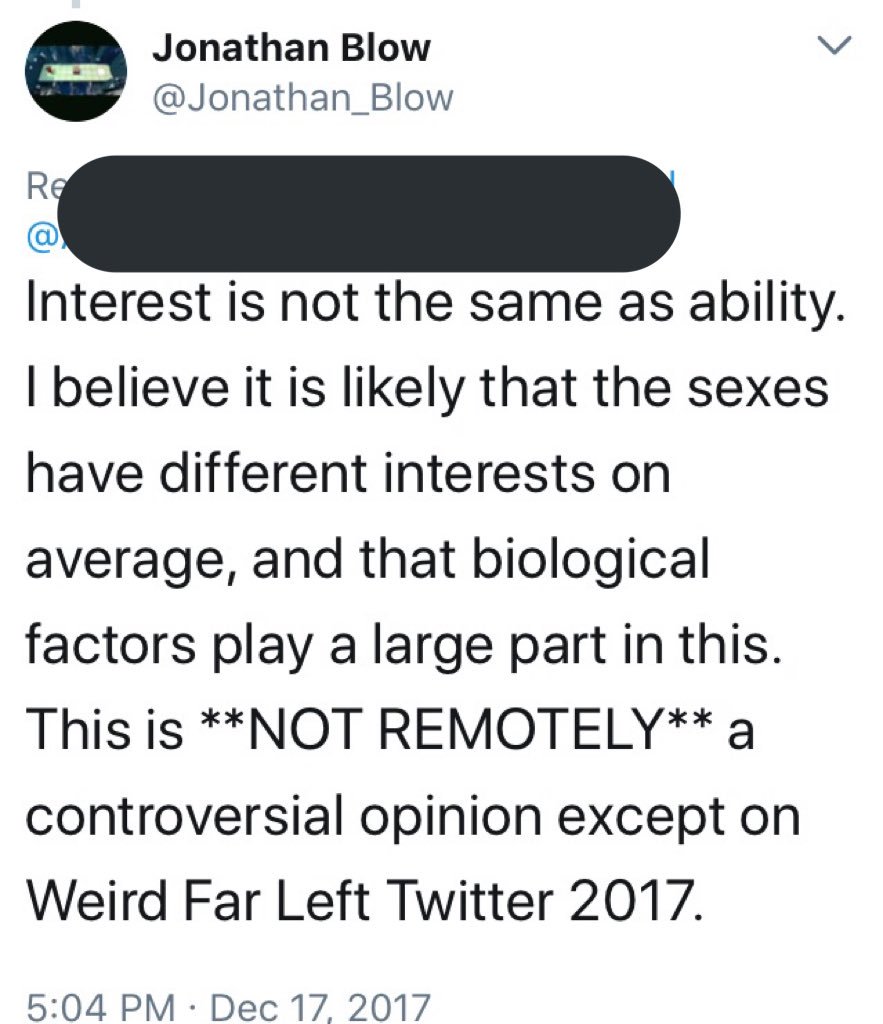

I quite enjoyed The Witness but The Looker was just great.
[1]: https://store.steampowered.com/app/1985690/The_Looker/